Loading video…


 15 Concepts
 116.4K views

Video Summary: Structure and Nomenclature of Epoxides Explained
Ever wondered why the plastic bottles you drink from don't break down easily in nature? The structure nomenclature epoxides plays a crucial role in creating durable polymers used in everything from water bottles to aerospace composites. Structure and nomenclature of epoxides explained reveals how these three-membered ring compounds, with their highly strained triangular geometry, become incredibly reactive building blocks. For instance, ethylene oxide is used to sterilize medical equipment in US hospitals because its reactive nature destroys bacterial cell walls. Watch the full video on JoVE Coach to master this concept with expert-led visuals and step-by-step explanations.
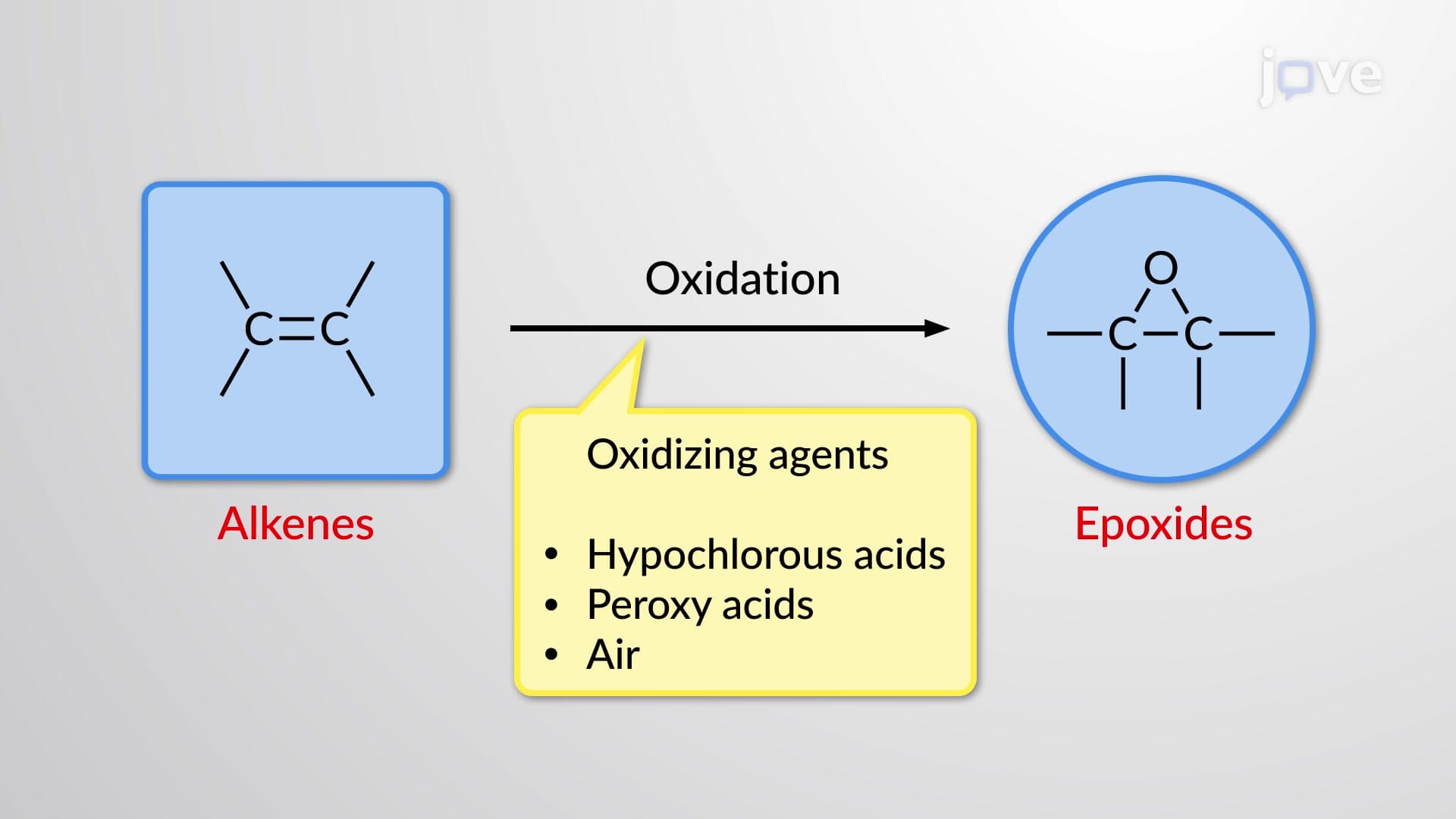
Epoxides represent one of the most important classes of cyclic ethers in organic chemistry, distinguished by their unique three-membered ring structure containing one oxygen and two carbon atoms. This seemingly simple arrangement creates a molecular powerhouse of reactivity that drives countless industrial processes, from pharmaceutical manufacturing to polymer production.
The fundamental structure of epoxides approximates an equilateral triangle, creating what chemists call "ring strain." In an ideal tetrahedral geometry, bond angles measure 109.5°, but epoxides compress these angles to approximately 60°. This dramatic deviation stores potential energy within the molecule, similar to a compressed spring ready to release energy. The strain energy in a typical epoxide measures about 27 kcal/mol, making these compounds significantly more reactive than their larger cyclic ether counterparts.
This high reactivity explains why epoxides serve as crucial intermediates in synthesizing complex molecules. For example, pharmaceutical companies use epoxide intermediates to manufacture blood thinners like warfarin, while the aerospace industry relies on epoxy resins derived from epoxide reactions to create lightweight, durable composite materials for aircraft construction.
The traditional naming system derives epoxide names from their parent alkenes followed by "oxide." This approach provides intuitive connections between starting materials and products. Ethylene oxide, the simplest and most industrially important epoxide, comes from ethylene. Similarly, propylene oxide derives from propylene, and these compounds serve as building blocks for antifreeze, polyurethane foams, and countless consumer products.
US students preparing for AP Chemistry or college organic chemistry courses frequently encounter questions about converting between alkene names and their corresponding epoxides. Understanding this relationship helps predict synthetic pathways and retrosynthetic analysis problems common on standardized tests.
The International Union of Pure and Applied Chemistry (IUPAC) system names epoxides as oxirane derivatives. The parent compound, oxirane, refers to the unsubstituted three-membered ring. Substituted versions receive names like 2-methyloxirane or 2,3-dimethyloxirane, with numbering starting from the oxygen atom and proceeding to give substituents the lowest possible numbers.
For epoxides incorporated into larger molecules, the prefix "epoxy" indicates the three-membered ring's presence within a more complex structure. Examples like 1,2-epoxycyclohexane or 2,3-epoxybutane demonstrate how this naming convention handles epoxides as functional groups rather than parent compounds.
Related Micro-courses