Loading subject page…


116,400 views

Video Summary: Autoxidation of Ethers to Peroxides Explained
Did you know that the diethyl ether sitting in your high school chemistry lab could slowly be forming explosive compounds just from air exposure? Autoxidation ethers peroxides formation is a dangerous process where common laboratory ethers like diethyl ether react with atmospheric oxygen to create unstable peroxide compounds. For example, aged ether bottles at MIT's undergraduate labs require mandatory peroxide testing before student use due to explosion risks. Understanding autoxidation of ethers to peroxides explained mechanisms helps prevent laboratory accidents through proper safety protocols and testing procedures. Watch the full video on JoVE Coach to master this concept with expert-led visuals and step-by-step explanations.
Autoxidation ethers peroxides formation represents one of the most significant safety concerns in organic chemistry laboratories across American universities. This spontaneous oxidation process transforms seemingly harmless ethers into explosive compounds through exposure to atmospheric oxygen. The mechanism involves a complex free radical chain reaction that can continue for months or years, making aged ether containers particularly dangerous.
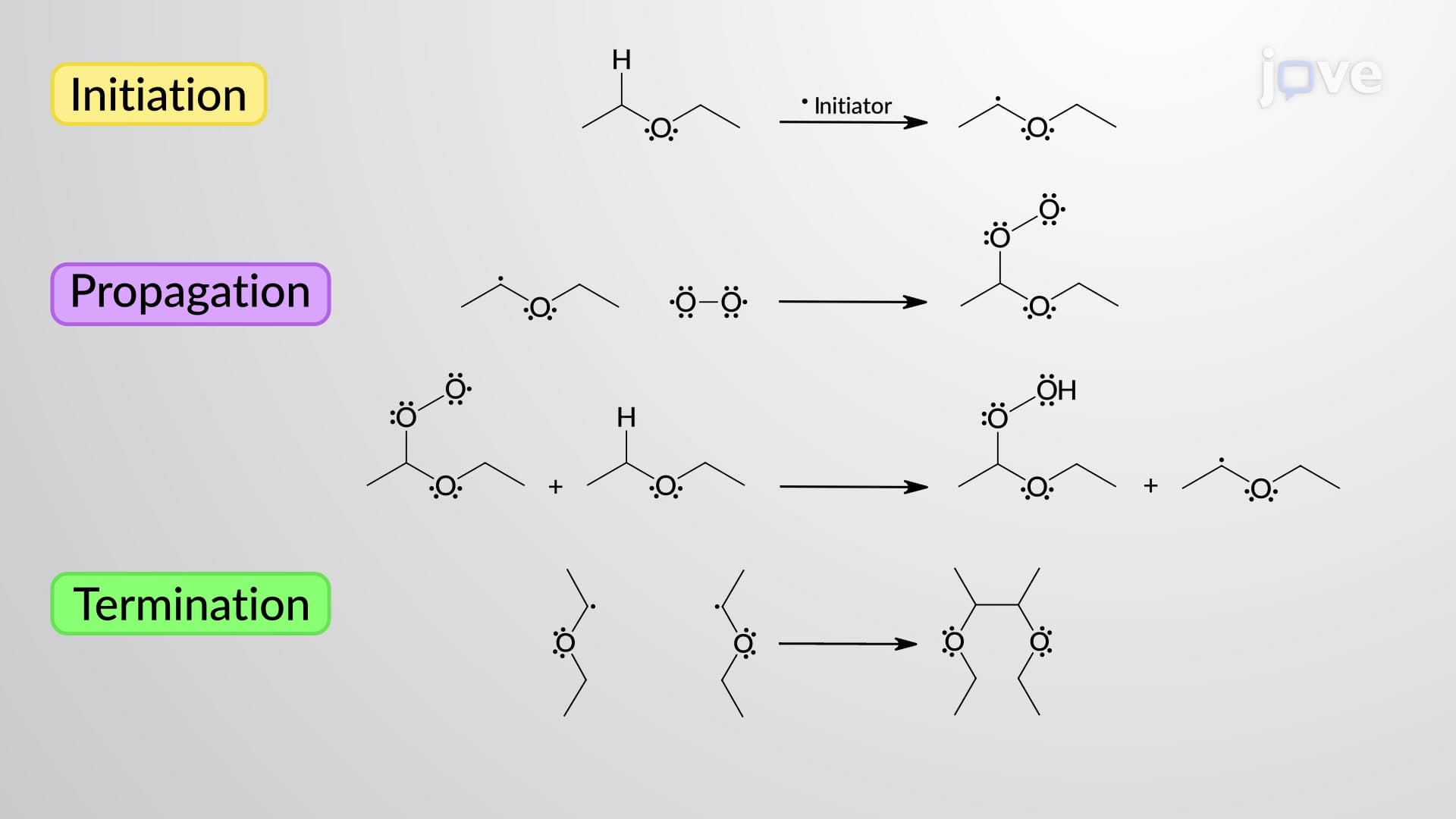
The autoxidation of ethers to peroxides proceeds through three distinct phases. During initiation, trace amounts of light, heat, or metal impurities abstract hydrogen atoms from carbons adjacent to ether oxygens, creating carbon-centered radicals. These radicals are highly reactive species that trigger the subsequent chain reaction.
Propagation occurs in two critical steps. First, carbon radicals rapidly combine with atmospheric oxygen molecules, forming peroxyl radicals (ROO•). Second, these oxygen-centered radicals abstract hydrogen atoms from additional ether molecules, creating hydroperoxides while generating new carbon radicals. This cyclical process can theoretically continue indefinitely, explaining why peroxide concentrations increase dramatically over time.
Termination happens when two radicals combine to form stable, non-radical products. However, termination occurs much less frequently than propagation, allowing dangerous peroxide accumulation.
American chemistry departments, from high school AP programs to graduate research facilities, implement strict protocols for ether safety. The University of California system requires monthly peroxide testing for all ether containers using potassium iodide solutions. When peroxides are present, the liberated iodine creates a distinctive yellow coloration, indicating dangerous contamination levels.
Students preparing for the MCAT or AP Chemistry exams frequently encounter questions about ether safety protocols. Understanding that peroxide formation increases with exposure time, surface area contact with air, and elevated temperatures helps explain why laboratories store ethers in dark, cool locations with minimal headspace.
This concept appears regularly on standardized tests, including AP Chemistry free-response questions and college organic chemistry midterms. Students must recognize that autoxidation ethers peroxides formation affects laboratory procedures, industrial processes, and pharmaceutical manufacturing. For instance, companies like Pfizer and Johnson & Johnson implement rigorous testing protocols for ether-based solvents to prevent explosive incidents during drug synthesis.
The reaction also demonstrates important principles tested on exams: free radical stability, chain reaction mechanisms, and structure-reactivity relationships. Primary and secondary ethers show different autoxidation rates based on the stability of their carbon radical intermediates.
Related Micro-courses