Loading subject page…


116,400 views


Video Summary: Base Catalyzed Ring Opening of Epoxides Explained
Ever wonder why some pharmaceutical syntheses require highly reactive three-membered rings that seemingly "want" to break open? Base catalyzed ring opening reactions exploit the inherent instability of epoxides, making them crucial in manufacturing drugs like epinephrine at companies such as Pfizer. Unlike their acid-catalyzed counterparts, these reactions demand powerful nucleophiles like sodium ethoxide to attack the less crowded carbon atom. Watch the full video on JoVE Coach to master this concept with expert-led visuals and step-by-step explanations.
The base catalyzed ring opening of epoxides represents one of organic chemistry's most fundamentally important reaction types, driven by the extraordinary ring strain inherent in three-membered cyclic ethers. Unlike typical ethers that resist nucleophilic attack, epoxides eagerly participate in ring-opening reactions due to their 60-degree bond angles-far from the ideal 109.5 degrees of sp3 hybridized carbons.
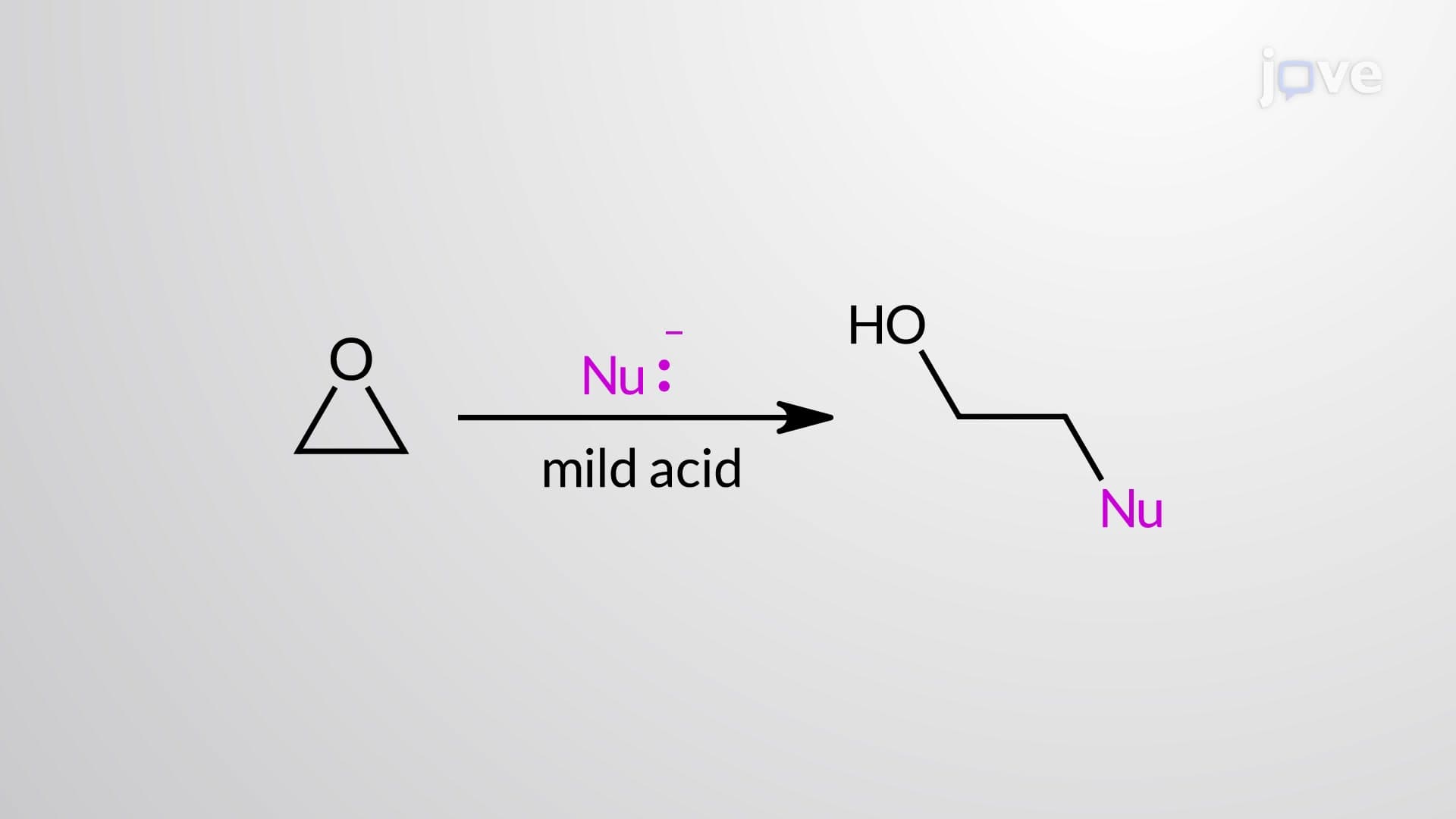
Base-catalyzed mechanisms require exceptionally strong nucleophiles, contrasting sharply with acid-catalyzed versions that can proceed with weaker nucleophiles. Common bases include sodium ethoxide (NaOEt), lithium aluminum hydride (LiAlH4), and Grignard reagents-all powerful enough to initiate the SN2-like attack. The mechanism proceeds through nucleophilic attack at the less substituted carbon, followed by protonation from the solvent to yield the final alcohol product.
This regioselectivity proves crucial in synthetic planning. For instance, when 2,2-dimethyloxirane reacts with sodium ethoxide in ethanol, the nucleophile selectively attacks the primary carbon rather than the more crowded tertiary position, producing 1-ethoxy-2-methyl-2-propanol with predictable regioselectivity.
The thermodynamic driving force behind epoxide ring opening becomes clear when comparing energy profiles. Epoxides exist as high-energy substrates due to angle strain, making them approximately 27 kcal/mol less stable than their corresponding open-chain ethers. This energy difference translates to lower activation barriers and thermodynamically favorable product formation-concepts frequently tested on AP Chemistry exams and college organic chemistry midterms.
The stereochemistry follows classic SN2 principles: nucleophilic attack occurs from the backside, causing complete inversion of configuration at the attacked carbon. This predictable stereochemical outcome makes base-catalyzed epoxide opening invaluable in pharmaceutical synthesis, where companies like Johnson & Johnson rely on such reactions to create specific stereoisomers of active pharmaceutical ingredients. Understanding these stereochemical principles proves essential for MCAT success and advanced organic chemistry coursework.
Related Micro-courses