Loading subject page…


116,400 views

Video Summary: Ethers to Alkyl Halides Acidic Cleavage Explained
Ever wondered why pharmaceutical companies can break down ether-based compounds in drug manufacturing? Ethers alkyl halides acidic cleavage transforms unreactive ethers into useful alkyl halides using strong acids like HI or HBr. For instance, breaking down diethyl ether (once used as anesthesia in US hospitals) produces ethyl iodide through this process. Ethers To Alkyl Halides Acidic Cleavage Explained reveals how acid protonation creates better leaving groups, enabling nucleophilic substitution reactions. Watch the full video on JoVE Coach to master this concept with expert-led visuals and step-by-step explanations.
The transformation of ethers into alkyl halides represents a fundamental shift from unreactive molecules to highly versatile synthetic intermediates. Unlike typical nucleophilic substitution reactions, ethers resist direct attack because alkoxide ions are exceptionally poor leaving groups due to their strong basicity. However, acid catalysis dramatically changes this reactivity profile by converting the ether oxygen into a protonated form.
The ethers alkyl halides acidic cleavage mechanism depends entirely on the substitution pattern of the alkyl groups. Primary ethers follow an SN2 pathway requiring excess concentrated acid (typically 47% HI) and elevated temperatures around 100-150°C. The mechanism proceeds through backside attack by halide ions on the less hindered carbon of the oxonium intermediate.
Tertiary ethers, along with allylic and benzylic systems, favor SN1 mechanisms under much milder conditions. These reactions occur at room temperature with dilute acids because the intermediate carbocations are stabilized by hyperconjugation or resonance. This mechanistic distinction appears frequently on AP Chemistry and college organic chemistry exams, where students must predict products based on substrate structure.
In pharmaceutical manufacturing, companies like Pfizer and Johnson & Johnson utilize ether cleavage reactions to synthesize drug intermediates. For example, breaking down tert-butyl ethers provides access to alcohols and alkyl halides needed for further synthetic transformations. Similarly, petroleum refineries employ acidic cleavage to convert ether additives like MTBE (methyl tert-butyl ether) during fuel processing.
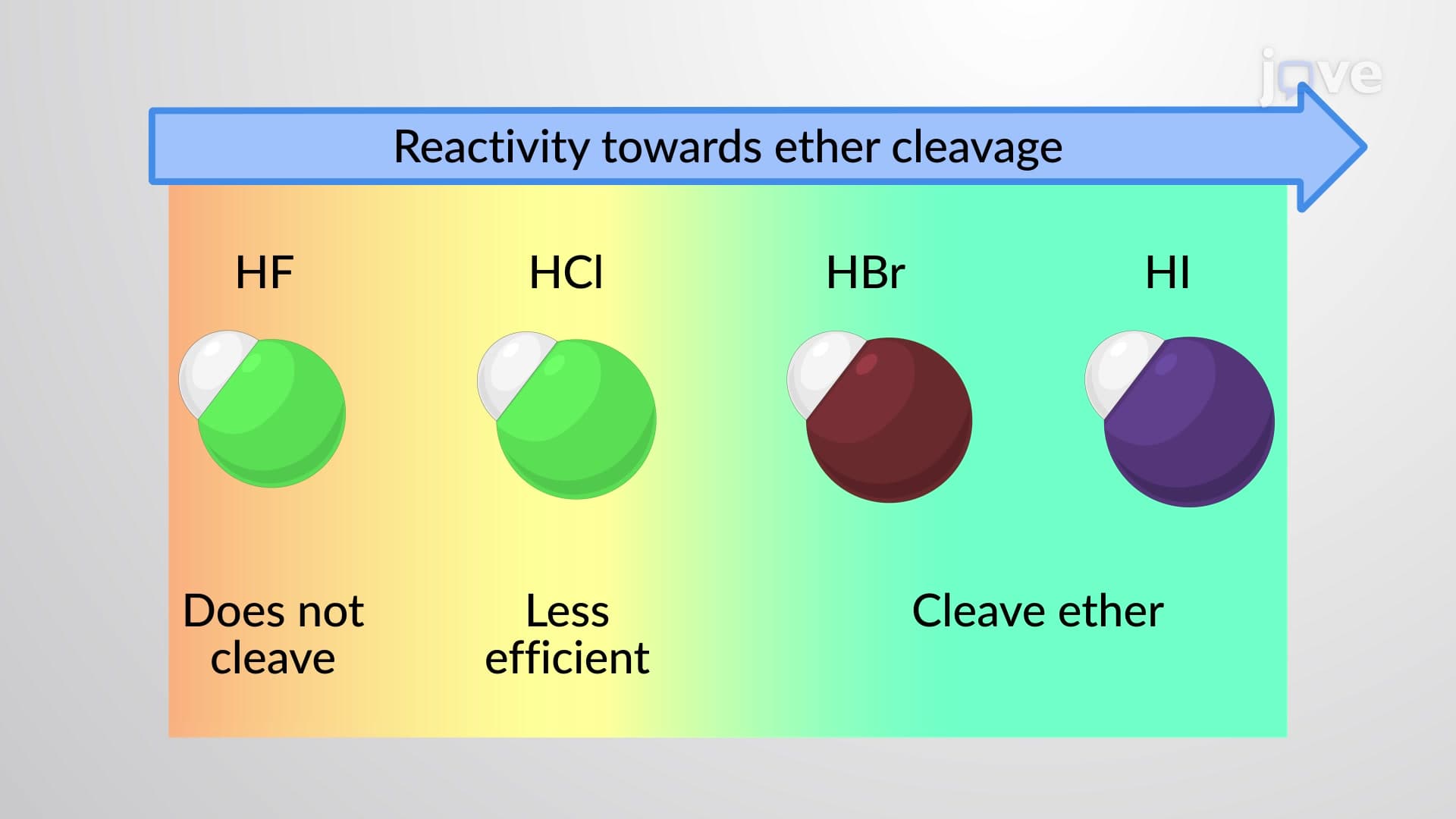
The halogen acid reactivity series (HI > HBr > HCl >> HF) reflects nucleophilicity trends that govern reaction rates. Hydroiodic acid cleaves ethers most efficiently because iodide is the strongest nucleophile among halides. This concept frequently appears on MCAT passages, where test-takers must explain why certain acids work better than others for specific ether substrates. Understanding this reactivity order helps predict both reaction rates and product distributions in complex molecular systems.
Related Micro-courses