Loading subject page…


116,400 views

Video Summary: What are Crown Ethers
Ever wondered how chemists can make oil-soluble purple potassium permanganate for specialized reactions? Crown ethers, discovered by Nobel Prize winner Charles Pedersen in 1967, are ring-shaped molecules that act like molecular "crowns" to capture metal ions. These versatile compounds enable pharmaceutical companies to purify drugs and help researchers create powerful oxidizing agents by dissolving typically water-soluble salts in organic solvents. Watch the full video on JoVE Coach to master this concept with expert-led visuals and step-by-step explanations.
Crown ethers represent a fascinating class of cyclic polyethers that revolutionized our understanding of host-guest chemistry. These remarkable molecules consist of repeating ethylene oxide units (-CH2CH2O-) arranged in a ring formation, creating a cavity lined with oxygen atoms. The discovery by American chemist Charles Pedersen at DuPont in 1967 earned him the Nobel Prize in Chemistry in 1987, fundamentally changing how we approach molecular recognition and ion transport.
The distinctive "crown" appearance comes from the three-dimensional conformation these molecules adopt, where oxygen atoms point inward toward the cavity center while the carbon-hydrogen framework forms the outer rim. This architecture creates a perfect pocket for hosting metal ions, making crown ethers invaluable in both academic research and industrial applications.
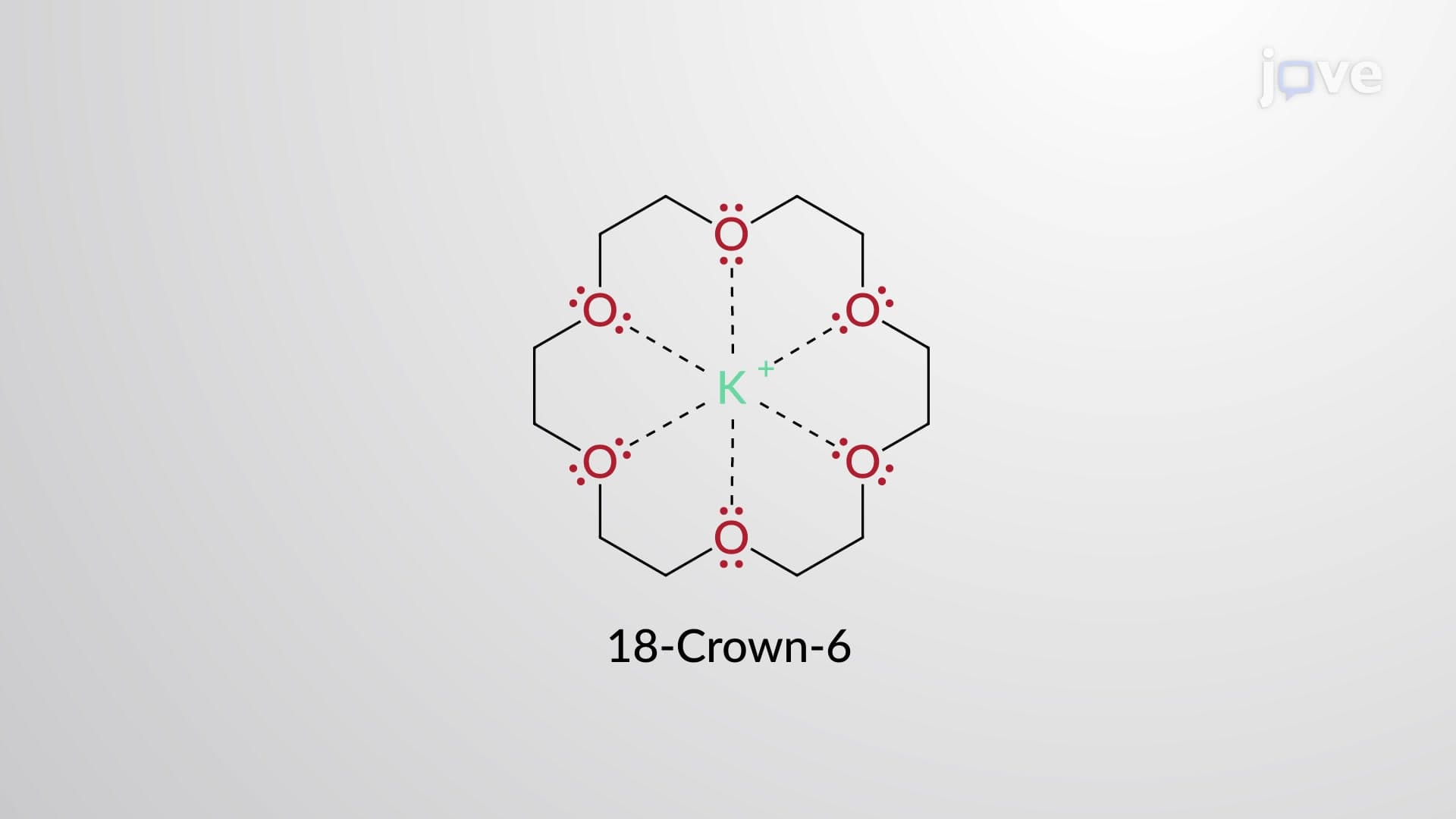
The systematic naming of crown ethers follows a logical x-crown-y format that immediately conveys structural information. In this system, 'x' represents the total number of atoms forming the macrocyclic ring, while 'y' indicates specifically how many oxygen atoms are present. For instance, 18-crown-6 contains 18 total ring atoms with 6 oxygen atoms strategically positioned around the cavity.
This naming convention helps predict binding properties and selectivity. Larger crown ethers like 18-crown-6 accommodate bigger ions such as potassium (K+), while smaller variants like 12-crown-4 show preference for lithium (Li+). Students preparing for AP Chemistry or college-level organic chemistry courses should master this nomenclature system, as it frequently appears on standardized tests and laboratory exercises.
The most remarkable property of crown ethers lies in their size-selective binding of metal cations. This selectivity operates on the principle of complementarity, the crown ether cavity diameter must closely match the ionic radius of the target cation for optimal binding. The oxygen atoms' lone electron pairs create a negatively charged environment that stabilizes positively charged metal ions through electrostatic interactions.
For example, 18-crown-6 (cavity diameter ~2.6-3.2 Å) shows exceptional affinity for potassium ions (ionic radius ~1.33 Å) but poorly accommodates smaller lithium ions (ionic radius ~0.76 Å). This size selectivity has profound implications in analytical chemistry, where crown ethers serve as selective extractants for specific metal ions from complex mixtures.
Crown ethers excel as phase-transfer catalysts, enabling reactions between ionic compounds and organic molecules that normally cannot interact due to solubility differences. The crown ether's unique amphiphilic nature, polar interior, nonpolar exterior, allows it to solubilize inorganic salts in organic solvents. This property proves invaluable in pharmaceutical synthesis, where companies like Merck and Pfizer utilize crown ethers to facilitate reactions that would otherwise require harsh conditions or expensive reagents.
The classic example of potassium permanganate dissolution in benzene demonstrates this principle beautifully. While KMnO4 remains insoluble in benzene alone, adding 18-crown-6 creates a purple solution containing the crown-complexed potassium cation and free permanganate anion. This "purple benzene" serves as a powerful, anhydrous oxidizing agent for sensitive organic substrates.
Related Micro-courses