Loading…
Loading video…

46,055 views
Ever wondered how your smartphone's touchscreen detects your finger? Spherical and cylindrical capacitors are specialized energy storage devices that consist of concentric conducting surfaces separated by insulating materials. Unlike flat-plate capacitors found in basic circuits, these geometries create unique electric field patterns crucial for advanced applications. Tesla's electric vehicles utilize cylindrical capacitors in their battery management systems to optimize power delivery. Understanding what is spherical and cylindrical capacitor configurations helps explain how electric fields behave in three-dimensional space. Watch the full video on JoVE Coach to master this concept with expert-led visuals and step-by-step explanations.
Spherical and cylindrical capacitors represent advanced applications of electrostatic principles, extending beyond the familiar parallel-plate capacitor model taught in introductory physics courses. These three-dimensional configurations demonstrate how geometry dramatically influences electric field behavior and energy storage capabilities.
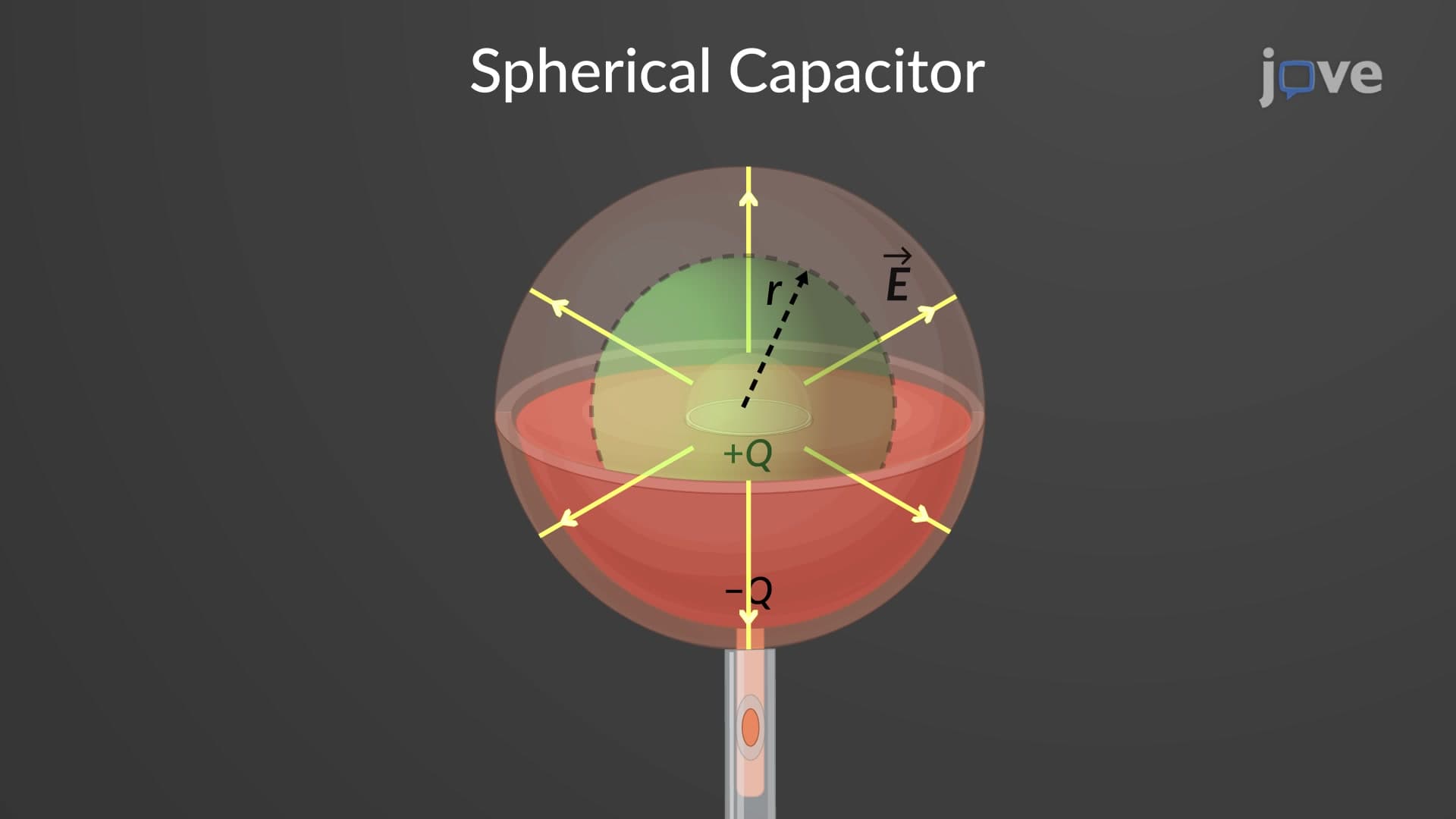
A spherical capacitor consists of two concentric conducting spherical shells with radii R₁ (inner) and R₂ (outer), separated by a dielectric material. The electric field between these shells follows an inverse-square relationship with distance from the center, creating a non-uniform field pattern. This design appears in specialized applications like Van de Graaff generators used in research facilities across US universities, including MIT's Plasma Science and Fusion Center.
The capacitance derivation for spherical configurations begins with Gauss's Law, which students encounter extensively in AP Physics C and college-level electromagnetism courses. For a spherical Gaussian surface at radius r (where R₁ < r < R₂), the electric field magnitude equals E = kQ/r², where k is Coulomb's constant and Q represents the charge on the inner sphere.
Integrating this electric field expression from R₁ to R₂ yields the potential difference: V = kQ(1/R₁ - 1/R₂). The resulting capacitance formula becomes C = 4πε₀R₁R₂/(R₂ - R₁), where ε₀ is the permittivity of free space. Students preparing for the MCAT physics section should note how this differs significantly from the parallel-plate capacitor formula C = ε₀A/d.
Cylindrical capacitors utilize concentric conducting cylinders rather than spherical shells, creating different field patterns and capacitance characteristics. The electric field between cylinders varies as E = λ/(2πε₀r), where λ represents the linear charge density and r is the radial distance from the central axis.
These configurations appear prominently in coaxial cables used throughout the US telecommunications infrastructure, including the cables connecting homes to internet service providers like Comcast and Verizon. The capacitance per unit length for cylindrical geometries equals C/L = 2πε₀/ln(R₂/R₁), making them ideal for high-frequency signal transmission where consistent impedance matters.
Students encountering these concepts on standardized tests should focus on recognizing the geometric setup and applying appropriate integration techniques. Common exam problems involve calculating capacitance ratios, energy storage comparisons, and electric field mapping. The key insight is understanding how radial symmetry simplifies complex three-dimensional problems into manageable one-dimensional integrations along radial paths.
Frequently Asked Questions
Spherical and cylindrical capacitors use concentric curved conducting surfaces instead of flat parallel plates. Spherical capacitors have two concentric spherical shells, while cylindrical capacitors use concentric cylinders. These geometries create non-uniform electric fields and different capacitance formulas compared to standard parallel-plate capacitors.
AP Physics C typically includes problems requiring Gauss's Law applications to find electric fields in these geometries, followed by integration to calculate potential differences and capacitance. Students must demonstrate understanding of radial symmetry and proper integration techniques. Practice with both multiple-choice conceptual questions and free-response mathematical derivations.
Yes, the MCAT physics section may include these concepts within electrostatics passages or discrete questions. Focus on understanding the relationship between geometry and electric field patterns rather than memorizing complex formulas. The exam emphasizes conceptual understanding of how different configurations affect capacitance and energy storage.
Cylindrical capacitors are essential in coaxial cables for internet and cable TV throughout the US, including connections from providers like AT&T and Spectrum. Spherical capacitors appear in high-voltage research equipment at national laboratories like Fermilab and in some medical devices like defibrillators manufactured by companies such as Medtronic.
Basic integration skills from Calculus I are sufficient for most applications. The key mathematical tools include simple integration along radial paths and applying Gauss's Law with appropriate symmetry arguments. Students comfortable with AP Calculus AB concepts can handle the required mathematical manipulations.
Start with mastering Gauss's Law applications for symmetric charge distributions, then practice deriving electric fields and potential differences step-by-step. Create comparison charts showing formulas for spherical, cylindrical, and parallel-plate configurations. Work through problems involving different radii ratios to understand how geometry affects capacitance values.
Cylindrical capacitors form the basis for understanding coaxial transmission lines, which are crucial for high-frequency signal propagation in communication systems. The capacitance per unit length affects characteristic impedance, which determines how electromagnetic waves travel through cables. This connects to advanced topics in electrical engineering and telecommunications.
Progress to studying dielectric materials and their effects on capacitance in various geometries, then explore energy density in electric fields and capacitor networks in complex circuits. Advanced students can investigate transmission line theory and electromagnetic wave propagation in guided media.
Related Micro-courses


Related Subjects
 Math Fundamentals 11 micro-courses›
 Statistics 17 micro-courses›