Loading…
Loading video…

52,444 views
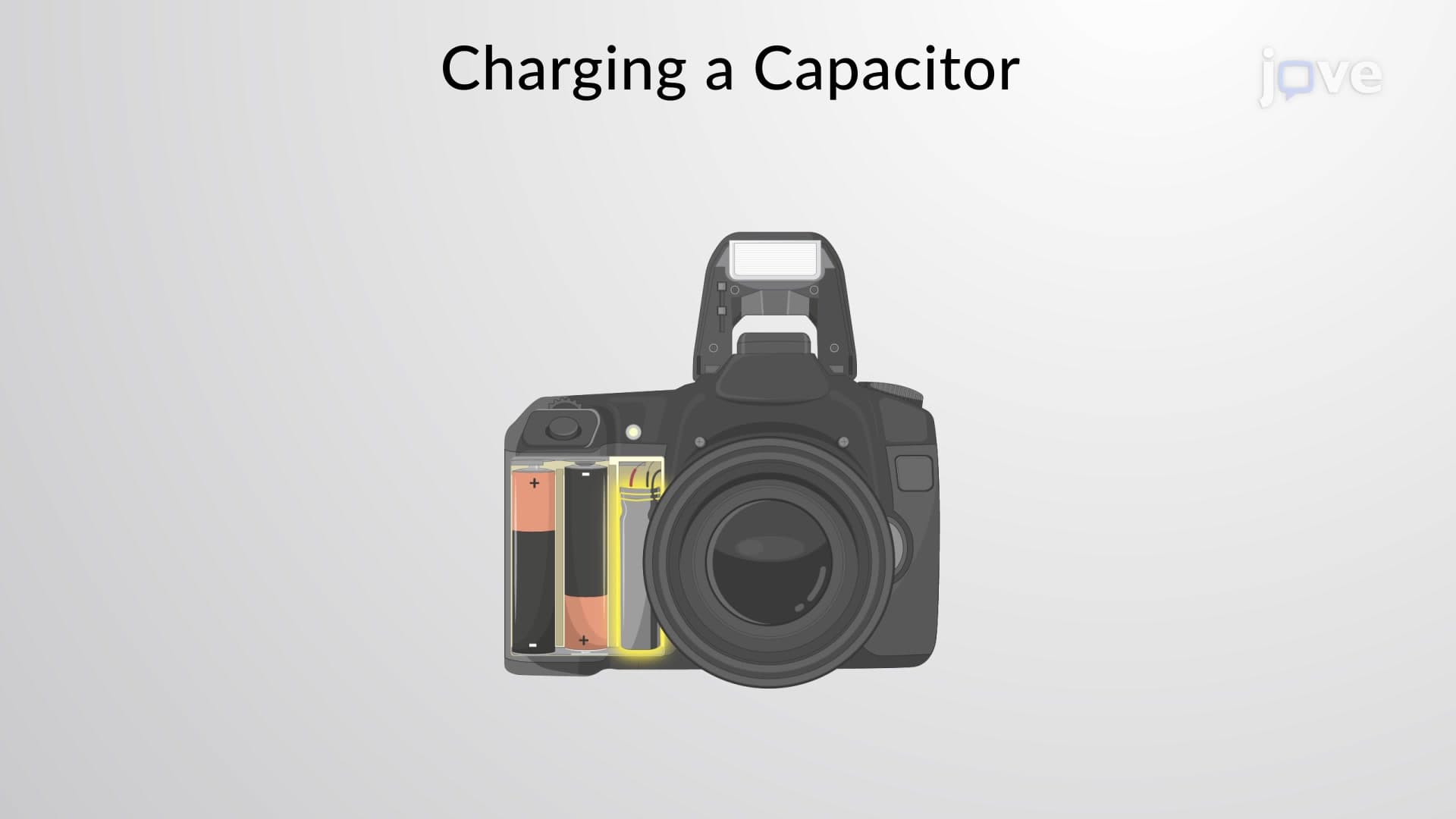
Ever wonder how your smartphone's camera flash delivers that instant burst of light? RC circuits charging a capacitor make this everyday technology possible, storing electrical energy that releases in milliseconds. Understanding how RC circuits charging a capacitor works is fundamental to electronics, from camera flashes to defibrillators used in US hospitals. The charging process follows predictable exponential patterns governed by time constants and Kirchhoff's voltage law. Watch the full video on JoVE Coach to master this concept with expert-led visuals and step-by-step explanations.
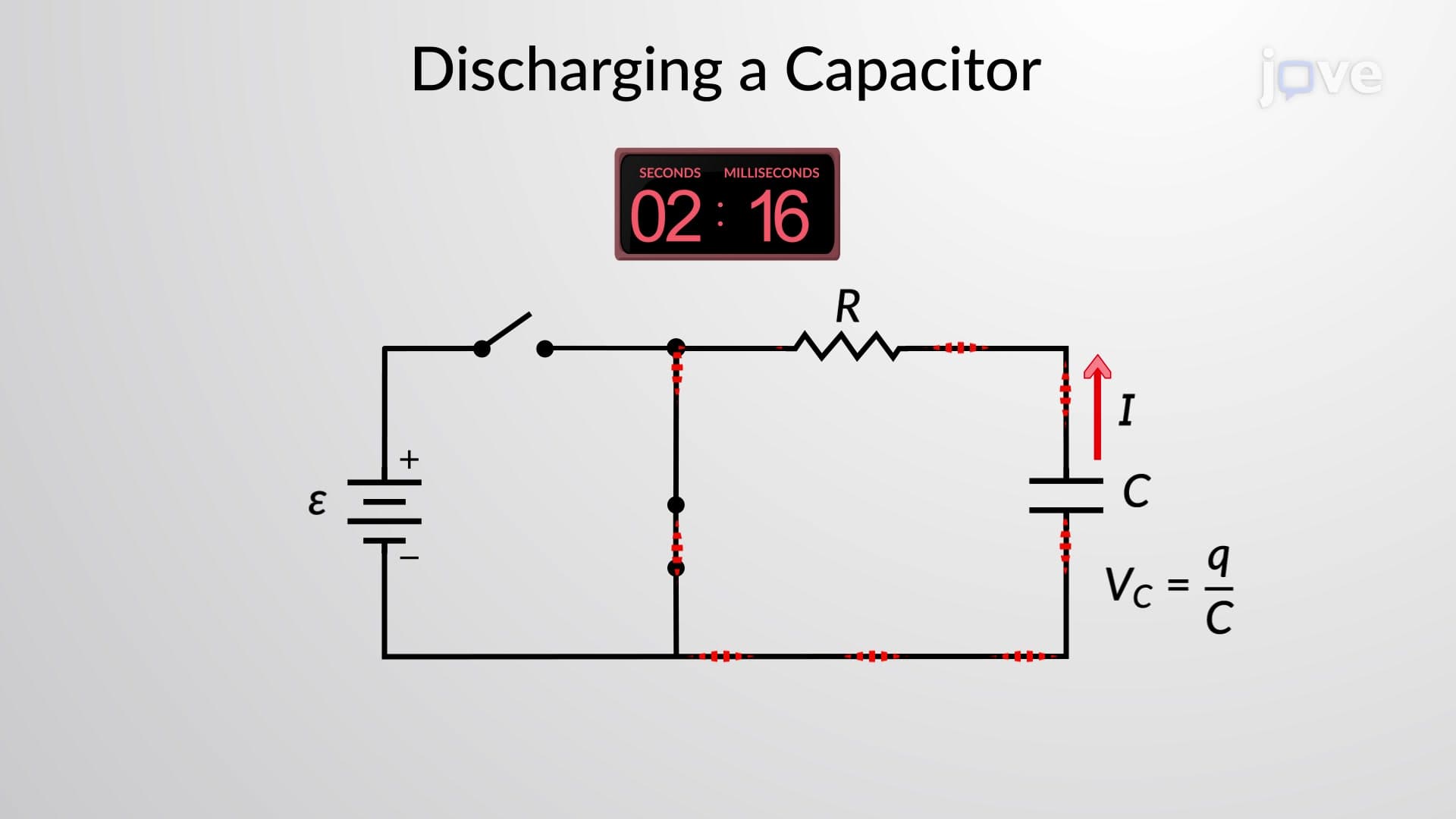
RC circuits charging a capacitor represent one of the most important concepts in introductory electronics and physics. When you connect a resistor and capacitor in series with a DC voltage source, the resulting circuit exhibits fascinating time-dependent behavior that governs countless electronic applications. The charging process begins the moment you close the circuit switch, initiating an exponential approach toward equilibrium.
The charging behavior follows Kirchhoff's voltage law: V(battery) = V(resistor) + V(capacitor). Since V(resistor) = I×R and V(capacitor) = Q/C, we get V(battery) = I×R + Q/C. This leads to the differential equation dQ/dt + Q/(RC) = V(battery)/R. Solving this yields Q(t) = C×V(battery)×(1 - e^(-t/RC)), where RC represents the time constant τ (tau).
The charging current follows I(t) = (V(battery)/R)×e^(-t/RC), starting at its maximum value V(battery)/R when t=0 and decaying exponentially toward zero. Meanwhile, the capacitor voltage grows as V(capacitor)(t) = V(battery)×(1 - e^(-t/RC)), approaching the battery voltage asymptotically.
The RC time constant τ = RC determines charging speed. After one time constant, the capacitor reaches 63.2% of full charge. After five time constants, it's essentially fully charged (99.3%). This principle appears in numerous US applications: camera flashes charge in seconds using small time constants, while larger capacitors in power supplies may require minutes.
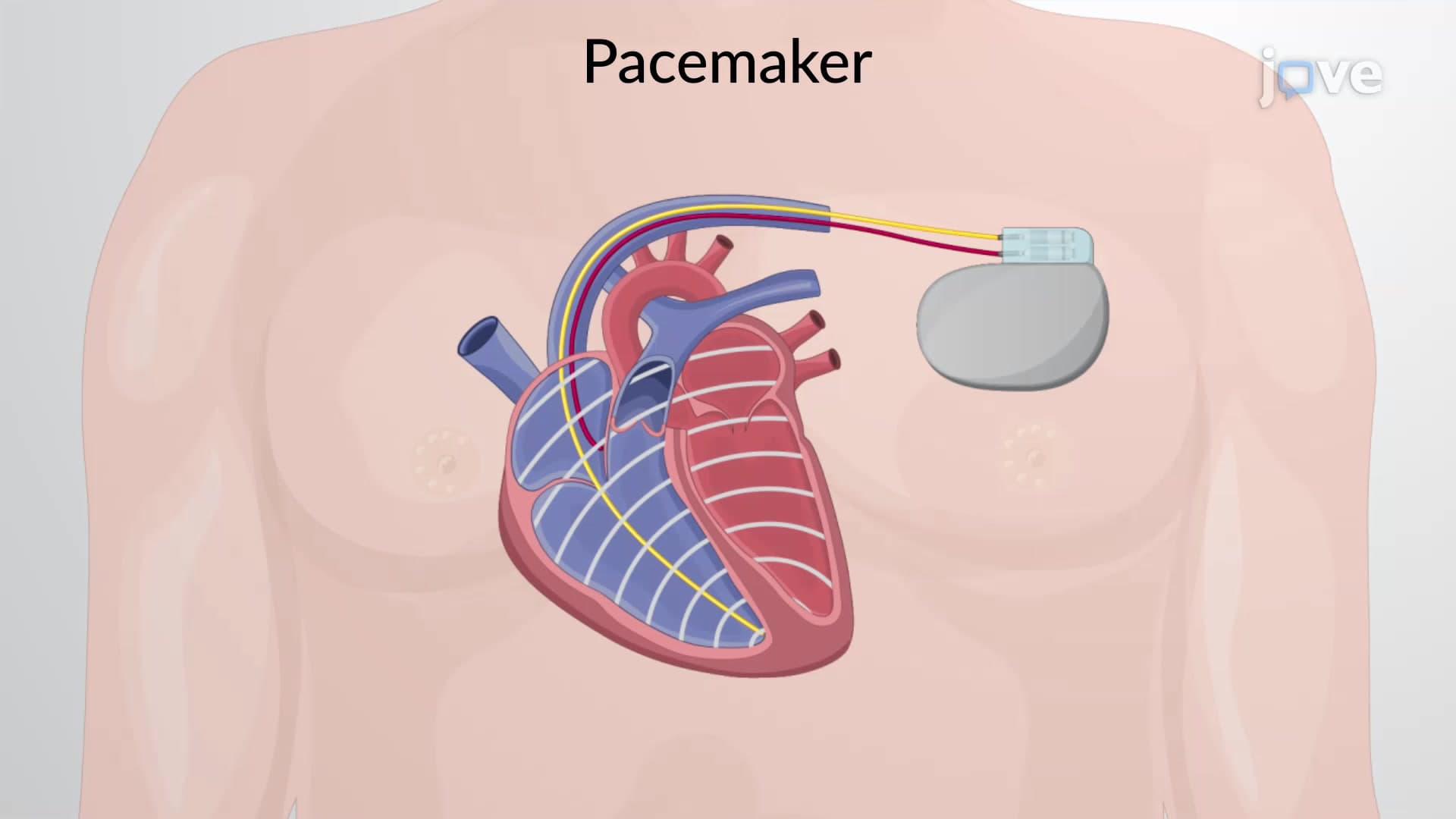
Understanding RC charging appears frequently on AP Physics exams, college circuits courses, and the MCAT. Students often encounter problems involving timing circuits, filter applications, and energy storage calculations. For instance, cardiac defibrillators used in US emergency rooms rely on RC charging principles to store life-saving electrical energy. Similarly, the timing circuits in traffic lights and electronic ignition systems in American automobiles utilize RC charging behavior for precise control.
Frequently Asked Questions
RC circuits charging a capacitor involves storing electrical energy in a capacitor through a resistor-controlled process. This fundamental concept explains how electronic devices store and release energy in controlled ways. It's essential for understanding timing circuits, power supplies, and energy storage systems used in everything from smartphones to medical equipment.
AP Physics C and college circuits exams frequently test RC charging through calculation problems involving time constants, exponential equations, and energy analysis. Students must solve for charging times, current values at specific moments, and energy stored in capacitors. Practice with exponential functions and differential equations proves crucial for success.
The MCAT Physics section tests RC circuits under electricity and magnetism, focusing on exponential decay, time constants, and energy storage. Understanding capacitor charging helps with EKG interpretation questions and medical device function. The mathematical relationships also connect to biological exponential processes like radioactive decay.
RC charging circuits power camera flashes in smartphones, control timing in microwave ovens, and regulate cardiac defibrillators in US hospitals. They're also found in car ignition systems, computer power supplies, and LED lighting controllers. Even electronic door locks and security systems rely on RC charging principles for operation.
RC circuit charging builds naturally from basic Ohm's law and algebra concepts taught in high school physics. While the exponential mathematics may seem challenging initially, the underlying principles are straightforward. With practice using graphing calculators and step-by-step problem solving, most students successfully master these concepts.
Focus on understanding the exponential relationships rather than memorizing formulas. Practice sketching charging curves, calculating time constants, and solving for values at specific times. Use dimensional analysis to check answers and create summary cards showing the three key equations: Q(t), I(t), and V(capacitor)(t).
After understanding RC charging, explore AC circuit analysis with impedance concepts, RLC circuits involving inductors, and frequency response in filter circuits. These topics appear in advanced physics courses and electrical engineering programs, building directly on RC circuit foundations.
Related Micro-courses


Related Subjects
 Math Fundamentals 11 micro-courses›
 Statistics 17 micro-courses›