Loading subject page…


196,000 views


Video Summary: Rocket Propulsion in a Gravitational Field Advanced Analysis
Did you know that SpaceX's Falcon Heavy loses about 9.8 m/s of velocity every second just fighting Earth's gravity during launch? Rocket propulsion in a gravitational field: advanced analysis reveals how gravitational forces create a constant downward acceleration that opposes rocket motion, requiring faster fuel combustion rates to achieve the same velocity changes compared to space flight. NASA engineers must account for this gravitational penalty when designing launch trajectories for missions to the International Space Station. Watch the full video on JoVE Coach to master this concept with expert-led visuals and step-by-step explanations.
When rockets launch from Earth, they face a fundamental challenge that doesn't exist in deep space: the constant pull of gravity. This gravitational influence significantly alters the classical rocket equation, creating what aerospace engineers call "gravity losses" that must be accounted for in every launch calculation.
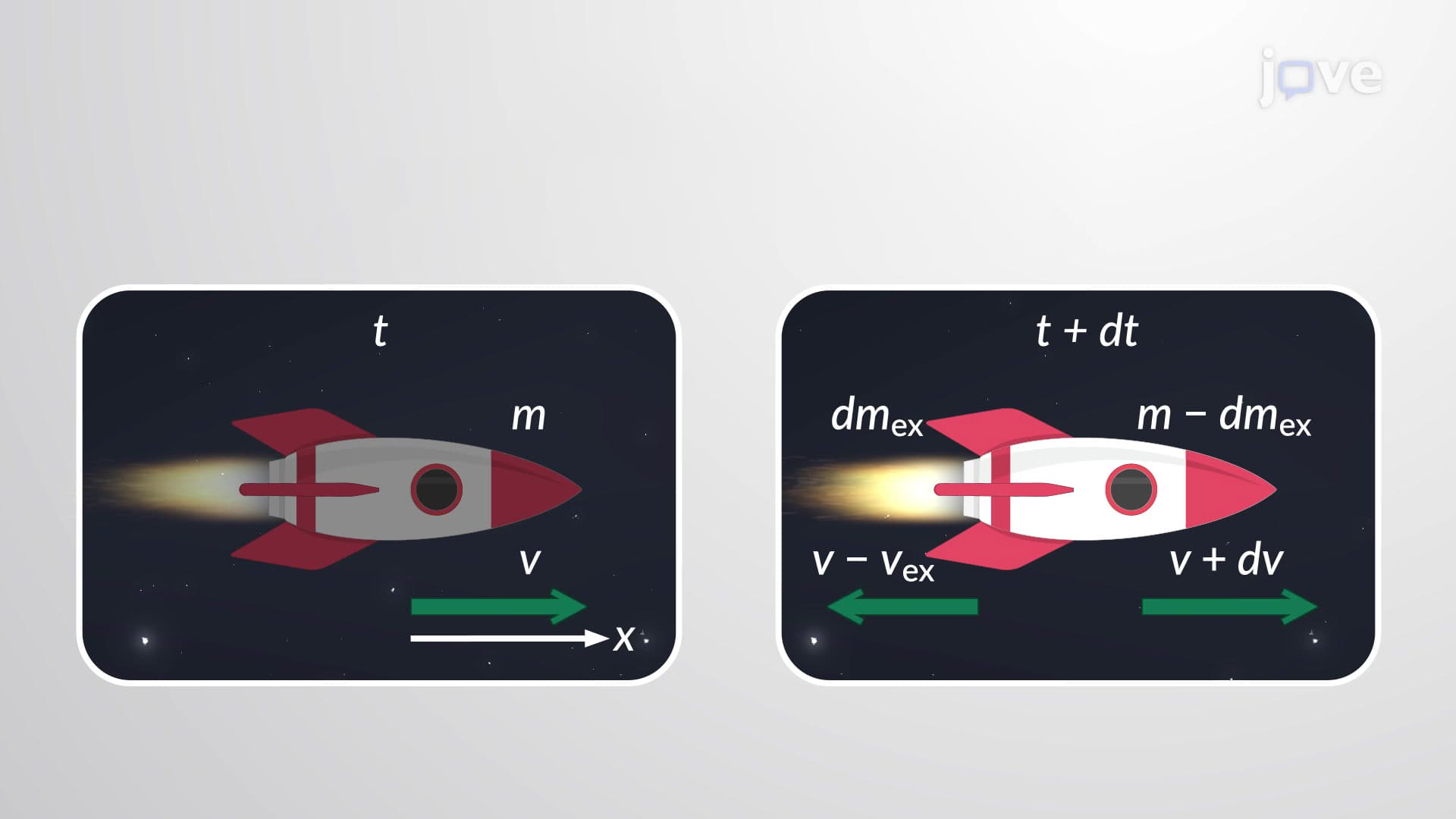
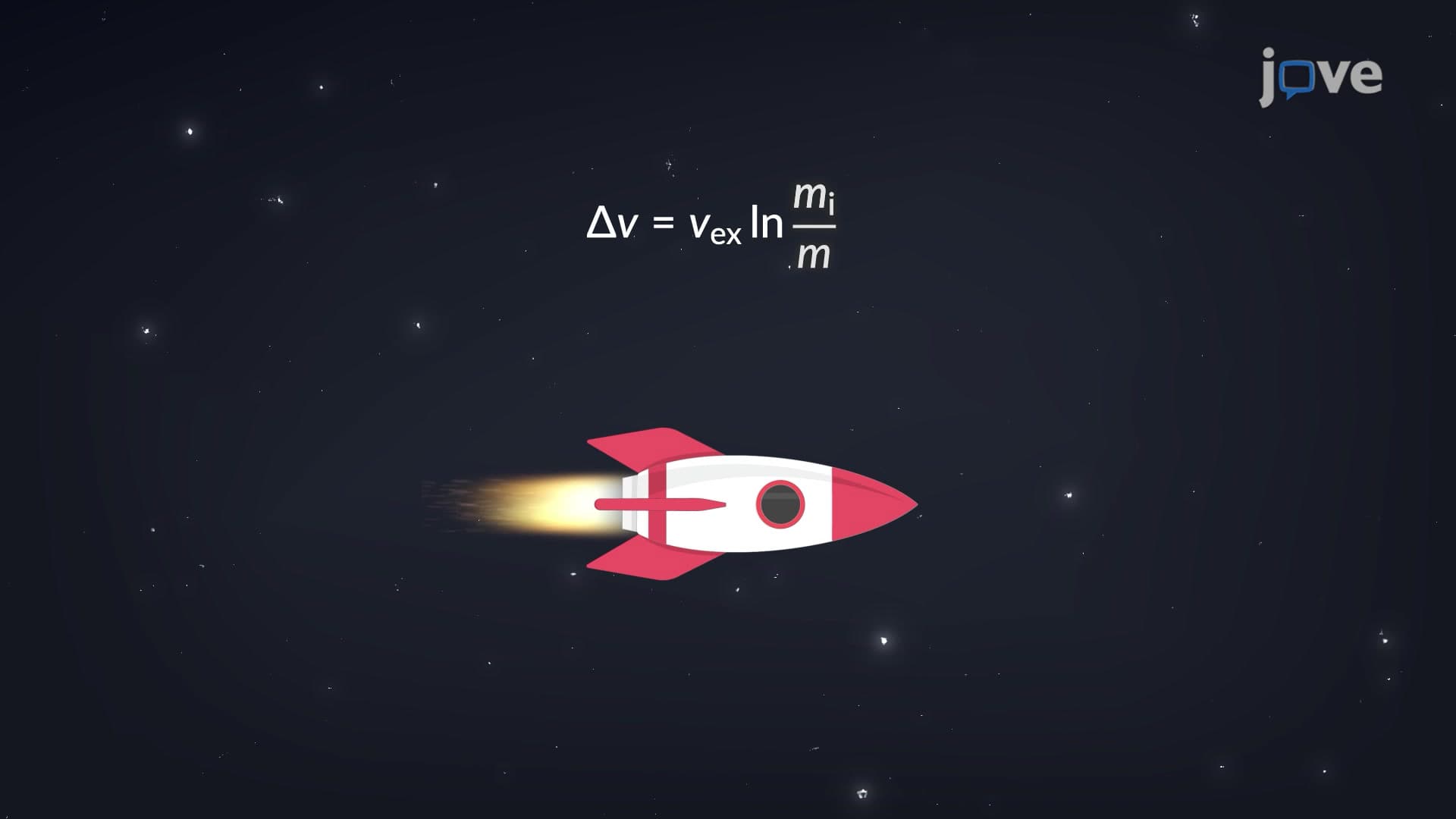
The standard rocket equation in space relates velocity change to the natural logarithm of the mass ratio and exhaust velocity. However, when operating in Earth's gravitational field, we must subtract an additional term: gt, where g represents gravitational acceleration (9.8 m/s²) and t represents the burn time.
The complete equation becomes: Δv = v(exhaust) × ln(m(initial)/m(final)) - gt
This seemingly simple addition has profound implications. For every second a rocket burns fuel while fighting gravity, it loses 9.8 m/s of potential velocity gain. This is why NASA's Space Launch System and SpaceX's Falcon 9 are designed for rapid initial acceleration-minimizing burn time reduces gravitational losses.
Consider NASA's Artemis missions to the Moon. During the initial launch phase, the Space Launch System must generate enough thrust not only to accelerate its massive payload but also to overcome the continuous gravitational deceleration. Mission planners calculate that extending the first-stage burn time by just 30 seconds would cost approximately 294 m/s of velocity-enough to significantly impact payload capacity.
Commercial providers like Blue Origin and SpaceX have revolutionized this challenge through reusable rocket technology, where precise gravitational field calculations enable controlled landings. Their landing burns must account for both deceleration needs and gravitational assistance during descent.
This concept frequently appears on AP Physics C: Mechanics exams and college-level aerospace engineering coursework. Students should focus on understanding how the gravitational term modifies the ideal rocket equation and practice calculating velocity changes under various burn time scenarios. The concept also connects to broader physics principles covered in SAT Subject Tests, where understanding force interactions and acceleration becomes crucial for problem-solving success.
Related Micro-courses