Loading…
Loading video…

53,700 views
Ever wondered how electric motors in Tesla cars generate their incredible torque? The secret lies in understanding torque on a current loop – the fundamental principle behind electromagnetic rotation. When a rectangular current-carrying loop sits in a magnetic field, it experiences forces that create rotational motion, just like in the electric motors powering everything from household fans to industrial machinery across American manufacturing plants. This torque on a current loop explained concept reveals how magnetic dipole moments determine the strength and direction of electromagnetic torque. Watch the full video on JoVE Coach to master this concept with expert-led visuals and step-by-step explanations.
Torque on a current loop represents one of electromagnetism's most practical applications, forming the foundation for electric motors, generators, and countless electromagnetic devices. When a current-carrying loop sits within a uniform magnetic field, the interaction between moving charges and magnetic field lines creates forces that attempt to rotate the loop around a specific axis.
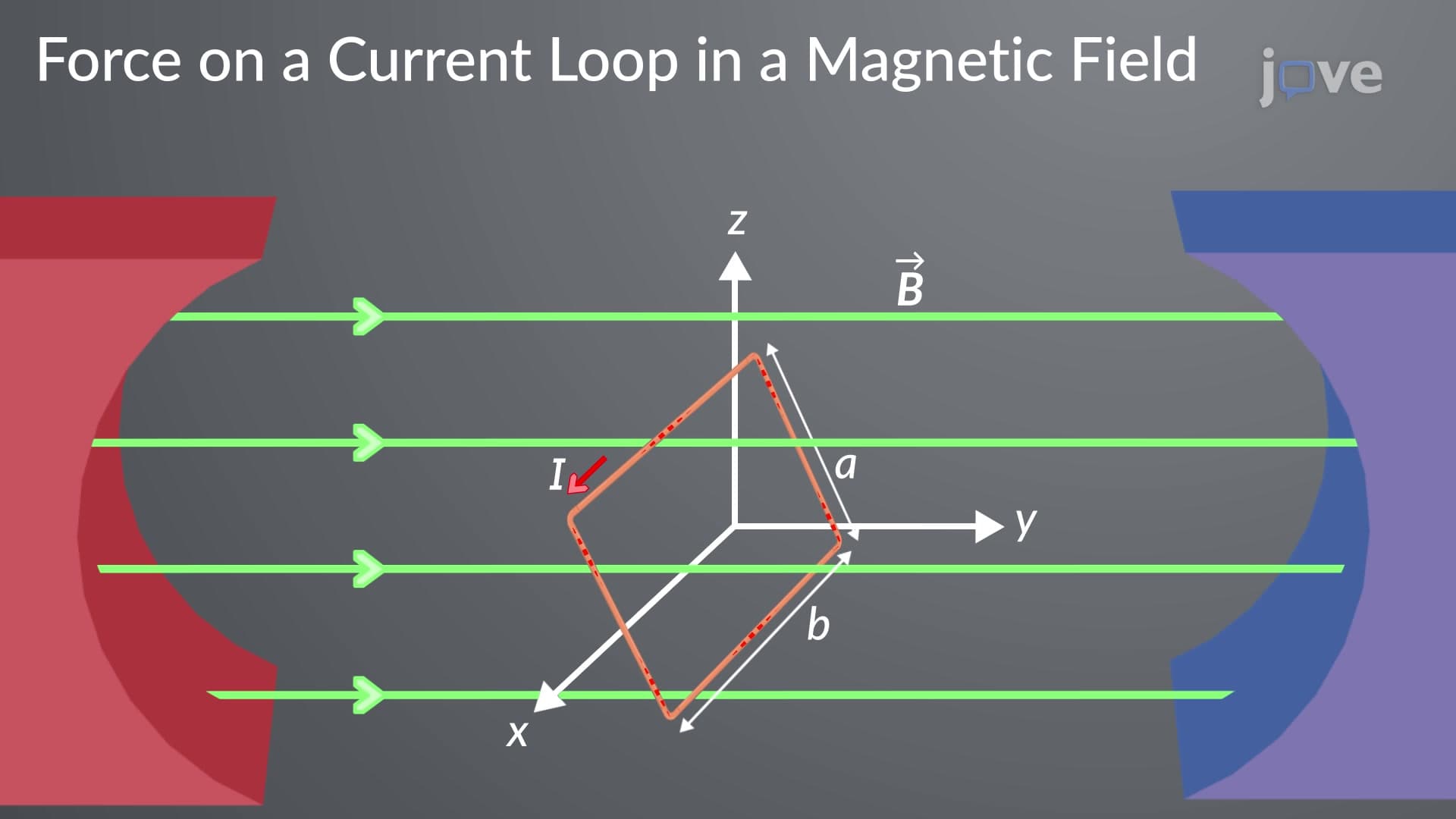
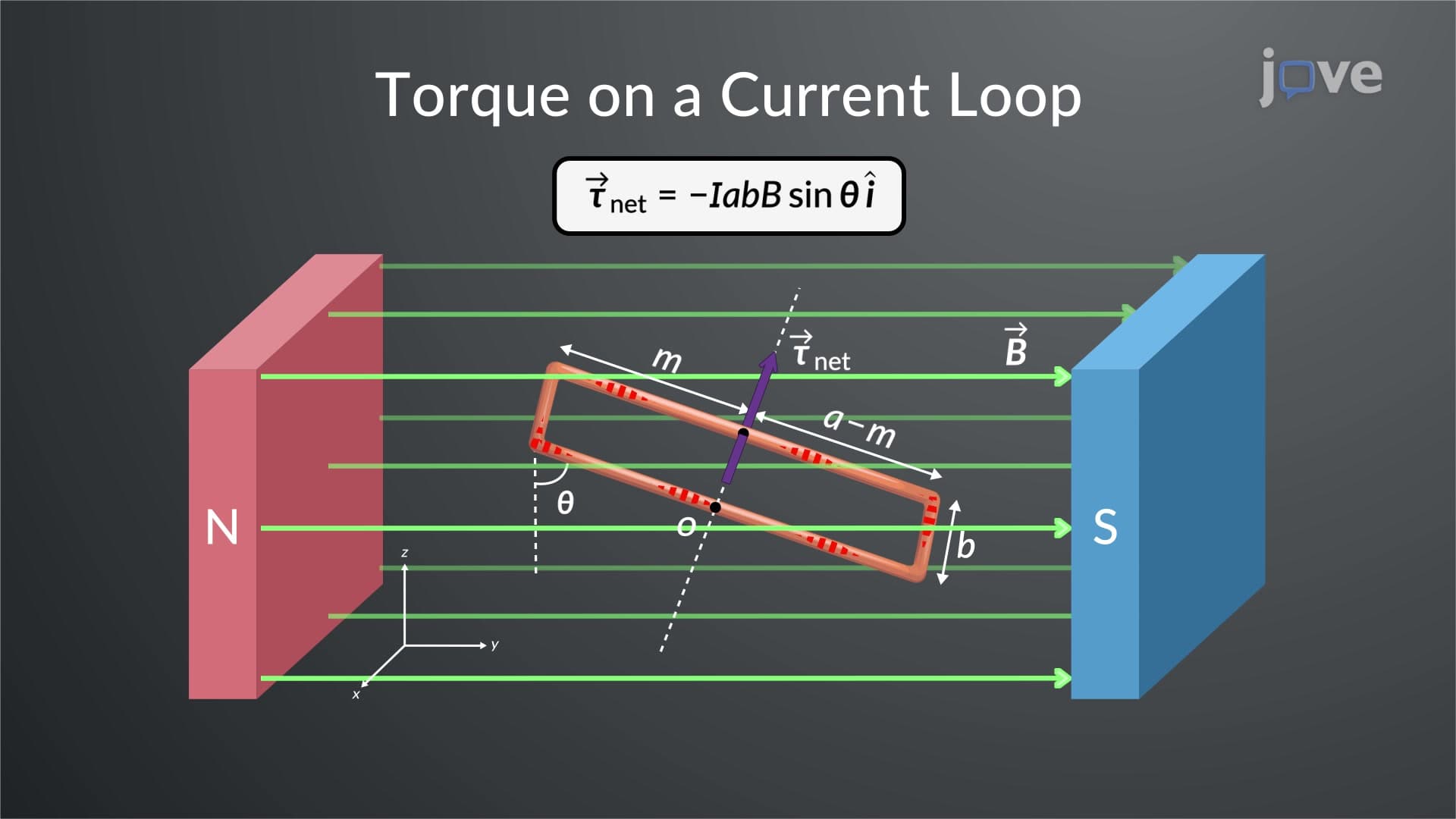
Consider a rectangular loop with dimensions *a* and *b* carrying steady current *I*. The magnetic field exerts forces on each segment of the loop according to *F = I × L × B*, where *L* represents the length of each segment. Crucially, forces acting on opposite sides of the loop are equal in magnitude but opposite in direction, creating zero net translational force. However, these forces don't cancel rotationally – they form what physicists call a torque couple.
The current loop behaves as a magnetic dipole, characterized by its magnetic dipole moment *μ = I × A*, where *A* represents the loop's enclosed area. This vector quantity points perpendicular to the loop plane, following the right-hand rule: curl your fingers in the current's direction, and your thumb indicates the dipole moment's direction.
This concept appears frequently on AP Physics exams and college electromagnetism courses. Students at institutions like MIT and Stanford learn that the magnetic dipole moment determines how strongly the loop interacts with external magnetic fields, similar to how electric dipole moments govern electric field interactions.
The torque magnitude equals *τ = μ × B × sin(θ)*, where *θ* represents the angle between the dipole moment and magnetic field vectors. Maximum torque occurs when *θ = 90°* (loop perpendicular to field), while zero torque exists at *θ = 0°* or *180°* (loop parallel to field).
This mathematical relationship explains why electric motors use commutators to maintain optimal angles between rotor coils and magnetic fields. American automotive manufacturers like Ford and General Motors rely on these principles in their electric vehicle motor designs.
Understanding how torque on a current loop works proves essential for engineering students preparing for FE exams and practicing engineers designing electromagnetic systems. From MRI machines in US hospitals to wind turbine generators across American wind farms, current loop torque principles enable countless technologies that power modern society.
Frequently Asked Questions
Torque on a current loop is the rotational force created when a current-carrying wire loop sits in a magnetic field. It occurs because magnetic forces act on different sides of the loop at different distances from the rotation axis, creating a net rotational effect even though the translational forces cancel out. This principle powers electric motors and generators used throughout American industry.
AP Physics C and college electromagnetism courses frequently test this concept through calculations involving magnetic dipole moments, torque directions using right-hand rules, and energy considerations in rotating loops. Students typically encounter problems asking for maximum torque orientations, equilibrium positions, and motor efficiency calculations. The concept also appears on MCAT physics sections for pre-med students.
MCAT physics tests magnetic dipole interactions relevant to MRI imaging principles used in American hospitals. Students should understand how current loops create magnetic fields, torque calculations for rotating systems, and energy transformations in electromagnetic devices. These concepts appear in passages about medical imaging technology and biomedical engineering applications.
Tesla, Ford, and GM electric vehicles use multiple current-carrying coils (loops) in magnetic fields to generate torque that rotates the motor shaft. By switching current directions through commutators or electronic controls, engineers maintain optimal torque angles, converting electrical energy into mechanical rotation. This same principle powers everything from household appliances to industrial machinery across US manufacturing.
Most students find current loop torque manageable with solid vector basics and right-hand rule practice. The key is visualizing 3D relationships between current direction, magnetic field orientation, and resulting forces. Start with simple rectangular loops before tackling complex geometries, and practice identifying torque directions using systematic approaches rather than memorizing formulas.
Focus on mastering vector cross products, right-hand rule applications, and systematic problem-solving approaches. Practice drawing clear diagrams showing current directions, magnetic field vectors, and force orientations. Work through problems involving different loop orientations and calculate both maximum and minimum torque scenarios. Many students benefit from creating 3D models to visualize spatial relationships.
Current loop torque connects directly to Faraday's law and electromagnetic induction principles covered in advanced physics courses. As loops rotate in magnetic fields, they experience changing magnetic flux, inducing back-EMF that affects motor performance. This relationship becomes crucial for understanding generator operation, motor efficiency, and electromagnetic energy conversion in power systems used throughout American electrical infrastructure.
Beyond motors and generators, current loop torque principles apply to galvanometers used in electrical measurements, magnetic levitation systems like those in experimental US transportation projects, and electromagnetic actuators in aerospace applications. NASA and American aerospace companies use these principles in satellite attitude control systems and precision positioning mechanisms for space exploration missions.
Related Micro-courses
Related Subjects
 Math Fundamentals 11 micro-courses›
 Statistics 17 micro-courses›