Loading subject page…


62,510 views

Video Summary: What Is Thermal Expansion
Ever wonder why the Golden Gate Bridge has expansion joints that can accommodate up to 5 feet of movement? Thermal expansion explains this fascinating phenomenon where materials change size when heated or cooled. From railroad tracks buckling on hot summer days to the precise engineering of spacecraft components, thermal expansion affects virtually every material around us. This fundamental physics concept demonstrates how increased molecular motion translates into measurable dimensional changes in solids, liquids, and gases. Watch the full video on JoVE Coach to master this concept with expert-led visuals and step-by-step explanations.
What is thermal expansion fundamentally relates to molecular behavior under temperature changes. When heat energy is added to any material, molecules begin moving more vigorously, increasing their average kinetic energy. This enhanced molecular motion creates greater spacing between particles, causing the entire material to expand. The process is reversible-cooling decreases molecular motion and reduces intermolecular distances, leading to contraction.
This molecular explanation applies universally across all three phases of matter, though the mechanisms differ slightly. In solids, molecules vibrate around fixed positions with increased amplitude when heated. Liquids experience more freedom of molecular movement, while gases show the most dramatic expansion due to minimal intermolecular forces constraining their motion.
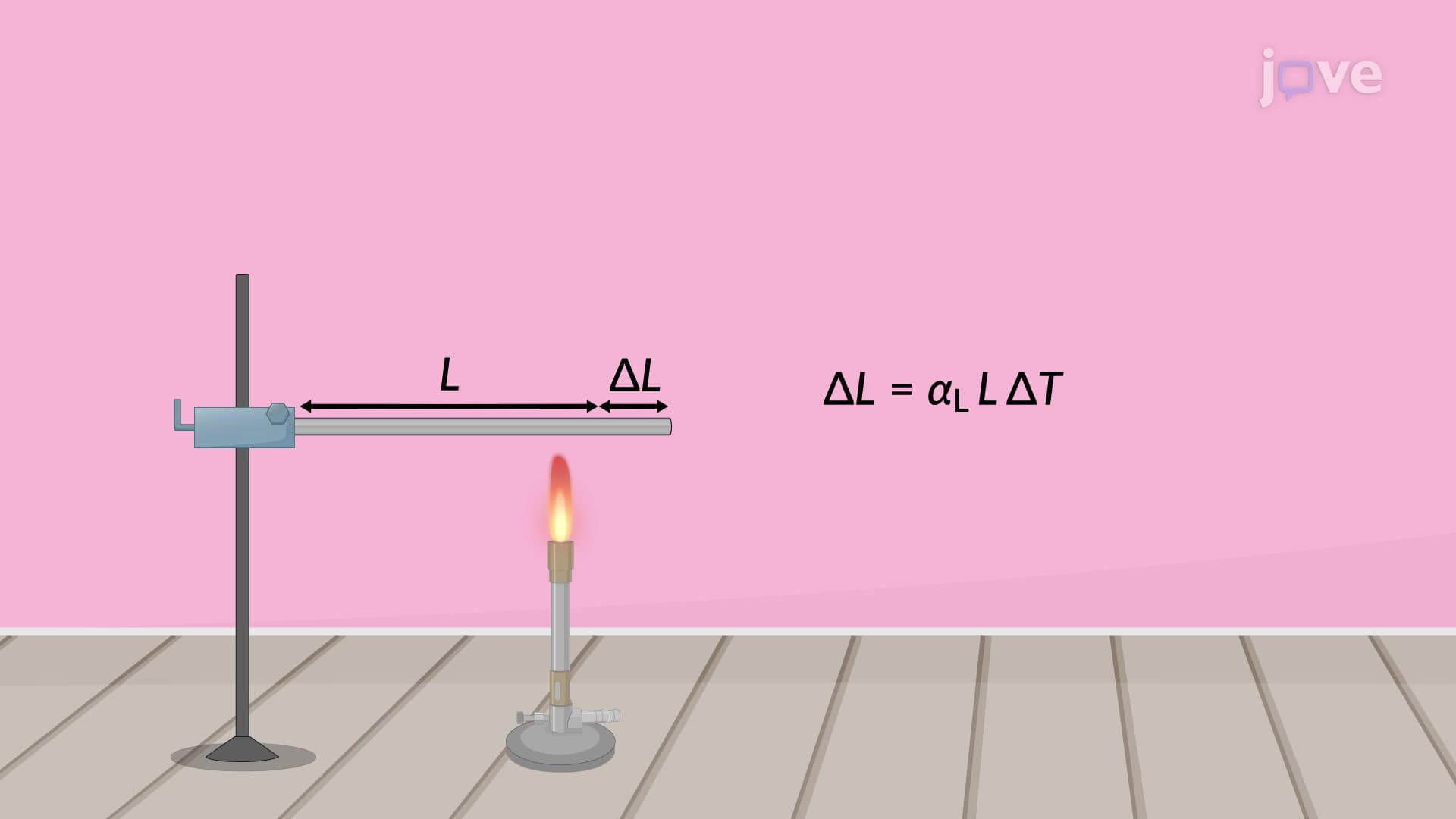
Linear expansion represents the most commonly studied form, measuring length changes in one dimension. The relationship follows the formula: ΔL = αLΔT, where α represents the coefficient of linear expansion, L is the original length, and ΔT is the temperature change. Steel railroad tracks exemplify this principle-engineers leave gaps between rail sections to accommodate expansion on hot days, preventing dangerous buckling.
Areal expansion measures surface area changes in two dimensions, particularly important for thin sheets or surfaces. The coefficient of areal expansion typically equals twice the linear expansion coefficient. Volumetric expansion considers three-dimensional changes, crucial for liquids and gases, with coefficients approximately three times the linear value for solids.
American infrastructure relies heavily on thermal expansion principles. The Statue of Liberty's copper exterior expands and contracts with seasonal temperature changes, requiring flexible internal support structures. Similarly, concrete highway sections include expansion joints every 30-40 feet to prevent cracking during temperature fluctuations.
In precision manufacturing, machined parts must account for thermal expansion during quality control measurements. Room temperature (68°F) serves as the standard reference point for dimensional specifications in American manufacturing standards.
Water presents a fascinating exception to typical expansion behavior. Between 32°F and 39°F (0°C to 4°C), water actually contracts when heated, reaching maximum density at 39°F (4°C). This anomalous behavior explains why ice floats and why lakes freeze from the surface down, creating insulating layers that protect aquatic life during harsh winters.
Students preparing for AP Physics or college-level thermodynamics courses frequently encounter thermal expansion problems requiring coefficient calculations and real-world applications. Understanding both the theoretical foundations and practical implications provides essential preparation for advanced STEM coursework.
Related Micro-courses