Loading subject page…


251,100 views

Video Summary: Standard Entropy Change for a Reaction Explained
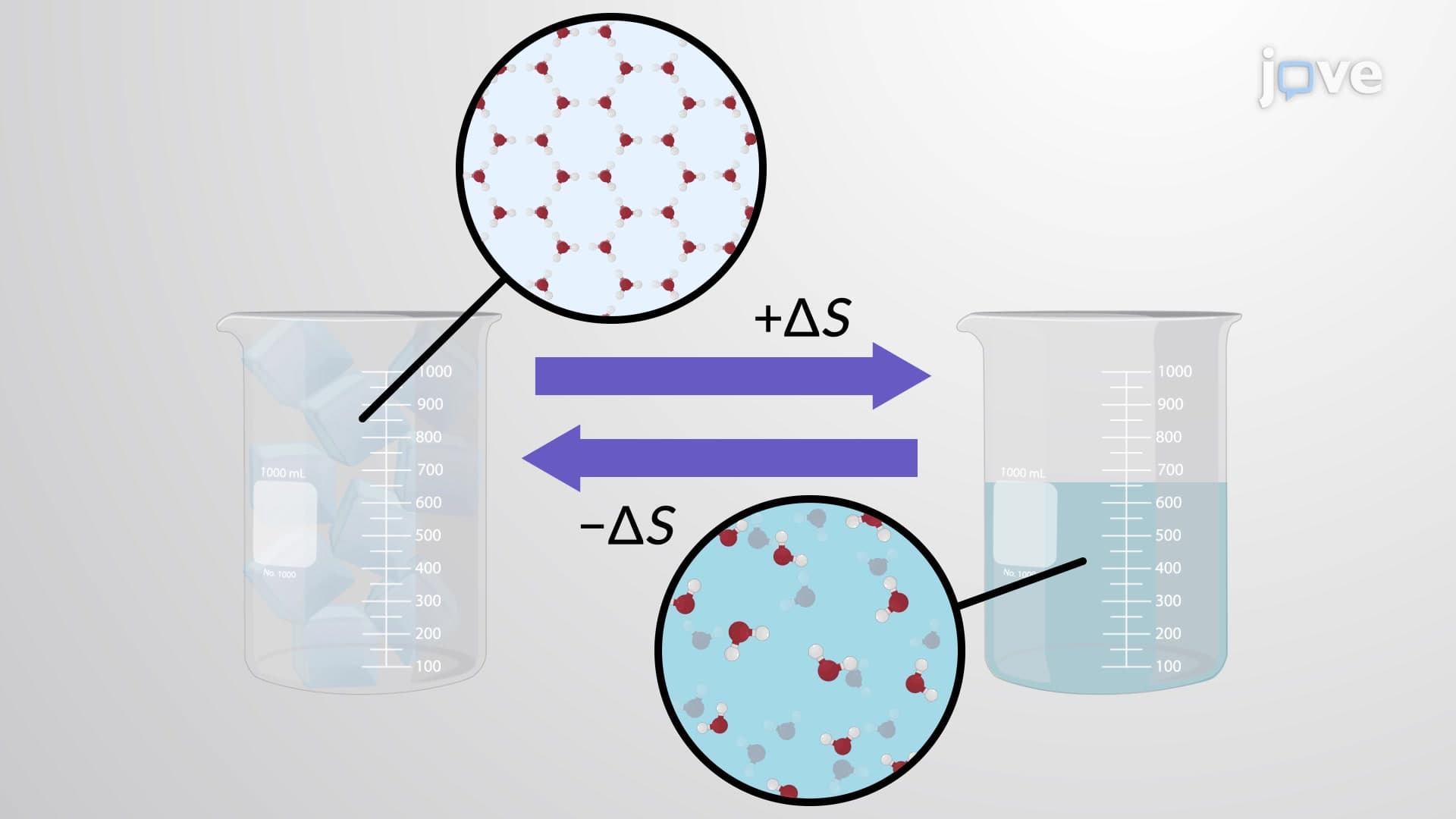
Why does ice melting feel inevitable while the reverse never happens spontaneously? The standard entropy change for a reaction reveals the fundamental driving force behind chemical processes, measuring how disorder shifts when reactants transform into products. Consider the combustion in a car engine, where gaseous fuel and oxygen create fewer gas molecules plus liquid water, actually decreasing the system's disorder. This counterintuitive example demonstrates how entropy calculations predict reaction spontaneity in everything from industrial catalysis to metabolic pathways. Watch the full video on JoVE Coach to master this concept with expert-led visuals and step-by-step explanations.
Standard entropy change for a reaction represents the total entropy difference when a chemical reaction occurs under standard conditions (298 K, 1 atm pressure). Unlike enthalpy changes that can be measured directly with calorimeters, entropy changes require calculation using tabulated standard molar entropy values. This fundamental thermodynamic property helps predict whether reactions will occur spontaneously and explains the molecular-level disorder changes during chemical transformations.
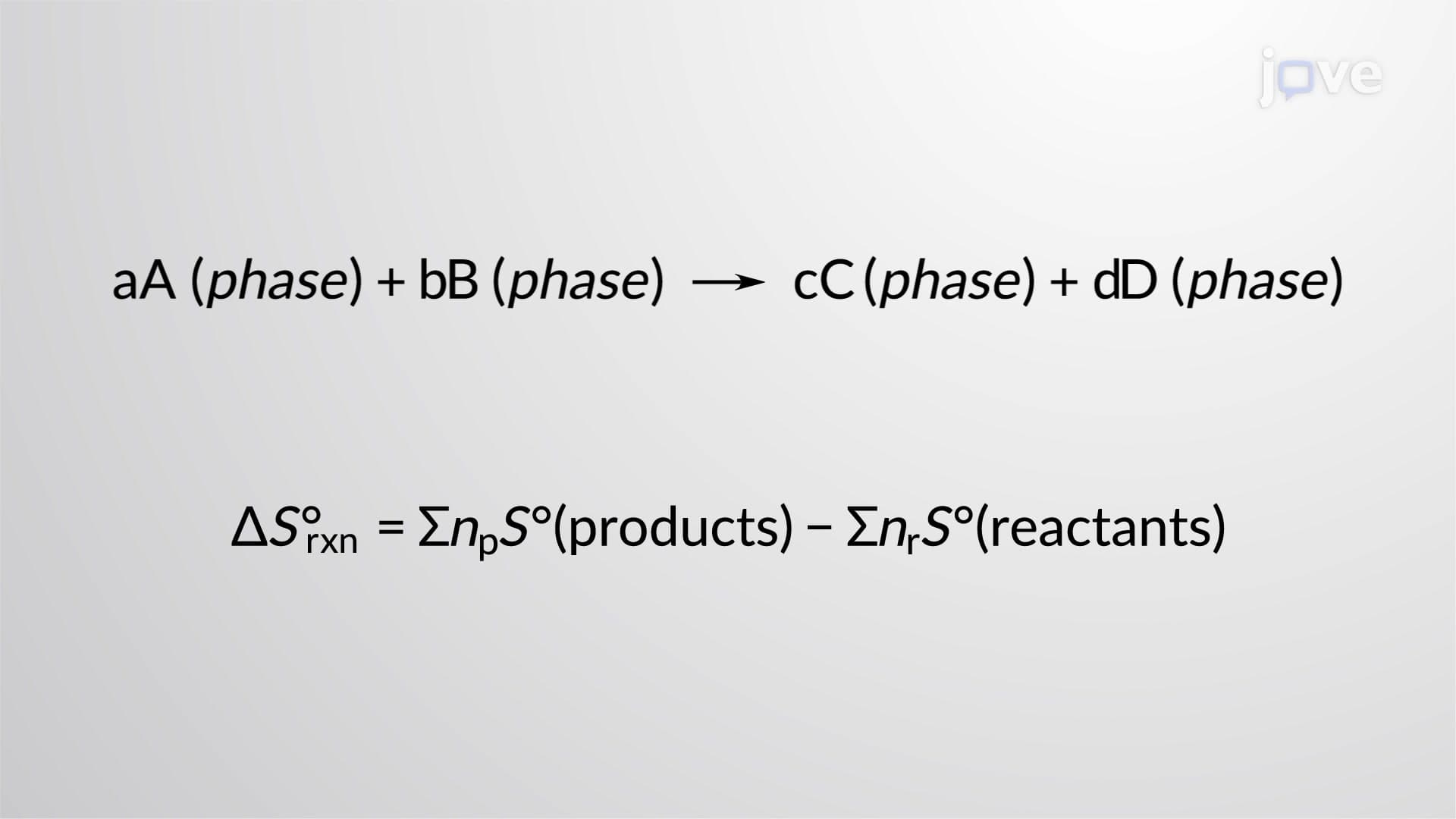
The calculation follows a straightforward stoichiometric approach: ΔS°reaction = Σ(S°products × coefficients) - Σ(S°reactants × coefficients). Each substance contributes its standard molar entropy multiplied by its balanced equation coefficient. This method works because entropy is a state function-the total change depends only on initial and final states, not the reaction pathway.
Students can often predict entropy change signs without calculations by examining molecular states and quantities. Gas-phase molecules exhibit the highest entropy due to maximum molecular freedom, followed by liquids, then solids. Reactions producing more gas molecules typically increase entropy, while those forming fewer gas molecules or condensing gases into liquids decrease entropy.
The ethylene combustion example illustrates this principle: C2H4(g) + 3O2(g) → 2CO2(g) + 2H2O(l). The reaction starts with 4 gas molecules but produces only 2 gas molecules plus 2 liquid molecules. This decrease from 4 to 2 gas-phase entities signals entropy reduction, confirmed by the calculated ΔS° = -268 J/K.
This concept appears frequently on AP Chemistry exams, college general chemistry courses, and MCAT sections covering thermodynamics. Students encounter entropy calculations in contexts ranging from combustion engines to biological metabolism. Understanding entropy changes helps explain why certain industrial processes require specific temperature and pressure conditions to proceed efficiently.
Professional chemists use entropy data to design reaction conditions, predict product distributions, and optimize manufacturing processes. Environmental engineers apply these principles when analyzing pollution control reactions, while biochemists study entropy changes in protein folding and enzyme catalysis.
Mastering standard entropy change calculations prepares students for more complex thermodynamic concepts like Gibbs free energy, where entropy and enthalpy combine to determine reaction spontaneity. The relationship ΔG° = ΔH° - TΔS° shows how entropy changes become increasingly important at higher temperatures, explaining why some reactions reverse their spontaneity as temperature changes.
Related Micro-courses