Loading subject page…


23,691 views

Video Summary: What Is Kirchhoffs Current Law
Ever wonder how electrical engineers ensure smartphone charging circuits don't overload? Kirchhoff's Current Law provides the fundamental principle that makes safe, reliable electronics possible. This law, rooted in charge conservation, states that current flowing into any junction equals current flowing out-a concept essential for analyzing everything from Tesla's battery management systems to power grid distribution. What is Kirchhoff's Current Law demonstrates how this principle applies to real circuit analysis and problem-solving. Watch the full video on JoVE Coach to master this concept with expert-led visuals and step-by-step explanations.
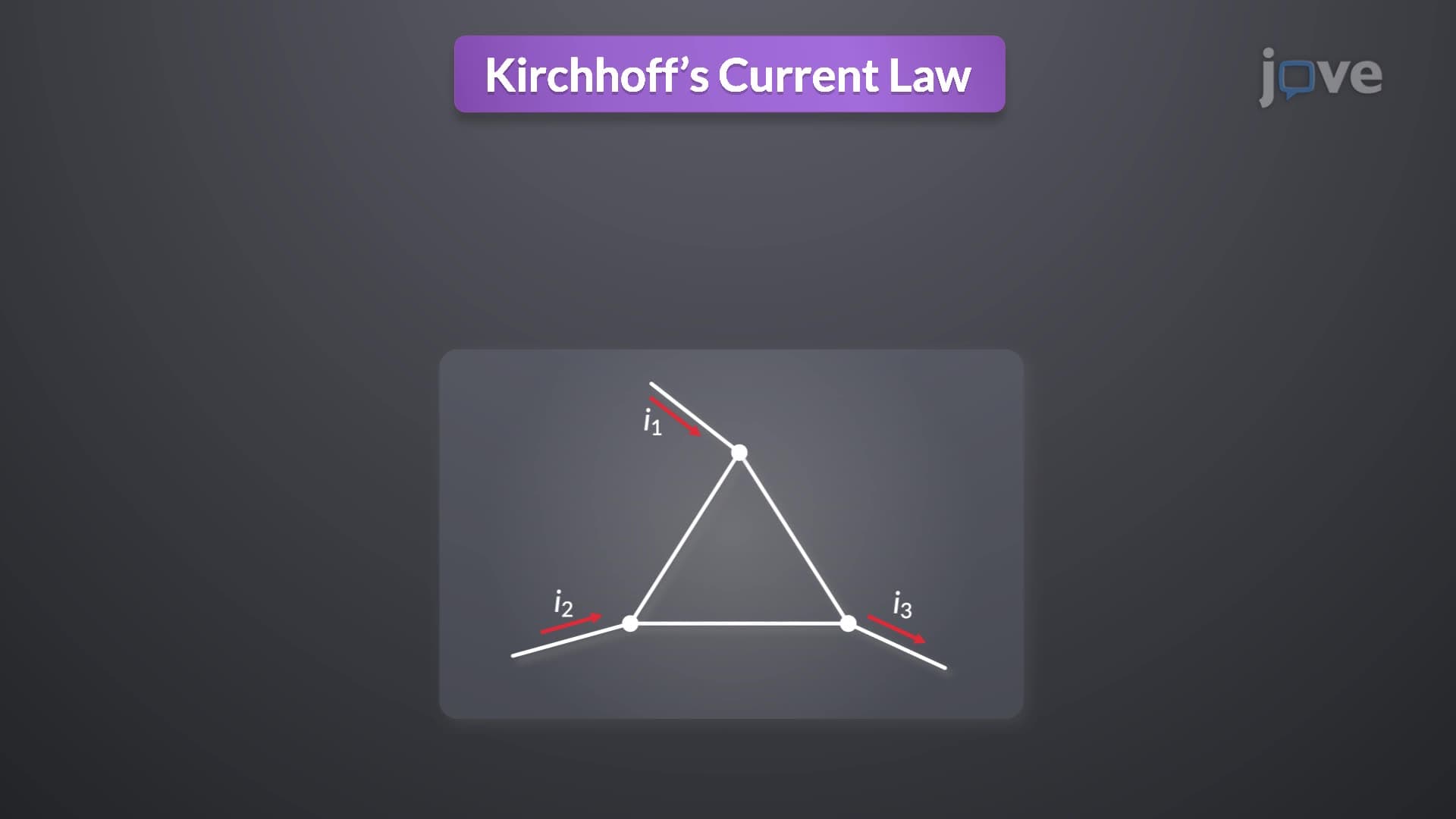
What is Kirchhoff's Current Law represents one of the most fundamental principles in electrical engineering, named after German physicist Gustav Kirchhoff. This law emerges directly from the principle of charge conservation-a cornerstone of physics stating that electric charge can neither be created nor destroyed in normal circumstances. In practical terms, KCL ensures that whatever current flows into a junction must equal the current flowing out, preventing charge accumulation at any point in a circuit.
The mathematical expression of Kirchhoff's Current Law involves algebraic summation of currents at any node. Conventionally, currents entering a node receive positive signs, while currents leaving carry negative signs. This systematic approach ensures consistent analysis across complex circuits. When properly applied, the sum of all currents at any node equals zero: ΣI = 0.
For students preparing for AP Physics or college-level electrical engineering courses, mastering these sign conventions proves crucial. Many exam problems specifically test this concept through multi-branch circuit analysis, where incorrect sign assignment leads to wrong answers despite correct problem-solving methodology.
Consider Tesla's Supercharger stations, which utilize multiple parallel charging units. Each charging station represents a current source, and KCL governs how these currents combine to deliver power safely to vehicles. Similarly, residential solar installations employ parallel solar panel configurations where individual panel currents sum according to KCL principles.
In smartphone technology, battery charging circuits use KCL to manage current distribution between charging the battery and powering device operations simultaneously. This application demonstrates why electrical engineering students study KCL extensively-it's not merely theoretical but essential for designing safe, efficient electronic systems.
Beyond basic node analysis, KCL extends to complex boundary analysis where entire circuit sections are treated as single nodes. This generalization proves particularly valuable in analyzing integrated circuits and power distribution systems. Engineering students at institutions like MIT and Stanford regularly apply these advanced KCL concepts in capstone projects involving renewable energy systems and electric vehicle design.
The law's versatility makes it indispensable for MCAT Physics sections and engineering fundamentals exams, where students must quickly identify parallel branches and apply current conservation principles under time pressure.
Related Micro-courses