Loading video…


 9 Concepts
 9.2K views

Video Summary: Characteristics of Practical Op Amps Explained
Ever wonder why your car's audio system doesn't pick up engine noise when playing music? The answer lies in understanding integrator and differentiator circuits and other key operational amplifier characteristics. Real-world op-amps in devices like Tesla's infotainment systems use common-mode rejection ratios to filter unwanted electrical interference while amplifying desired audio signals. The characteristics of practical op AMPS explained include gain-bandwidth products, voltage followers, and signal isolation techniques that make modern electronics possible. Watch the full video on JoVE Coach to master this concept with expert-led visuals and step-by-step explanations.
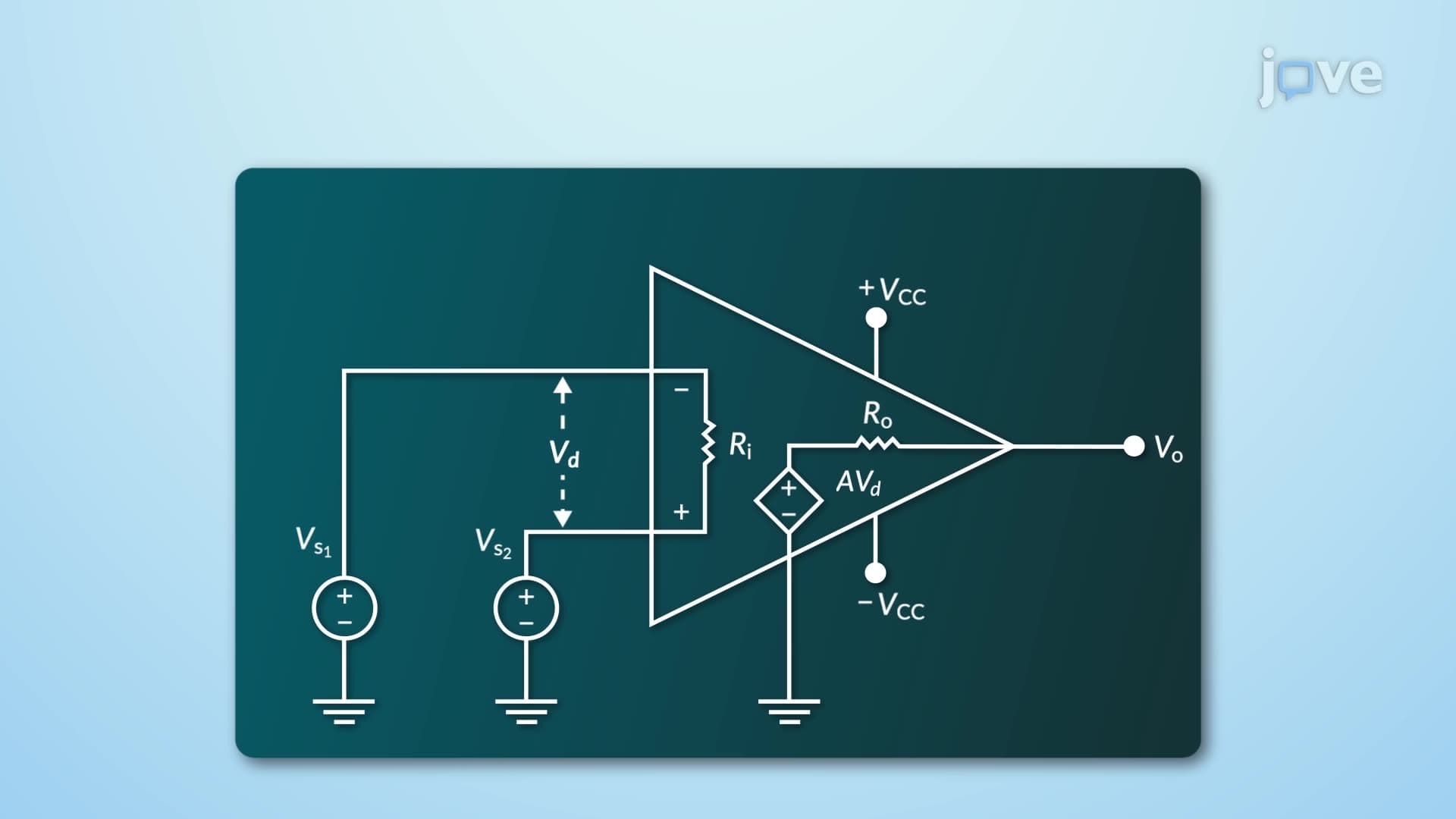
Real operational amplifiers differ significantly from their ideal counterparts, exhibiting specific characteristics that engineers must consider in circuit design. Unlike theoretical models, practical op-amps have finite gain, limited bandwidth, and susceptibility to unwanted signals that affect performance in integrator and differentiator applications and other circuit configurations.
The common-mode rejection ratio (CMRR) represents one of the most critical characteristics of practical op-amps. This parameter measures an amplifier's ability to reject signals that appear simultaneously at both inputs while amplifying the difference between them. In mathematical terms, CMRR = Ad/Ac, where Ad is differential gain and Ac is common-mode gain.
Consider a medical ECG machine used in hospitals like Mayo Clinic. The patient's body acts as an antenna, picking up 60 Hz electrical noise from power lines. A high-quality medical amplifier with CMRR values exceeding 100 dB can effectively reject this common interference while amplifying the tiny millivolt heart signals. This principle directly applies to integrator and differentiator definition in biomedical applications where signal purity is paramount.
Students preparing for the MCAT or AP Physics C exams should understand that CMRR typically appears in decibel form: CMRR(dB) = 20 × log10(Ad/Ac). Values above 80 dB indicate excellent common-mode rejection for most practical applications.
Every op-amp exhibits a fundamental limitation called the gain-bandwidth product (GBP), which remains constant regardless of circuit configuration. This characteristic determines the maximum usable frequency for any given gain setting. For instance, the popular LM741 op-amp has a GBP of approximately 1 MHz.
If you design an amplifier with a gain of 100, the maximum useful frequency becomes 1 MHz ÷ 100 = 10 kHz. This limitation directly impacts integrator and differentiator circuits, where frequency response determines integration and differentiation accuracy across different input frequencies.
Voltage followers, or unity gain buffers, represent a special op-amp configuration providing impedance transformation without voltage amplification. These circuits feature extremely high input impedance (typically > 1 MΩ) and very low output impedance (< 100 Ω), making them ideal for signal isolation applications.
In practical scenarios, such as connecting a high-impedance pH sensor to a data acquisition system at Stanford University's chemistry lab, a voltage follower prevents signal loading that would otherwise cause measurement errors. This concept frequently appears in college-level electronics courses and professional engineering exams.
Related Micro-courses