Loading video…


 9 Concepts
 9.2K views

Video Summary: What Is Cascaded Op Amps
Ever wonder how your smartphone amplifies weak signals from distant cell towers into crystal-clear calls? An instrumentation amplifier achieves this through cascaded op amps-multiple operational amplifiers connected in sequence to boost signal strength exponentially. Medical devices at Johns Hopkins Hospital use this same principle to amplify tiny bioelectric signals from patients' hearts into readable ECG traces. What is cascaded op AMPS becomes essential when single amplifiers can't provide sufficient gain while maintaining signal quality. Watch the full video on JoVE Coach to master this concept with expert-led visuals and step-by-step explanations.
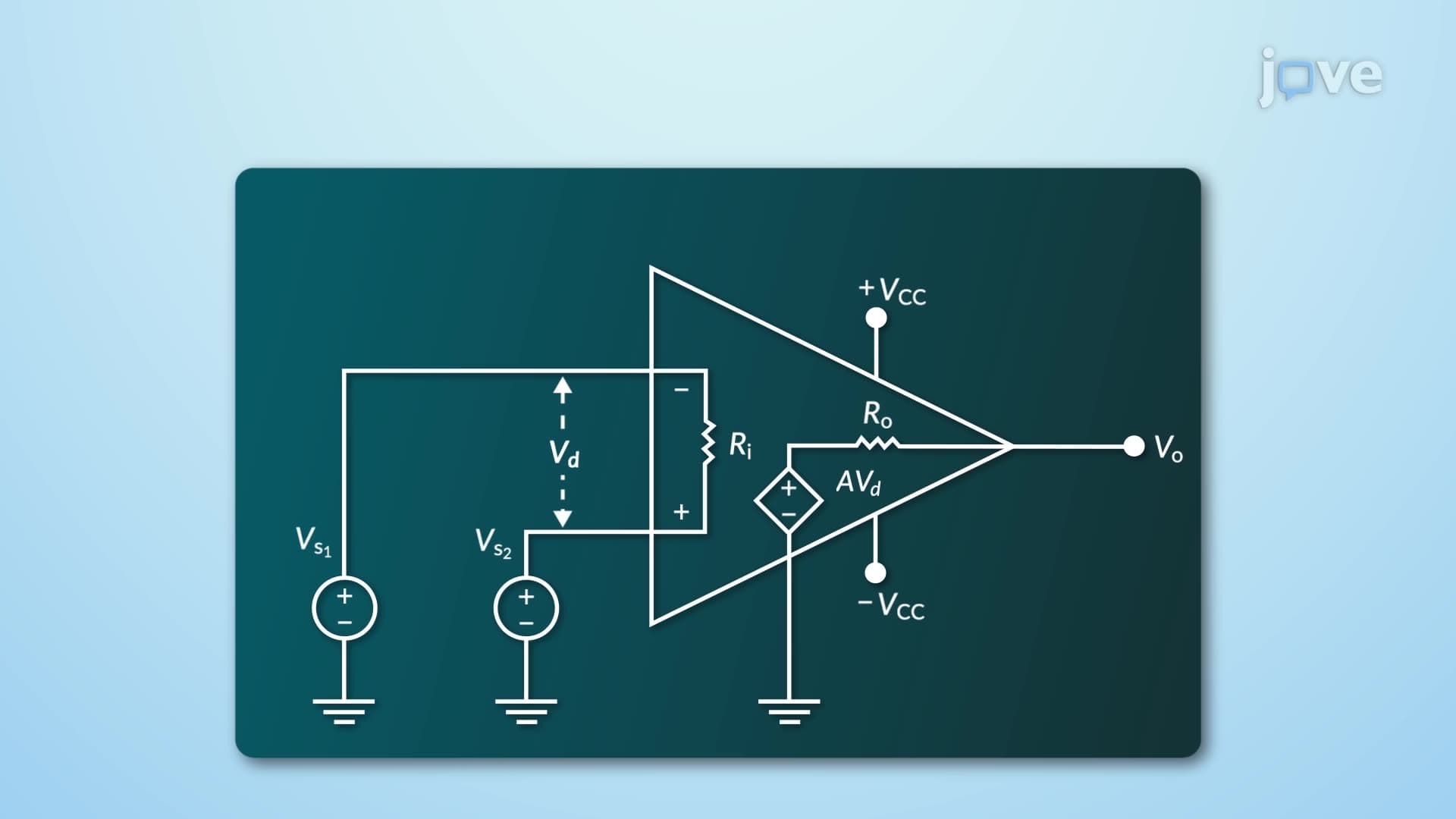
Instrumentation amplifier circuits often employ cascaded op amps to achieve performance impossible with single amplifiers. This configuration connects multiple operational amplifiers in series, where each stage's output drives the next stage's input. The beauty lies in op amps' ideal characteristics: infinite input impedance means no loading between stages, while zero output impedance ensures perfect signal transfer.
The instrumentation amplifier definition becomes clearer when examining gain relationships. If Stage 1 provides 10× gain and Stage 2 provides 20× gain, total system gain reaches 200× (10 × 20). This multiplicative effect allows designers to achieve high overall gains while keeping individual stages within reasonable limits.
Crucially, the gain-bandwidth product remains constant for each op amp. When gain is distributed across multiple stages, each stage operates at lower individual gain, resulting in higher bandwidth per stage. Students preparing for AP Physics or college electronics courses should remember this inverse relationship: lower gain per stage equals wider bandwidth per stage.
Understanding what is instrumentation amplifier in detail reveals extensive US applications. Medical device manufacturers like Medtronic use cascaded configurations in pacemakers to amplify cardiac signals. The FDA requires these devices to maintain signal integrity across wide frequency ranges-exactly what cascaded designs provide.
Television broadcasting stations across America employ cascaded RF amplifiers to boost weak antenna signals. These systems amplify everything from local news broadcasts to NFL games, requiring both high gain and wide bandwidth to preserve signal quality. The cascaded approach prevents any single stage from saturating, maintaining broadcast standards mandated by the FCC.
The instrumentation amplifier overview emphasizes preventing signal saturation-a critical concern in cascaded systems. Engineers must calculate maximum input signals and distribute gains appropriately. If the first stage saturates, subsequent stages amplify the distorted signal, ruining overall performance.
Students encountering this concept in college electronics labs or MCAT preparation should focus on the practical design rule: keep individual stage gains reasonable while achieving desired total gain. This principle appears frequently in engineering licensing exams and graduate school entrance tests.
The instrumentation amplifier basics extend beyond simple gain calculations to impedance considerations, noise analysis, and frequency response optimization-topics essential for students pursuing electrical engineering degrees at institutions like MIT, Stanford, or Georgia Tech.
Related Micro-courses