Loading video…


 7 Concepts
 3.2K views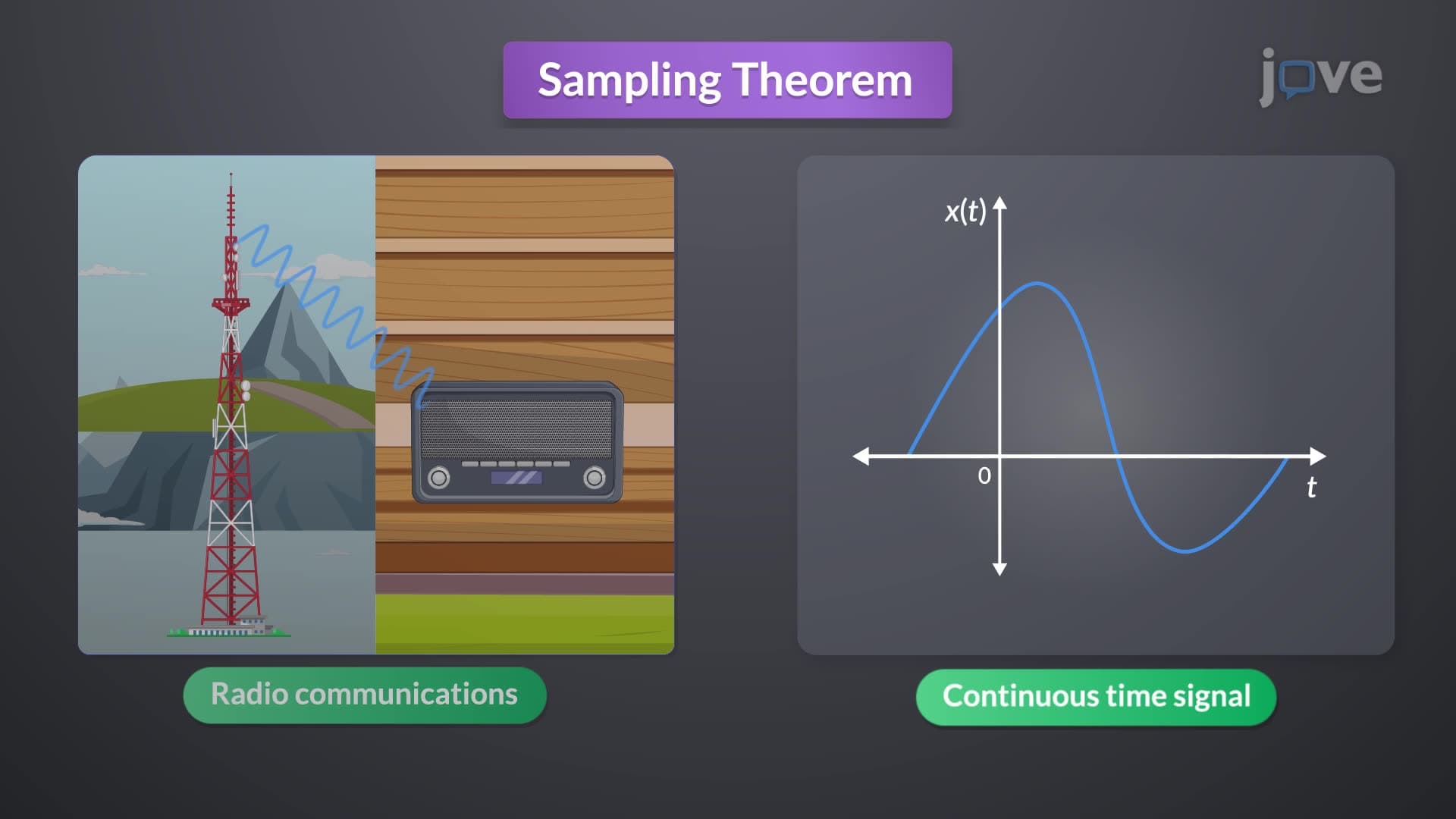

Video Summary: What Is Sampling Theorem
Ever wonder how your smartphone converts your voice into crystal-clear digital audio during calls? The process relies on sampling continuous time signal techniques that capture analog sound waves and transform them into discrete digital data. The Sampling Theorem establishes the mathematical foundation ensuring no information loss occurs during this conversion, which is crucial for technologies like digital audio recording systems used by major US companies like Apple and Spotify. Watch the full video on JoVE Coach to master this concept with expert-led visuals and step-by-step explanations.
The Sampling Theorem, also known as the Nyquist-Shannon sampling theorem, represents one of the most fundamental principles in digital signal processing and telecommunications engineering. This mathematical concept provides the bridge between the analog world of continuous signals and the digital realm of discrete data processing that powers everything from your iPhone's audio recording to sophisticated medical imaging equipment used in hospitals across the United States.
When we examine sampling continuous time signal processes, we're essentially asking: "How frequently must we measure a continuous signal to capture all its information perfectly?" The answer lies in understanding the frequency content of the original signal and applying the theorem's precise mathematical requirements.
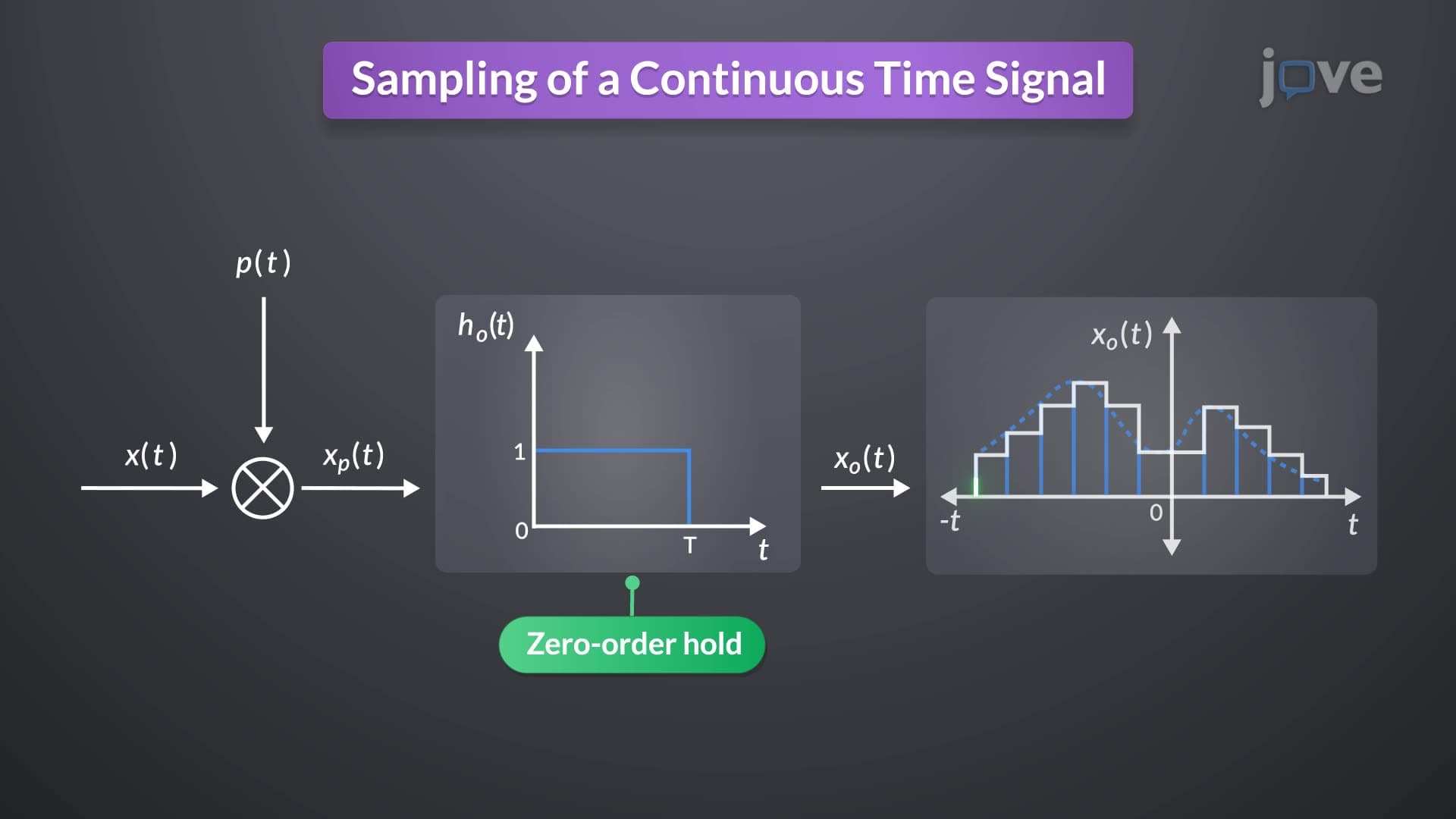
The sampling continuous time signal definition involves multiplying a continuous-time signal x(t) with a periodic impulse train. This multiplication creates a series of discrete samples spaced at regular intervals T_s (the sampling interval). The sampling frequency f_s equals 1/T_s, representing how many samples we collect per second.
The Fourier transform reveals the spectral consequences of this sampling process. The spectrum of the sampled signal becomes a summation of shifted versions of the original signal's spectrum, with each shift occurring at integer multiples of the sampling frequency. This mathematical relationship directly impacts whether we can perfectly reconstruct the original continuous signal from its discrete samples.
For students preparing for AP Physics or college-level electrical engineering courses, understanding this spectral replication concept is crucial for solving sampling-related problems and avoiding common misconceptions about digital signal processing.
The core requirement of the Sampling Theorem states that the sampling frequency must exceed twice the highest frequency component present in the original signal. This minimum sampling frequency is called the Nyquist rate, named after Bell Labs engineer Harry Nyquist who contributed significantly to communication theory development in the early 20th century.
What is sampling continuous time signal in detail becomes clearer when we examine practical scenarios. Consider a typical music recording: human hearing extends to approximately 20 kHz, so CD-quality audio uses a 44.1 kHz sampling rate (slightly more than twice 20 kHz). This ensures faithful reproduction of all audible frequencies without aliasing distortion.
Students encountering this concept in MCAT preparation, particularly in the physics section, should recognize how sampling theory applies to medical imaging technologies like MRI and CT scanners used throughout the US healthcare system. These devices rely on proper sampling to create accurate diagnostic images without artifacts.
Understanding sampling continuous time signal overview concepts also proves essential for engineering students tackling problems in courses like MIT's 6.003 (Signals and Systems) or similar curricula at universities like Stanford and UC Berkeley, where sampling theory forms the foundation for advanced digital signal processing topics.
Related Micro-courses