Loading video…


 7 Concepts
 3.2K views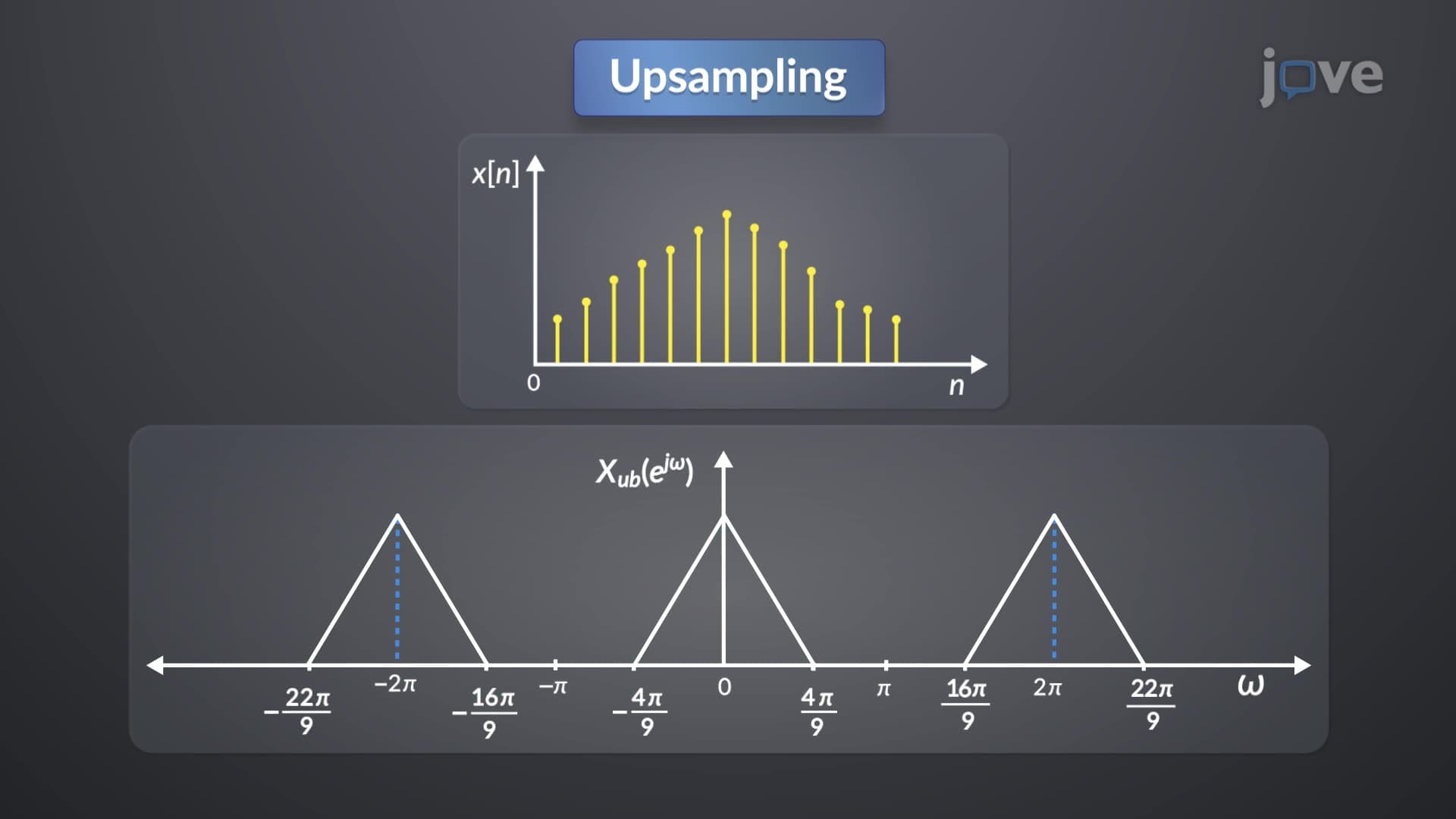

Video Summary: What Is Upsampling
Ever wonder how your smartphone seamlessly switches between cell towers while maintaining crystal-clear call quality? This process relies heavily on bandpass sampling techniques, where upsampling plays a crucial role in digital signal processing. When engineers at companies like Qualcomm design cellular modems, they use upsampling to increase sampling rates while preserving original signal characteristics. What is upsampling becomes essential knowledge for understanding how digital systems manipulate frequency content through zero insertion and filtering processes. Watch the full video on JoVE Coach to master this concept with expert-led visuals and step-by-step explanations.
Upsampling represents a fundamental digital signal processing technique that increases the effective sampling rate of a discrete-time signal. Unlike simply collecting more samples from the original source, upsampling works by strategically inserting zeros between existing samples, then applying sophisticated filtering to reconstruct a higher-resolution representation of the original signal.
The upsampling process begins with zero insertion, where L-1 zeros are placed between each pair of original samples when upsampling by a factor of L. This seemingly simple operation creates profound changes in the frequency domain. The zero insertion causes the original spectrum to repeat at intervals determined by the new, higher sampling frequency. These spectral replicas appear as exact copies of the original frequency content, positioned at multiples of the original sampling frequency divided by the upsampling factor.
After zero insertion, a carefully designed lowpass filter becomes essential for proper signal reconstruction. This filter must have a cutoff frequency positioned at the new Nyquist limit, effectively removing the unwanted spectral replicas while preserving the original frequency components. The filter design directly impacts the quality of the upsampled signal, inadequate filtering leaves artifacts, while overly aggressive filtering can remove desired signal content.
Bandpass sampling applications using upsampling appear throughout modern electronics. Audio engineers use upsampling in digital audio workstations when converting between different sample rates, such as converting 44.1 kHz CD audio to 96 kHz studio formats. Medical imaging systems employ upsampling in MRI and CT scan processing to enhance image resolution. Telecommunications companies like Verizon and AT&T use these techniques in their 5G infrastructure to manage different frequency bands efficiently.
For students preparing for AP Physics, understanding upsampling connects directly to wave theory and frequency analysis concepts. College engineering students encounter these principles in signals and systems courses, where professors often assign problems involving spectral analysis of upsampled signals. The mathematical relationships governing upsampling appear frequently on standardized exams, particularly in contexts involving frequency domain transformations and sampling theorem applications.
Related Micro-courses