Loading subject page…

- Chemistry
- Chemical Kinetics
- Temperature Dependence on Reaction Rate
Micro-course: Chemical Kinetics
561,000 views
Learn key concepts and earn your certificate.



Temperature Dependence on Reaction Rate

00:00
02:55
Video Summary: Temperature Dependence on Reaction Rate Explained
Ever wonder why your steak cooks faster on high heat, or why food spoils quicker in summer? The temperature dependence on reaction rate reveals that just a 10°C temperature rise can accelerate chemical reactions by 3-4 times. This dramatic effect, first explained by Swedish chemist Svante Arrhenius in 1889, governs everything from food preservation in US refrigerated supply chains to pharmaceutical manufacturing. Watch the full video on JoVE Coach to master this concept with expert-led visuals and step-by-step explanations.
- Understand the fundamental principles of temperature dependence on reaction rate and how the Arrhenius equation quantifies this relationship
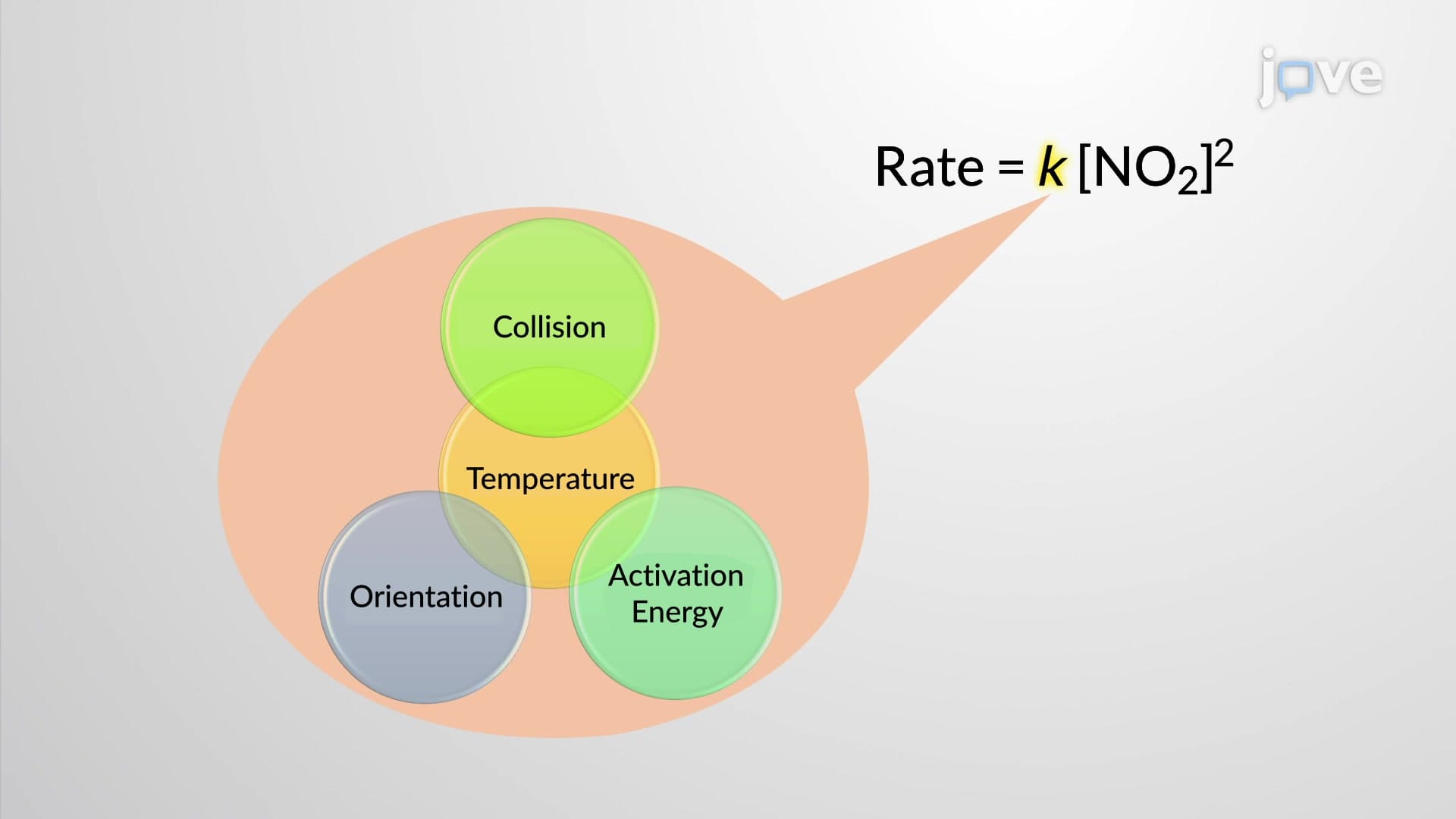
- Identify the key components of the rate constant and explain why temperature affects reaction rates while reactant concentration remains independent
- Analyze the collision model to explain how molecular motion, orientation, and activation energy determine successful chemical reactions
- Compare the roles of the frequency factor and exponential factor in the Arrhenius equation and their temperature sensitivity
- Evaluate how activation energy barriers control the fraction of successful molecular collisions that lead to product formation
- Apply temperature-rate relationships to predict reaction behavior in real-world scenarios like industrial processes and biological systems
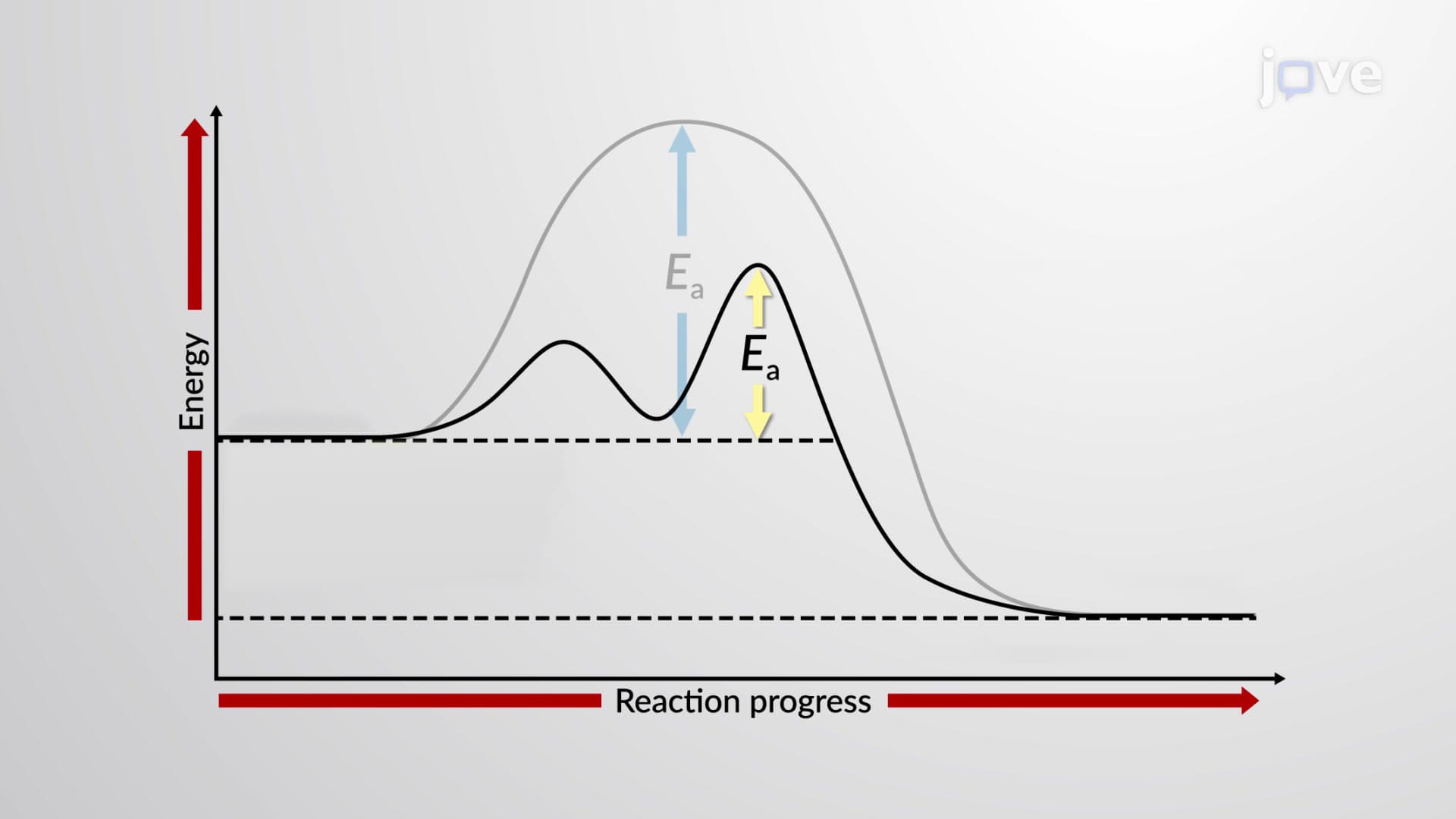
- Recognize the significance of the transition state and activated complex in determining reaction pathways and energy requirements
- Explore quantitative calculations using the Arrhenius equation to solve problems involving temperature changes and rate constants
Understanding Temperature Dependence On Reaction Rate Fundamentals
The temperature dependence on reaction rate represents one of chemistry's most predictable and practically important relationships. Unlike reactant concentrations, which directly appear in rate laws, temperature exerts its influence through the rate constant (k), making this relationship both elegant and powerful for predicting chemical behavior.
The Arrhenius Equation: Mathematical Foundation of Temperature Effects
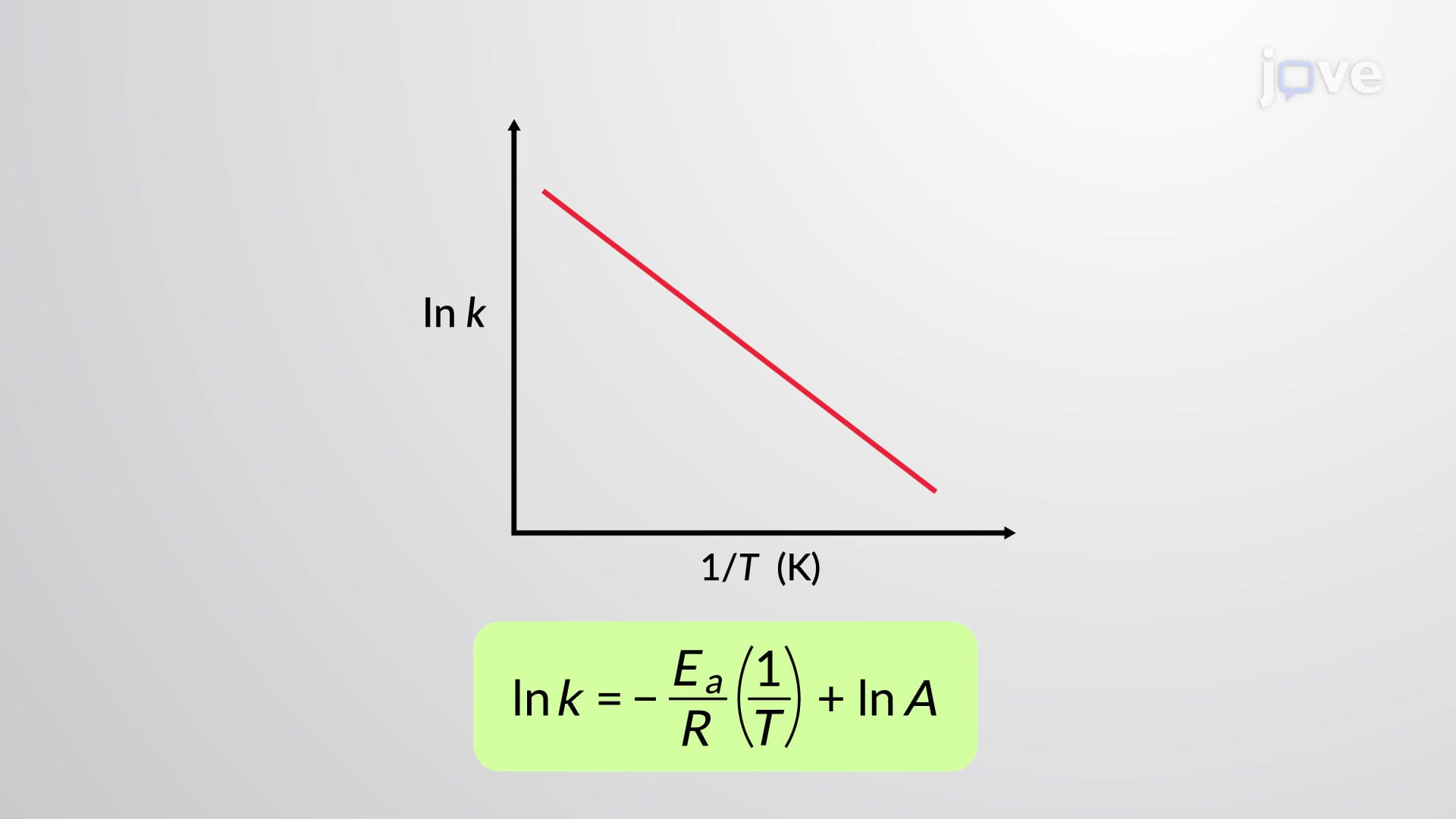
Svante Arrhenius's groundbreaking 1889 work established that k = A × e^(-Ea/RT), where A represents the pre-exponential factor, Ea is activation energy, R is the gas constant, and T is absolute temperature. This equation elegantly captures why pharmaceutical companies like Pfizer and Merck carefully control reaction temperatures during drug synthesis-small temperature changes dramatically affect production rates and yields.
Collision Theory: The Molecular Basis of Temperature Sensitivity
At the molecular level, temperature dependence stems from collision theory principles. Higher temperatures increase molecular kinetic energy, leading to more frequent and more energetic collisions. Consider catalytic converters in Ford and GM vehicles: these devices require specific operating temperatures (typically 400-800°C) to ensure exhaust gas molecules have sufficient energy to overcome activation barriers and react with catalyst surfaces.
The frequency factor (A) encompasses both collision frequency and proper molecular orientation. As temperature rises, molecules move faster and collide more often, but they also have better chances of achieving the correct spatial arrangement for bond breaking and formation.
Activation Energy and the Exponential Factor
The exponential term e^(-Ea/RT) represents the fraction of molecules possessing energy equal to or greater than the activation energy. This Boltzmann distribution explains why reaction rates increase exponentially rather than linearly with temperature. In AP Chemistry exams, students often encounter problems calculating how many times faster a reaction proceeds when temperature increases-a direct application of this exponential relationship.
Industrial applications abound: Intel and AMD semiconductor manufacturing requires precise temperature control during silicon wafer processing, where even degree-level variations can affect chip yield and performance. Similarly, food scientists at companies like General Mills use this knowledge to optimize baking temperatures and predict shelf life under different storage conditions.
Frequently Asked Questions
Temperature dependence on reaction rate describes how chemical reaction speeds change with temperature variations, typically increasing 3-4 times per 10°C rise. This relationship controls everything from how quickly your car engine runs to how fast medications work in your body. Understanding this concept helps predict and control chemical processes in industries ranging from pharmaceuticals to food production.
MCAT questions often involve calculating rate constants at different temperatures using the Arrhenius equation, while AP Chemistry tests focus on graphical analysis of ln(k) vs 1/T plots. Both exams expect you to explain why higher temperatures increase reaction rates using collision theory. Practice problems typically involve determining activation energies from experimental data or predicting rate changes with temperature shifts.
Not at all-while the Arrhenius equation involves exponentials, the underlying concepts rely on logical thinking about molecular motion and energy. Focus first on understanding why faster-moving molecules at higher temperatures collide more effectively. The mathematical applications in introductory courses use straightforward logarithms and graphing skills you already have from algebra.
Companies like Johnson & Johnson and Pfizer use temperature control to optimize drug synthesis reactions, ensuring maximum yield and purity. They also apply these principles to determine proper storage temperatures and expiration dates-understanding how reaction rates change helps predict how quickly medications degrade under different conditions.
Create a concept map linking temperature, molecular motion, collision frequency, activation energy, and reaction rate. Practice converting between Celsius and Kelvin temperatures, and work through Arrhenius equation problems step-by-step. Focus on explaining the "why" behind temperature effects using collision theory rather than just memorizing formulas.
Enzyme-catalyzed reactions follow the same temperature dependence principles, but with an important twist-excessive heat denatures proteins and actually decreases reaction rates. This creates optimal temperature ranges for biological systems. Many pre-med students encounter this concept in both general chemistry and biochemistry courses.
Reactions with lower activation energies show less dramatic temperature sensitivity because more molecules already possess sufficient energy to react. The exponential factor in the Arrhenius equation means high-activation-energy reactions are much more temperature-dependent. This explains why some industrial processes require extreme heating while others proceed readily at room temperature.
Related Micro-courses

10 Concepts
14 Concepts

15 Concepts