Loading subject page…


251,100 views

Video Summary: What Is Gibbs Free Energy
Ever wonder why some chemical reactions happen instantly while others need a spark? Gibbs free energy determines whether reactions like the combustion in your car's engine will occur spontaneously or require external energy input. Named after physicist J. Willard Gibbs, this thermodynamic concept combines enthalpy and entropy to predict reaction spontaneity without measuring surroundings. Watch the full video on JoVE Coach to master this concept with expert-led visuals and step-by-step explanations.
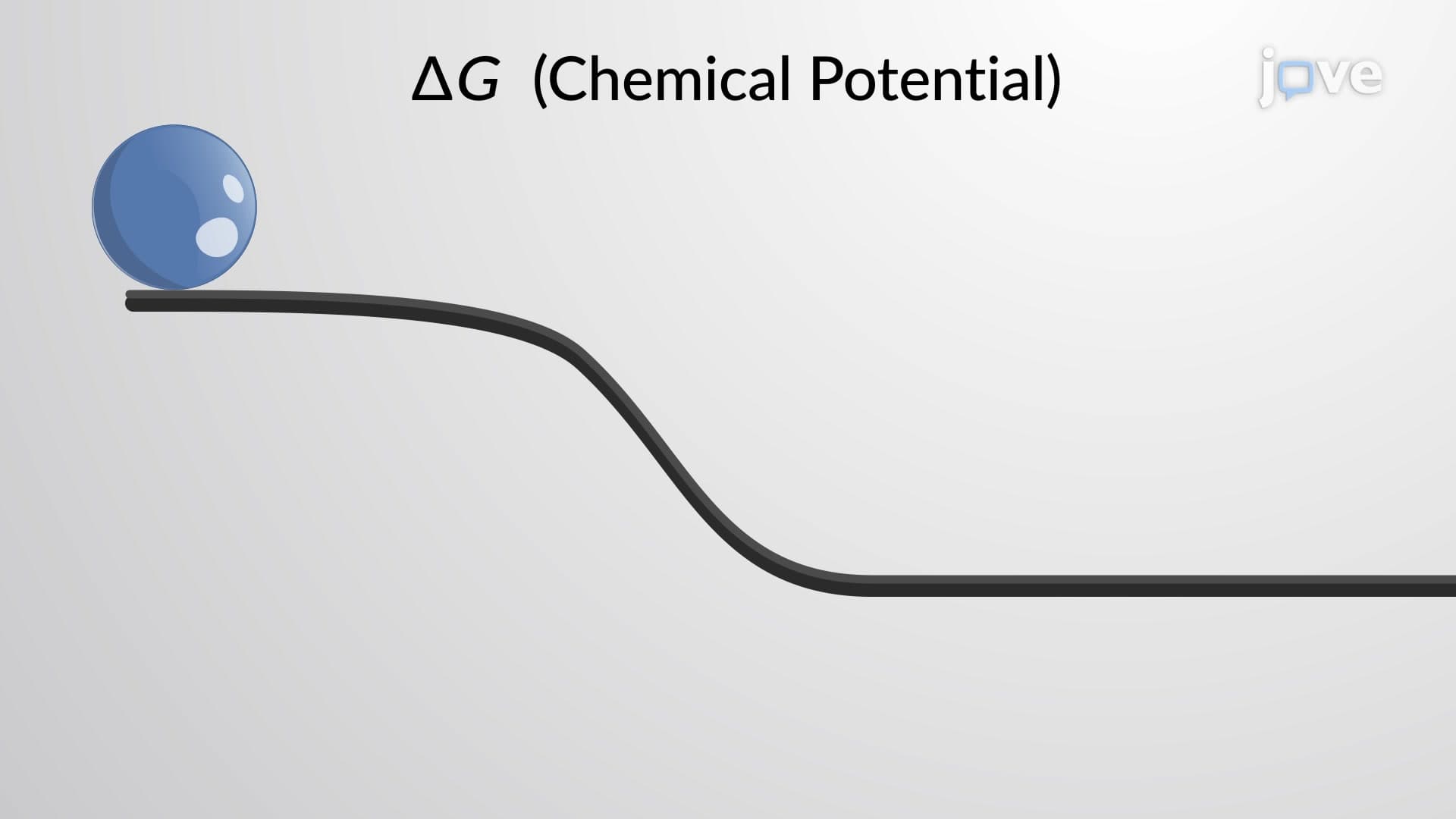
Gibbs free energy represents one of chemistry's most powerful predictive tools, bridging the gap between theoretical thermodynamics and practical reaction chemistry. This state function, denoted as G, quantifies the maximum reversible work a thermodynamic system can perform at constant temperature and pressure. Unlike entropy calculations that require complex surroundings analysis, Gibbs free energy focuses exclusively on system properties, making it invaluable for laboratory and industrial applications.
The Gibbs free energy equation, ΔG = ΔH - TΔS, elegantly combines enthalpy (heat content) and entropy (disorder) effects. When ΔG < 0, reactions proceed spontaneously-like gasoline combustion in automotive engines or cellular respiration in human metabolism. Positive ΔG values indicate non-spontaneous processes requiring external energy input, such as photosynthesis converting carbon dioxide and water into glucose. At ΔG = 0, systems reach equilibrium, exemplified by saturated salt solutions where dissolution and crystallization rates balance perfectly.
Major US chemical manufacturers like DuPont and Dow Chemical rely heavily on Gibbs free energy calculations for process optimization. Consider ammonia production via the Haber-Bosch process at industrial facilities across the American Midwest. Engineers manipulate temperature and pressure conditions to achieve favorable ΔG values, maximizing yield while minimizing energy costs. Similarly, pharmaceutical companies use Gibbs free energy predictions to design drug synthesis pathways, ensuring reactions proceed efficiently under controlled laboratory conditions.
Students preparing for AP Chemistry, MCAT, or college-level physical chemistry courses must master Gibbs free energy calculations. Typical exam problems involve determining reaction spontaneity given enthalpy and entropy data, or calculating equilibrium constants from free energy changes. The concept frequently appears on standardized tests, particularly in thermodynamics sections where students analyze energy diagrams and predict reaction outcomes. Understanding the temperature dependence of ΔG proves especially crucial, as many reactions shift between spontaneous and non-spontaneous behavior based on thermal conditions.
Related Micro-courses