Loading subject page…


5,896 views

Video Summary: What Is Diseconomies of Scale
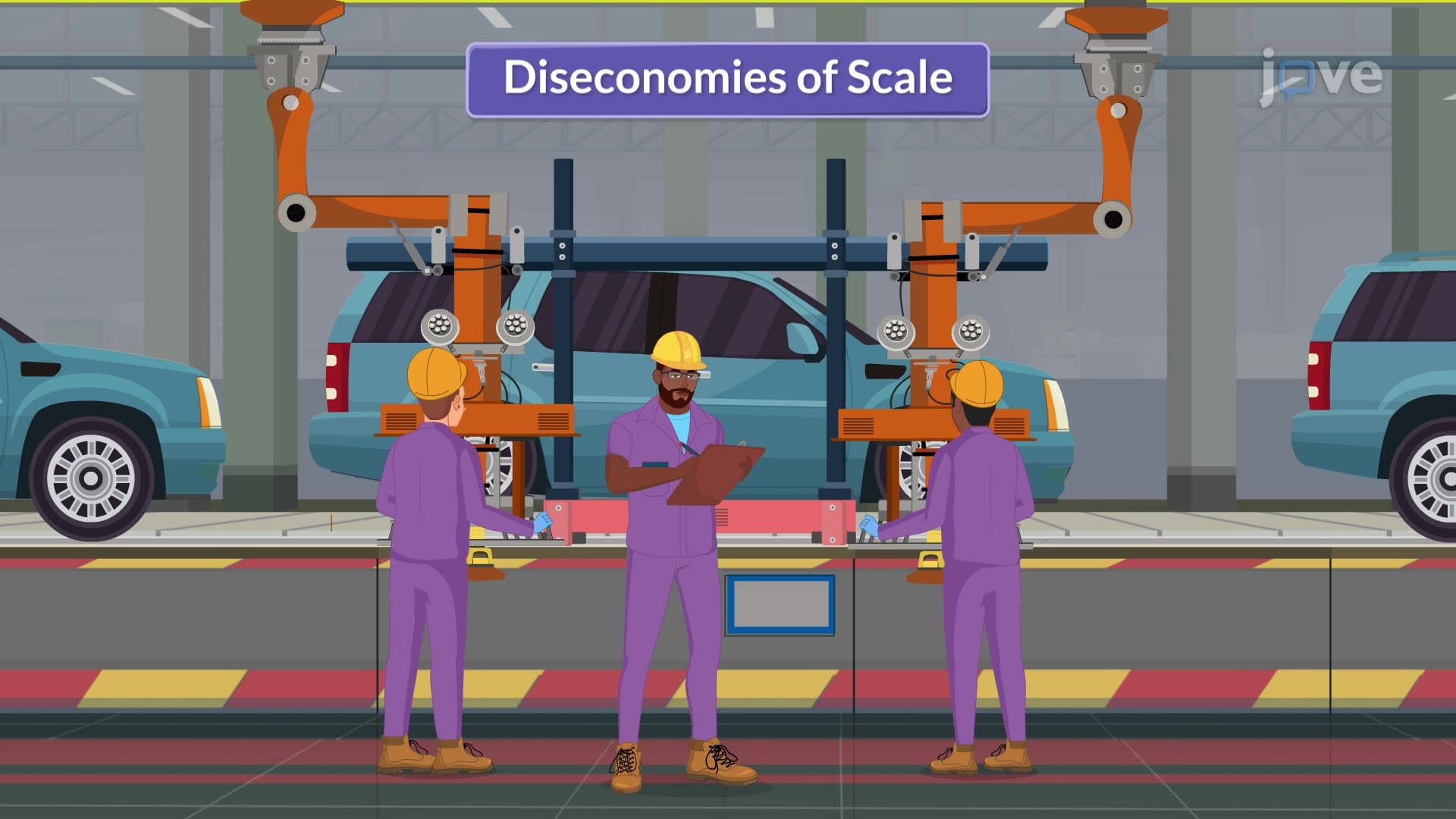
Why would expanding production at Tesla's Gigafactory actually increase the cost per car? Diseconomies of scale occur when doubling output more than doubles total costs, creating inefficiencies that hurt profitability. Companies like General Motors have faced this challenge when rapid expansion led to coordination problems, quality control issues, and bureaucratic slowdowns. Understanding what is diseconomies of scale helps explain why bigger isn't always better in business operations. Watch the full video on JoVE Coach to master this concept with expert-led visuals and step-by-step explanations.
Diseconomies of scale represent a critical concept in microeconomics where expanding production beyond an optimal point actually increases the average cost per unit. Unlike economies of scale, where larger production volumes reduce per-unit costs, diseconomies occur when organizational inefficiencies outweigh the benefits of size. This phenomenon appears frequently in AP Economics exams and college microeconomics courses, making it essential for students to grasp both the theory and practical applications.
The diseconomies of scale definition explained mathematically shows that when output doubles, total costs more than double, creating an upward-sloping long-run average total cost (LRATC) curve. For example, if Ford doubles car production from 100,000 to 200,000 vehicles annually, but total costs increase from $2 billion to $5 billion, the company experiences diseconomies. The average cost per vehicle rises from $20,000 to $25,000, demonstrating how expansion can hurt profitability.
Major US corporations frequently encounter diseconomies of scale during rapid expansion phases. Amazon's warehouse operations illustrate this perfectly-as fulfillment centers grow beyond optimal size, coordination between departments becomes increasingly complex. Management layers multiply, decision-making slows, and communication breakdowns occur more frequently. Similarly, when McDonald's expands too rapidly in new markets, quality control becomes challenging, training costs skyrocket, and brand consistency suffers.
Understanding diseconomies helps explain why many successful companies deliberately limit growth or restructure operations. Google's parent company Alphabet reorganized into separate divisions partly to avoid diseconomies of scale. This diseconomies of scale concept explained through corporate restructuring shows how smart management can prevent efficiency losses. Students studying for college business courses should note how this concept connects to organizational behavior, strategic management, and operational efficiency topics that appear in case studies and exam scenarios.
Related Micro-courses