Loading video…


 14 Concepts
 5.9K views

Video Summary: Comparing Short Run and Long Run Average Cost Structures
Why does Netflix spend billions on content while smaller streaming services struggle to compete? The answer lies in short-run vs. long-run average cost differences that determine business success. Netflix leverages economies of scale in the long run, spreading massive content investments across millions of subscribers, while competitors face higher per-unit costs with fixed short-term resources. Watch the full video on JoVE Coach to master this concept with expert-led visuals and step-by-step explanations.
Comparing short-run and long-run average cost structures forms a cornerstone of microeconomic analysis, explaining why businesses make different decisions based on their time horizon. The fundamental distinction lies in input flexibility: short-run analysis assumes at least one input (typically capital) remains fixed, while long-run analysis allows all inputs to vary.
In the short run, firms operate with predetermined constraints-existing factories, equipment, and facilities cannot be immediately changed. Labor remains the primary variable input, leading to the law of diminishing marginal returns as more workers crowd limited capital. This constraint forces the short-run average total cost curve (ATC SR) above the long-run curve at most output levels.
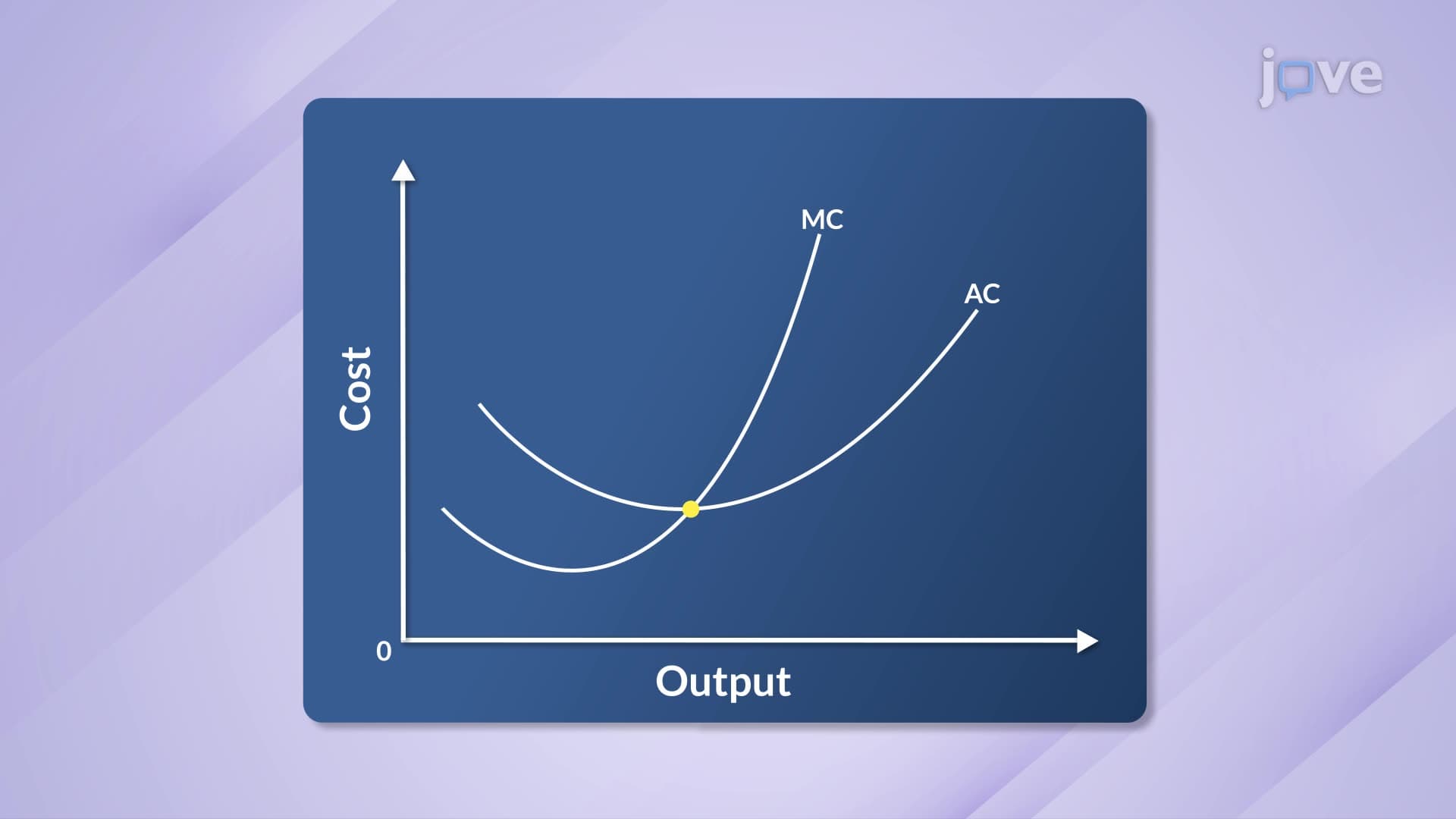
The relationship between short-run and long-run average costs follows a precise mathematical pattern. Multiple short-run curves exist for different capital levels, but only one short-run curve can share its minimum point with the long-run average total cost curve (ATC LR). This occurs because the optimal capital level for any given output in the short run represents just one point on the long-run planning curve.
Consider the envelope theorem: the long-run average cost curve "envelops" all possible short-run curves, touching each at exactly one point. These tangency points represent the optimal scale of operation for each output level when firms can adjust all inputs freely.
Amazon's warehouse expansion strategy perfectly illustrates these cost principles. In the short run, Amazon operates with fixed warehouse capacity and server infrastructure. During peak seasons like Black Friday, the company faces higher per-unit costs as variable inputs (temporary workers, overtime pay) increase against fixed capital.
However, Amazon's long-run strategy involves building new fulfillment centers and expanding server capacity. This approach reduces long-run average costs through economies of scale, spreading fixed infrastructure costs across more deliveries. The company's ability to achieve lower unit costs in the long run explains its competitive pricing advantage.
AP Economics and college microeconomics courses frequently test students' understanding of these cost relationships through graphical analysis and calculation problems. Students must recognize that short-run cost minimization differs from long-run optimization, and that firms make capacity decisions based on long-run projections rather than short-run constraints.
For business strategy, this concept explains timing decisions around expansion, pricing, and market entry. Companies often accept short-run losses during expansion phases, anticipating that long-run economies of scale will generate sustainable competitive advantages.
Related Micro-courses