Loading…
Loading video…

61,845 views
Ever wondered why musical instruments like flutes and clarinets produce distinct pitches despite having similar tube shapes? The answer lies in modes of standing waves II, which explains how air columns in partially closed tubes create specific frequency patterns. Unlike tubes closed at both ends, a flute's embouchure hole creates unique boundary conditions where air molecules vibrate freely at the open end but remain stationary at the closed end. This fundamental principle determines why a concert flute can produce its characteristic range of harmonious overtones. Watch the full video on JoVE Coach to master this concept with expert-led visuals and step-by-step explanations.
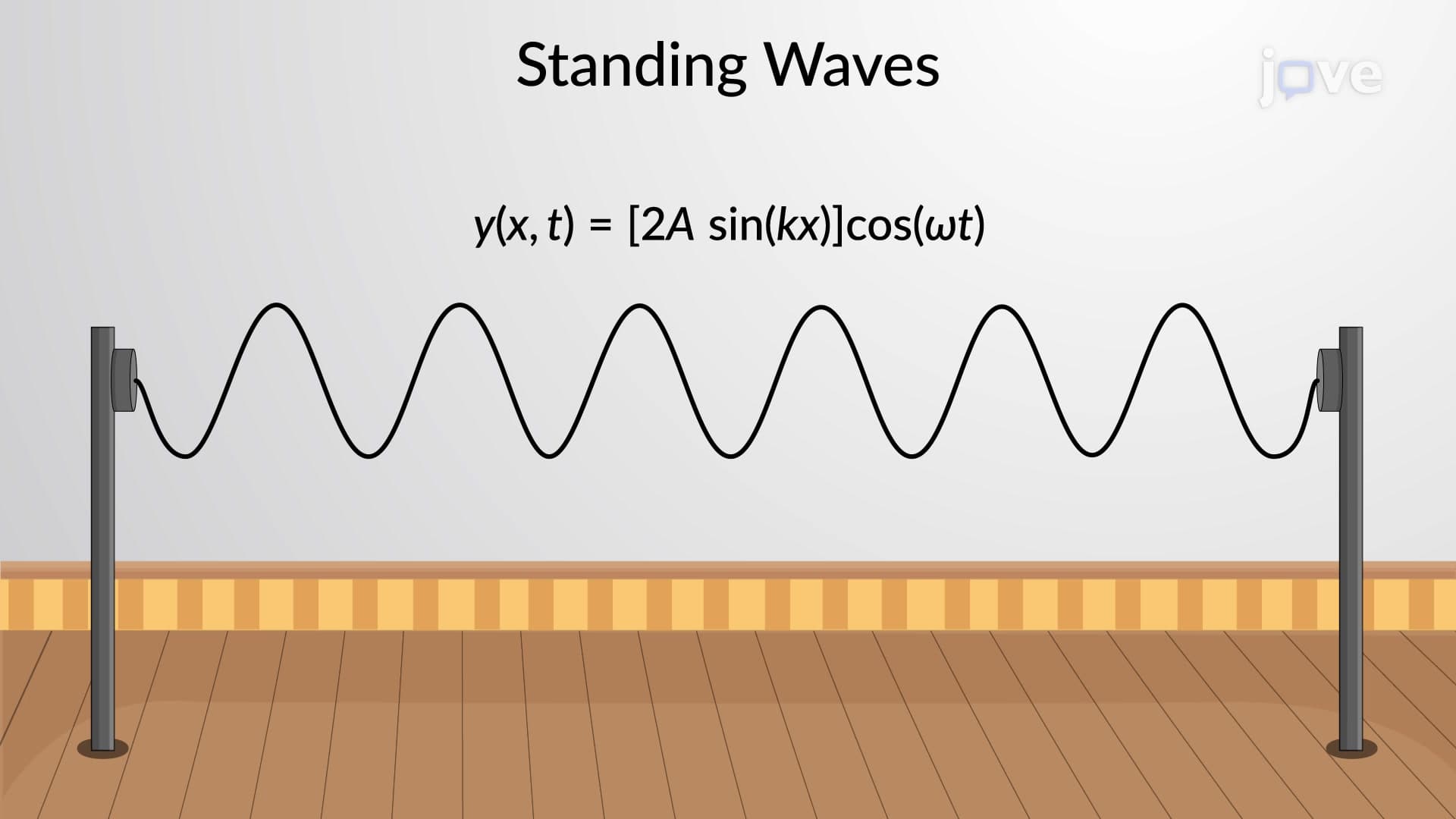
Modes of Standing Waves II describes the specific wave behavior that occurs when sound waves reflect within tubes that have one open end and one closed end. This configuration creates unique boundary conditions that fundamentally differ from tubes closed at both ends, producing a distinctive pattern of possible frequencies and wavelengths.
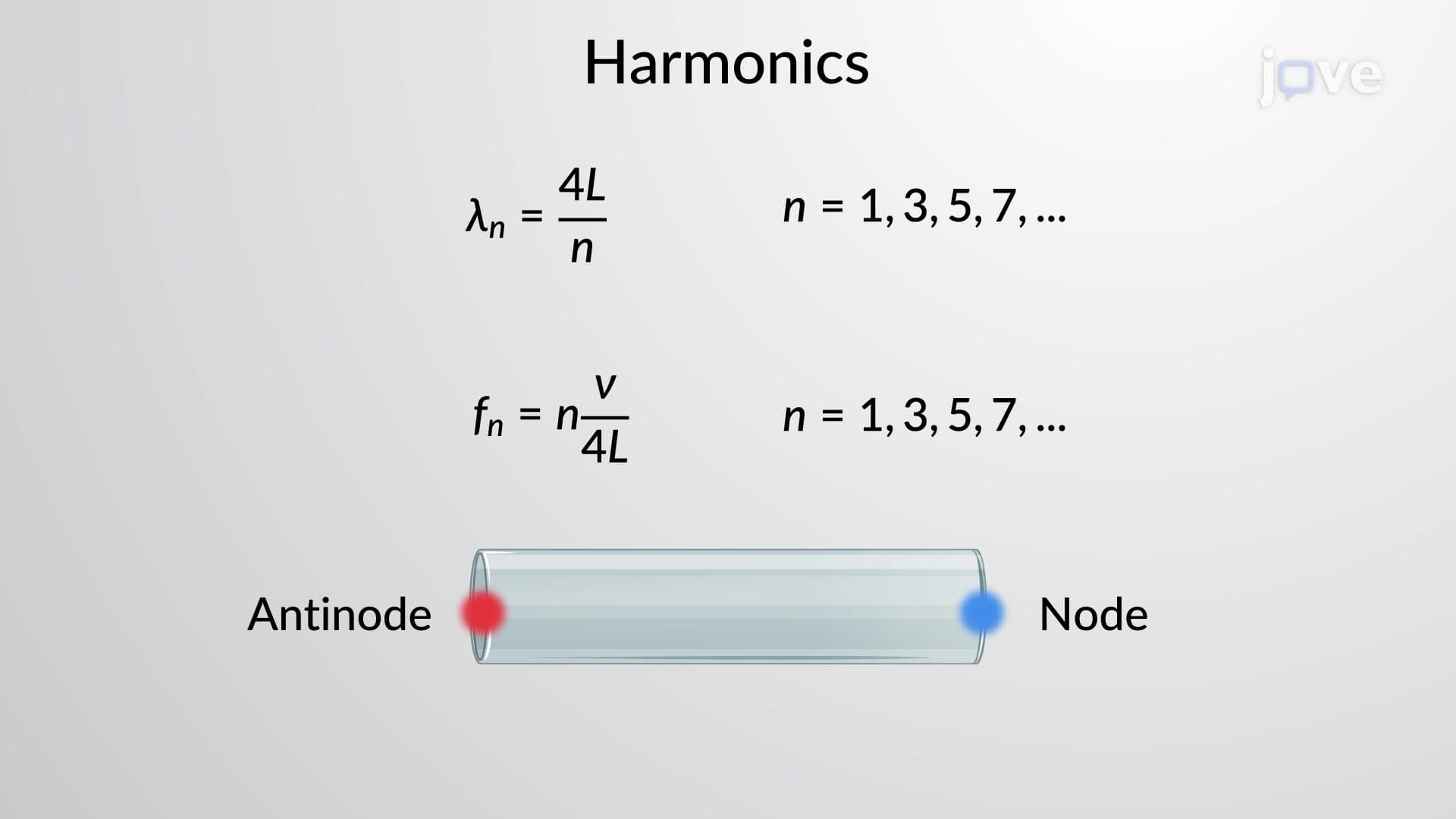
The key to understanding this concept lies in recognizing how air molecules behave at each end of the tube. At the open end, air molecules can vibrate freely, creating what physicists call an antinode—a point of maximum displacement. Conversely, at the closed end, air molecules cannot move, forming a node where displacement remains zero. This asymmetric boundary condition is what makes modes of standing waves II unique compared to other standing wave scenarios.
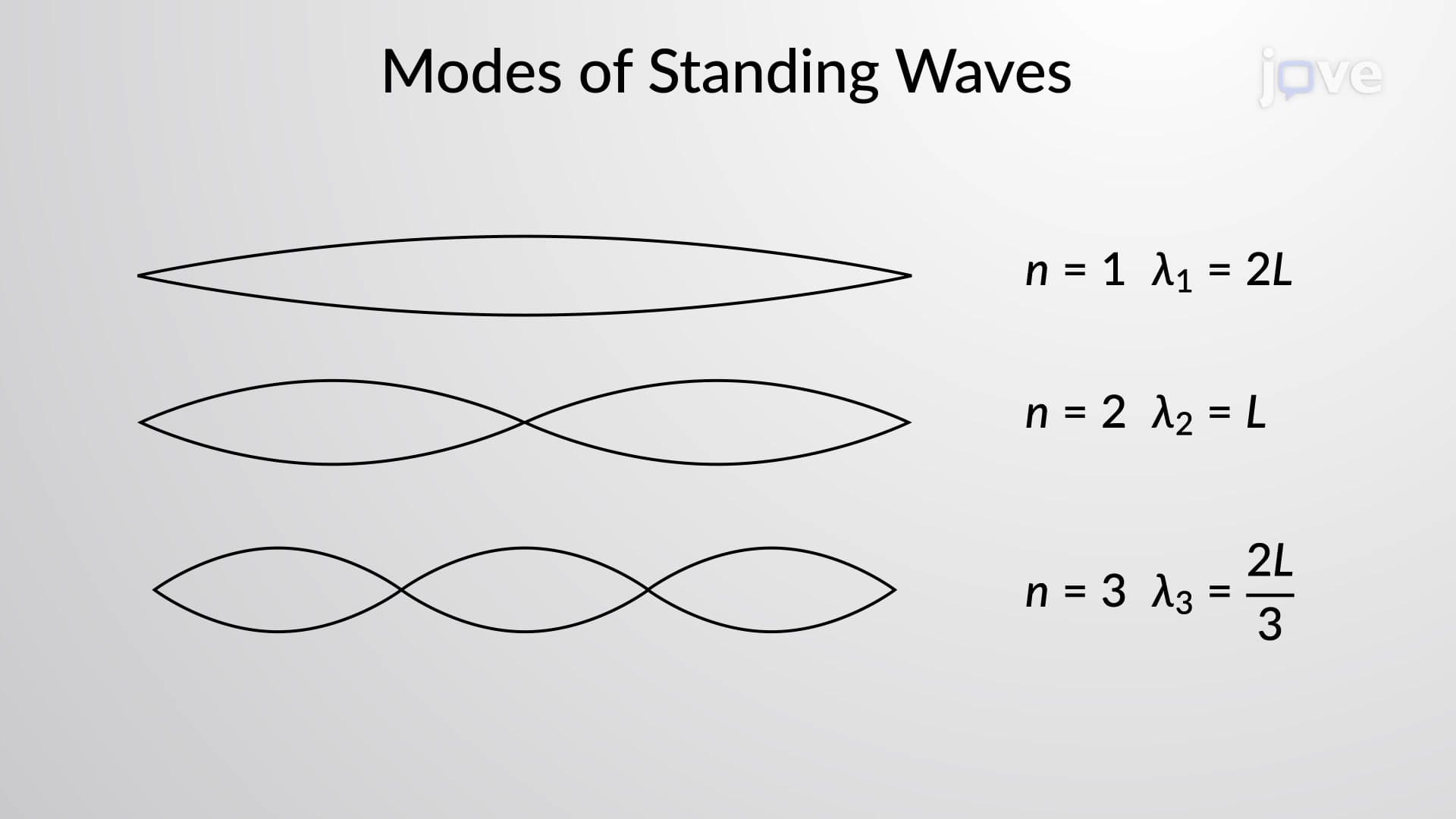
When a sound wave enters the tube and reflects off the closed end, it interferes with incoming waves to create standing wave patterns. However, unlike symmetric systems, only certain wavelengths can establish stable standing waves that satisfy both boundary conditions simultaneously.
The mathematics behind modes of standing waves II reveals a fascinating pattern. For the fundamental mode (first harmonic), the tube length equals exactly one-fourth of the wavelength: L = λ/4. This means a 34 cm clarinet tube produces a fundamental frequency around 250 Hz (assuming room temperature air speed of 343 m/s).
For overtones, the pattern continues with odd multiples: the first overtone occurs when L = 3λ/4, the second overtone when L = 5λ/4, and so forth. This creates the general formula λ = 4L/n, where n represents only odd integers (1, 3, 5, 7...). Consequently, these systems can only produce odd-numbered harmonics, which explains why clarinets have their characteristic timbre compared to instruments that produce both even and odd harmonics.
This concept appears frequently on AP Physics exams, particularly in wave mechanics and sound problems. Students taking the MCAT will encounter similar principles when studying auditory system physiology. In engineering acoustics courses, understanding modes of standing waves II is essential for designing concert halls, designing musical instruments, and even optimizing car exhaust systems for noise reduction.
Modern applications extend beyond traditional acoustics. Microwave ovens use similar principles to create standing wave patterns that heat food efficiently, while laser resonators employ comparable concepts to amplify light waves in optical systems.
Frequently Asked Questions
Modes of Standing Waves II describes standing wave patterns in tubes with one open and one closed end, creating antinodes at the open end and nodes at the closed end. Unlike tubes closed at both ends, this configuration only allows odd-numbered harmonics, producing a unique frequency series that follows the pattern f = nv/4L where n is odd.
Absolutely—this concept appears regularly on AP Physics 1 and 2 exams, especially in wave mechanics sections. You'll encounter problems asking you to calculate frequencies, wavelengths, and harmonic relationships in air columns. Mastering the λ = 4L/n formula and recognizing odd-harmonic patterns will directly boost your exam performance.
Focus on identifying the boundary conditions first, then apply the fundamental relationship L = λ/4 for the first harmonic. Remember that only odd harmonics exist, so multiply by odd integers (1, 3, 5...) when finding overtone frequencies. Practice converting between frequency, wavelength, and wave speed using v = fλ to tackle multi-step problems efficiently.
You experience this daily through wind instruments like clarinets, oboes, and organ pipes found in American orchestras and marching bands. Even car exhaust pipes use these principles for noise control, and your home's plumbing can create similar resonance effects when air gets trapped in partially closed pipe sections.
Not at all—high school algebra and basic trigonometry are sufficient for most applications. The core concepts rely on simple ratios and proportional relationships, making this accessible to students in Physics 1 or even conceptual physics courses. Focus on understanding the physical principles rather than complex mathematical derivations.
Connect the math to physical imagery—visualize the wave pattern with a node "pinned" at the closed end and an antinode "free" at the open end. Practice drawing these patterns while reciting "L equals lambda over 4 times n" where n is odd. Use mnemonics like "Odd harmonics Only" for closed-open tubes versus "All harmonics Allowed" for closed-closed tubes.
Explore Doppler effect applications in medical ultrasound, then investigate electromagnetic standing waves in transmission lines and laser cavities. These concepts build directly on your wave mechanics foundation and appear frequently in advanced physics courses and engineering applications.
Related Micro-courses
Related Subjects
 Math Fundamentals 11 micro-courses›
 Statistics 17 micro-courses›