Loading…
Loading video…

61,845 views
Ever wondered why seismologists at the US Geological Survey can predict earthquake wave speeds before they hit distant cities? Understanding velocity and acceleration wave properties reveals how wave motion governs everything from California's seismic monitoring systems to NASA's gravitational wave detectors. When studying What is Velocity And Acceleration Wave, physicists analyze how particles move within wave systems by examining mathematical relationships between position, time derivatives, and wave parameters. This fundamental concept connects particle motion to wave propagation through partial differential equations. Watch the full video on JoVE Coach to master this concept with expert-led visuals and step-by-step explanations.
The velocity and acceleration wave definition centers on how particles within a wave system move as the wave propagates through space and time. Unlike everyday objects that move in straight lines, particles in waves follow complex oscillatory patterns that require sophisticated mathematical tools to analyze properly.
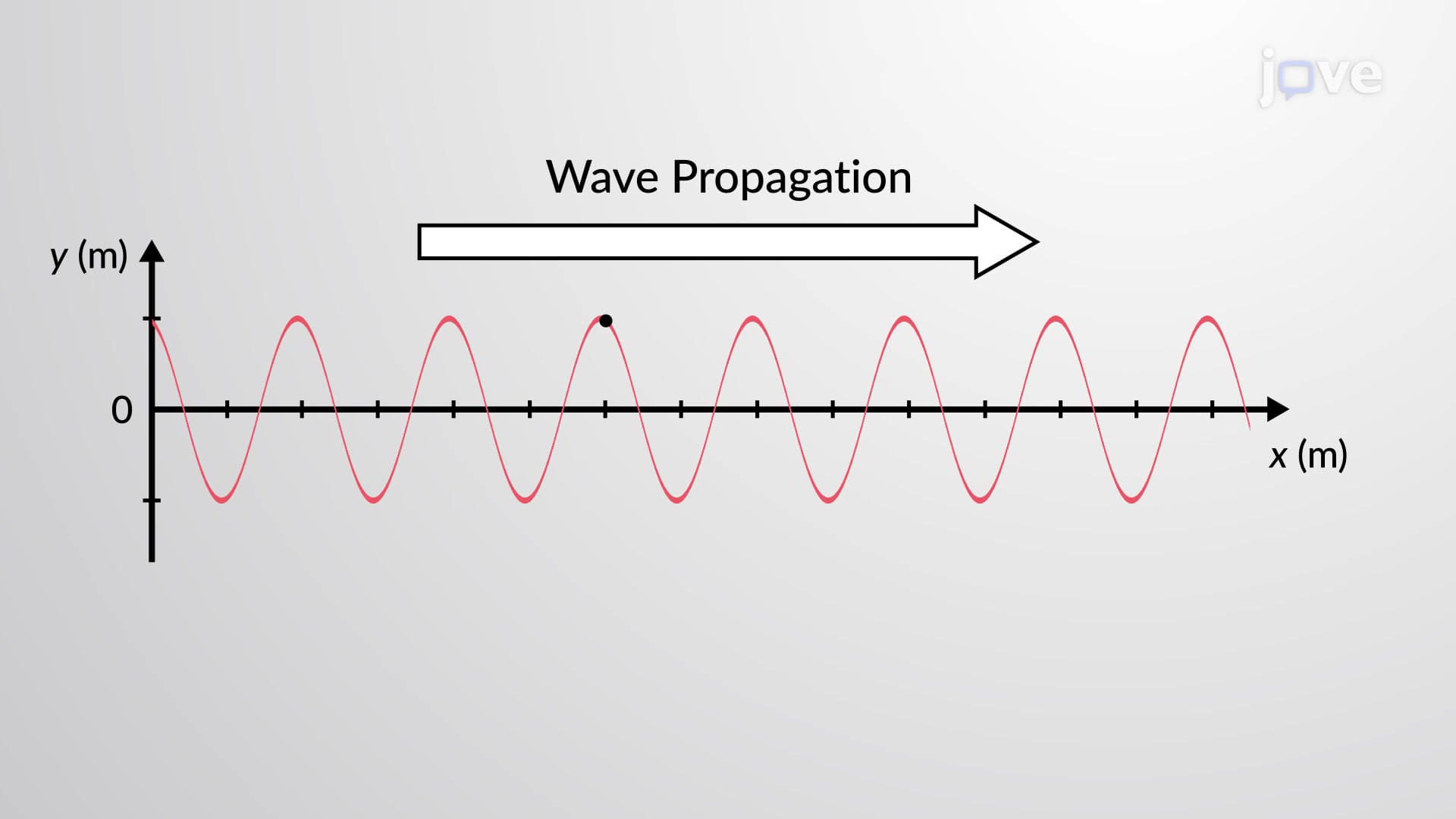
When studying what is velocity and acceleration wave in detail, we begin with sinusoidal wave functions that describe wave motion in the positive x-direction. These functions serve as the foundation for understanding how individual particles behave within the larger wave system. The mathematical approach involves taking partial derivatives—a calculus technique that examines how one variable changes while keeping others constant.
The velocity and acceleration wave concept emerges when we take the partial derivative of the wave function with respect to time. This mathematical operation reveals the instantaneous velocity of particles at any specific position along the wave. For students preparing for AP Physics or college-level mechanics courses, this represents a crucial bridge between basic kinematics and advanced wave theory.
Consider how this applies to practical scenarios: when engineers at Boeing analyze wing vibrations during flight testing, they use these same principles to understand how stress waves propagate through aircraft structures. The particle velocity calculations help predict potential failure points and ensure passenger safety.
Taking the partial derivative of velocity with respect to time yields particle acceleration—a fundamental component in the velocity and acceleration wave overview. This second-order derivative provides insights into how quickly particle velocities change as waves pass through different media.
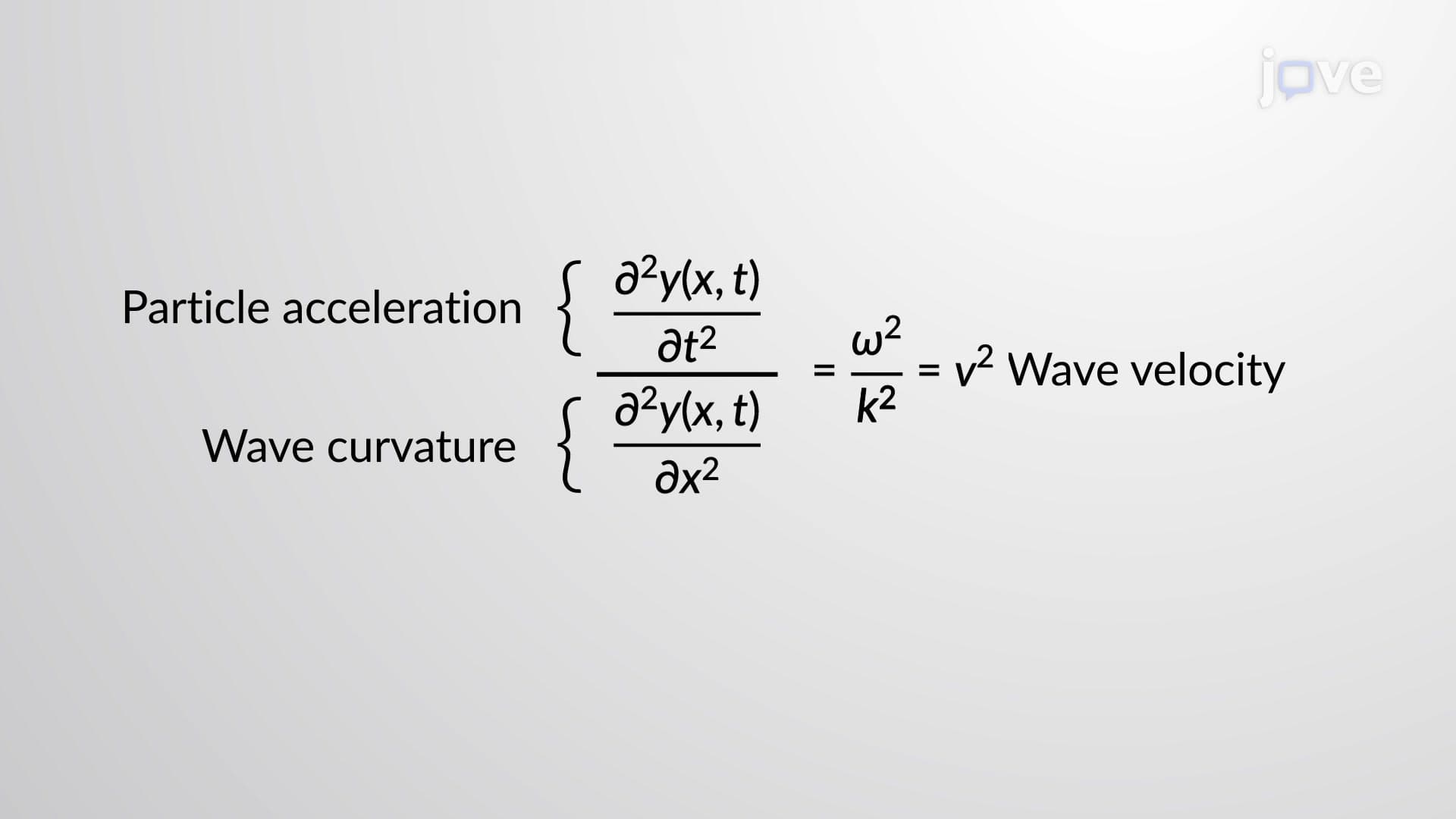
Simultaneously, examining spatial derivatives reveals wave geometry. The first partial derivative with respect to position gives the wave slope, while the second partial derivative indicates wave curvature. These geometric properties directly influence how waves bend, reflect, and transmit energy through various materials.
The velocity and acceleration basics culminate in deriving the linear wave equation—a cornerstone of physics that appears on MCAT exams and college physics assessments. By dividing particle acceleration by wave curvature and applying the fundamental relationship where angular frequency divided by wavenumber equals wave velocity, students can derive this essential equation.
This derivation process exemplifies how mathematical tools translate into physical understanding. Students at institutions like MIT and Stanford use these same techniques to analyze everything from quantum mechanical wave functions to electromagnetic radiation patterns in their advanced physics coursework.
Frequently Asked Questions
Velocity and acceleration wave describes how particles move within wave systems using mathematical derivatives. It involves analyzing particle motion by taking partial derivatives of wave functions with respect to time and position. This concept helps predict how waves propagate through different materials and influences everything from earthquake monitoring to aerospace engineering applications.
AP Physics C: Mechanics frequently tests wave motion through partial derivative problems and wave equation derivations. Students encounter questions requiring them to find particle velocities and accelerations from given wave functions. The College Board emphasizes connecting mathematical derivatives to physical wave properties, making this concept essential for achieving high scores on the mechanics portion.
The MCAT Physics section tests understanding of wave motion principles without requiring complex calculus calculations. Pre-med students should focus on conceptual relationships between particle motion and wave propagation rather than mathematical derivations. Understanding how wave properties affect biological systems, like ultrasound imaging or cochlear function, proves more valuable than memorizing derivative formulas.
The petroleum industry uses these principles extensively in seismic exploration across Texas and Alaska oil fields. Companies like ExxonMobil employ geophysicists who analyze how seismic waves propagate through rock layers to locate oil deposits. The wave velocity and acceleration data help determine optimal drilling locations and reduce exploration costs significantly.
Basic understanding of derivatives suffices for introductory wave concepts, though partial derivatives enhance comprehension significantly. High school students can grasp fundamental principles through graphical analysis and conceptual explanations. College-level physics courses gradually introduce mathematical complexity, making the topic accessible to students with strong algebra and trigonometry backgrounds.
Focus on connecting mathematical operations to physical meanings rather than memorizing formulas blindly. Practice identifying when to use time derivatives versus position derivatives in wave problems. Create concept maps linking particle motion, wave properties, and real-world applications to build comprehensive understanding for midterm and final examinations.
Electromagnetic theory, quantum mechanics, and fluid dynamics all extend these fundamental wave principles into specialized applications. Students planning engineering or physics majors should explore how wave equations apply to antenna design, particle physics, and atmospheric modeling. These connections become crucial for graduate school preparation and research opportunities.
Physics lab experiments involving oscilloscopes, wave generators, and vibration analysis directly apply these concepts to measurable phenomena. Students learn to connect theoretical derivatives with experimental data collection, preparing them for research opportunities and industry internships. This hands-on experience reinforces mathematical concepts through practical application.
Seismologists, acoustic engineers, telecommunications specialists, and medical imaging technicians all rely heavily on wave motion analysis. Companies like Lockheed Martin, General Electric, and major hospital systems seek employees who understand how wave properties affect their respective technologies and can solve complex propagation problems.
Related Micro-courses
Related Subjects
 Math Fundamentals 11 micro-courses›
 Statistics 17 micro-courses›