Loading…
Loading video…

13,330 views
Ever wonder how researchers determine if a sequence of coin flips is truly random or rigged? The Wald Wolfowitz Runs Test I reveals whether sequential data patterns occur by chance or follow hidden trends. From analyzing voting patterns in US elections to detecting bias in medical trial results, this statistical test examines "runs" - consecutive sequences of similar values - to measure randomness. When runs are too few or too many, the data likely isn't random. Watch the full video on JoVE Coach to master this concept with expert-led visuals and step-by-step explanations.
The Wald Wolfowitz Runs Test I serves as a fundamental non-parametric statistical method for detecting patterns in sequential data. Unlike parametric tests that assume specific distributions, this runs test evaluates randomness based solely on the order and grouping of observations. The test's core principle centers on counting "runs" - uninterrupted sequences of identical or similar values within ordered datasets.
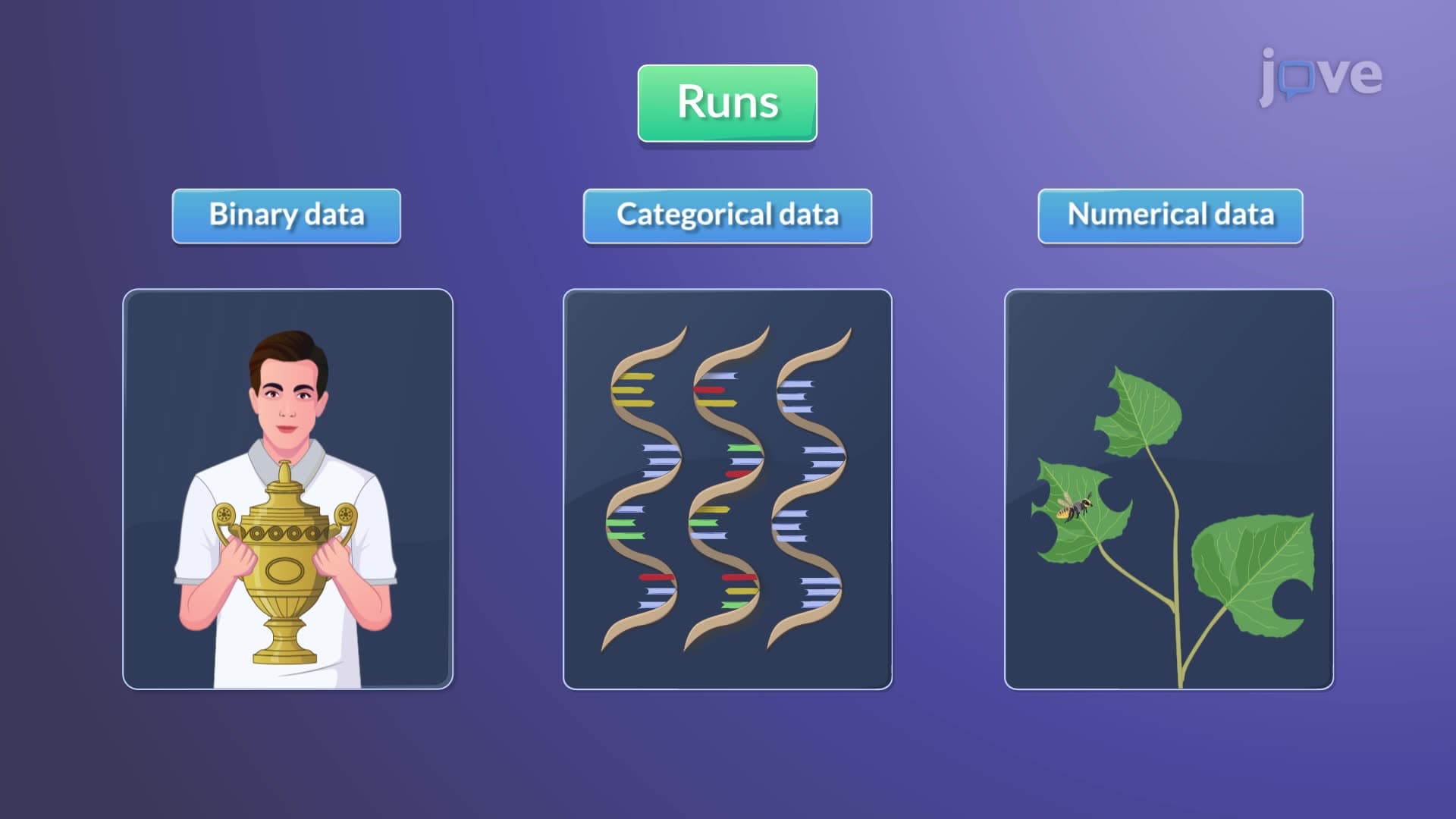
Binary data presents the most straightforward application for runs analysis. Consider a series of basketball free-throw attempts: Success-Success-Failure-Failure-Success creates three distinct runs. US college basketball coaches use similar analysis to identify shooting streaks versus random performance fluctuations. When runs are extremely low (indicating long streaks) or extremely high (showing excessive alternation), the sequence likely deviates from randomness.
Categorical data applications extend to DNA sequence analysis, where geneticists at institutions like the National Institutes of Health examine nucleotide patterns (A, T, G, C) for randomness indicators. Manufacturing quality control also employs categorical runs tests when evaluating product defect patterns across production shifts.
Numerical datasets require preprocessing before runs analysis. Researchers convert continuous measurements into binary sequences by comparing each value to the dataset's median or mean. Values above the threshold receive positive signs (+), while those below get negative signs (-). This transformation enables runs counting on originally numerical data.
Consider analyzing daily stock price movements for the S&P 500. Financial analysts at firms like Goldman Sachs might examine whether price increases and decreases follow random patterns or exhibit systematic trends. Extended runs of consecutive gains or losses could indicate market manipulation or underlying economic factors rather than random market behavior.
The runs test employs specific statistical thresholds to determine randomness. Too few runs suggest clustering or trend persistence, while excessive runs indicate artificial alternation. These principles apply directly to AP Statistics coursework and appear frequently on college statistics exams. Students preparing for the MCAT encounter similar concepts when analyzing biological sequence data or clinical trial randomization effectiveness.
Real-world applications span from pharmaceutical companies ensuring proper randomization in drug trials to election officials detecting potential voting irregularities. The test's simplicity and broad applicability make it invaluable for initial data exploration before applying more complex statistical methods.
Frequently Asked Questions
The Wald Wolfowitz Runs Test I determines whether sequential data appears randomly ordered by counting consecutive similar values called "runs." Use it when examining any ordered dataset - from sports performance streaks to quality control patterns - where you need to verify randomness rather than hidden systematic trends.
AP Statistics and college exams typically present runs test problems involving binary sequences like coin flips or survey responses. You'll calculate total runs, compare to expected values, and interpret whether patterns suggest randomness or systematic bias using provided statistical tables.
MCAT biological sciences sections feature runs test applications in genetics (DNA sequence analysis), experimental design (randomization verification), and data interpretation passages. Understanding runs helps evaluate whether biological sequences or treatment assignments follow expected random patterns.
The FDA uses runs tests when evaluating pharmaceutical manufacturing data to ensure drug potency measurements don't show systematic trends over time. If consecutive batches consistently test high-low-high-low, this alternating pattern suggests equipment calibration issues rather than random variation.
Not at all - the runs test requires only basic counting skills and simple arithmetic. If you can identify patterns and count consecutive identical values, you can master this concept. The mathematical complexity stays minimal while providing powerful insights into data randomness.
Focus on the "clustering versus alternating" principle: too few runs mean values cluster together (suggesting trends), while too many runs indicate excessive back-and-forth switching (suggesting artificial patterns). Practice with simple binary examples before tackling numerical data conversions.
Runs tests introduce fundamental non-parametric testing concepts without complex mathematical prerequisites. This foundation prepares you for advanced randomness tests, time series analysis, and experimental design validation techniques commonly used in research methodology courses.
Progress to other non-parametric tests like the Mann-Whitney U test and Kruskal-Wallis test, then explore time series analysis and autocorrelation concepts. These advanced topics build upon the pattern recognition skills developed through runs test applications.
Related Micro-courses
Related Subjects
 Physics 33 micro-courses›
 Math Fundamentals 11 micro-courses›