Loading subject page…

781 views

Video Summary: The Debye Hckel Theory of Electrolyte Solutions Explained
Why do saltwater solutions behave so differently from pure water, even when only tiny amounts of salt are dissolved? The Debye-Hückel Theory of Electrolyte Solutions basics reveal exactly why: ions in solution don't act independently. They form charged "ionic atmospheres" that reduce each ion's effective reactivity. In US chemistry labs, this explains why sodium chloride solutions deviate from ideal behavior. Watch the full video on JoVE Coach to master this concept with expert-led visuals and step-by-step explanations.
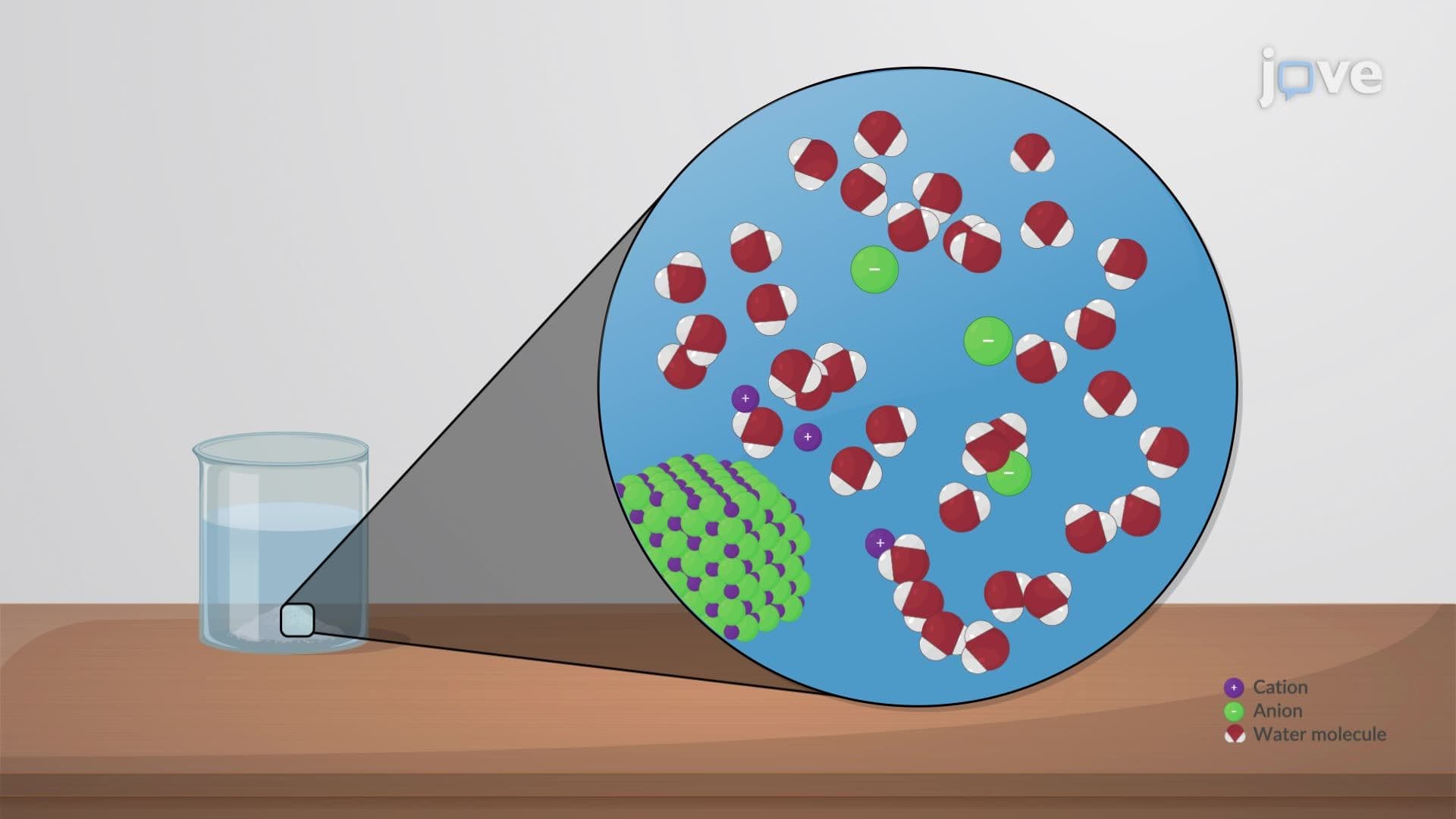
Dissolve table salt in water and the sodium and chloride ions don't simply float around independently. They interact, constantly, electrostatically, and in ways that significantly affect the solution's thermodynamic behavior. The Debye-Hückel Theory of Electrolyte Solutions, developed by Peter Debye and Erich Hückel in 1923, provides the foundational mathematical framework for understanding these interactions and quantifying how far real electrolyte solutions stray from ideal behavior.
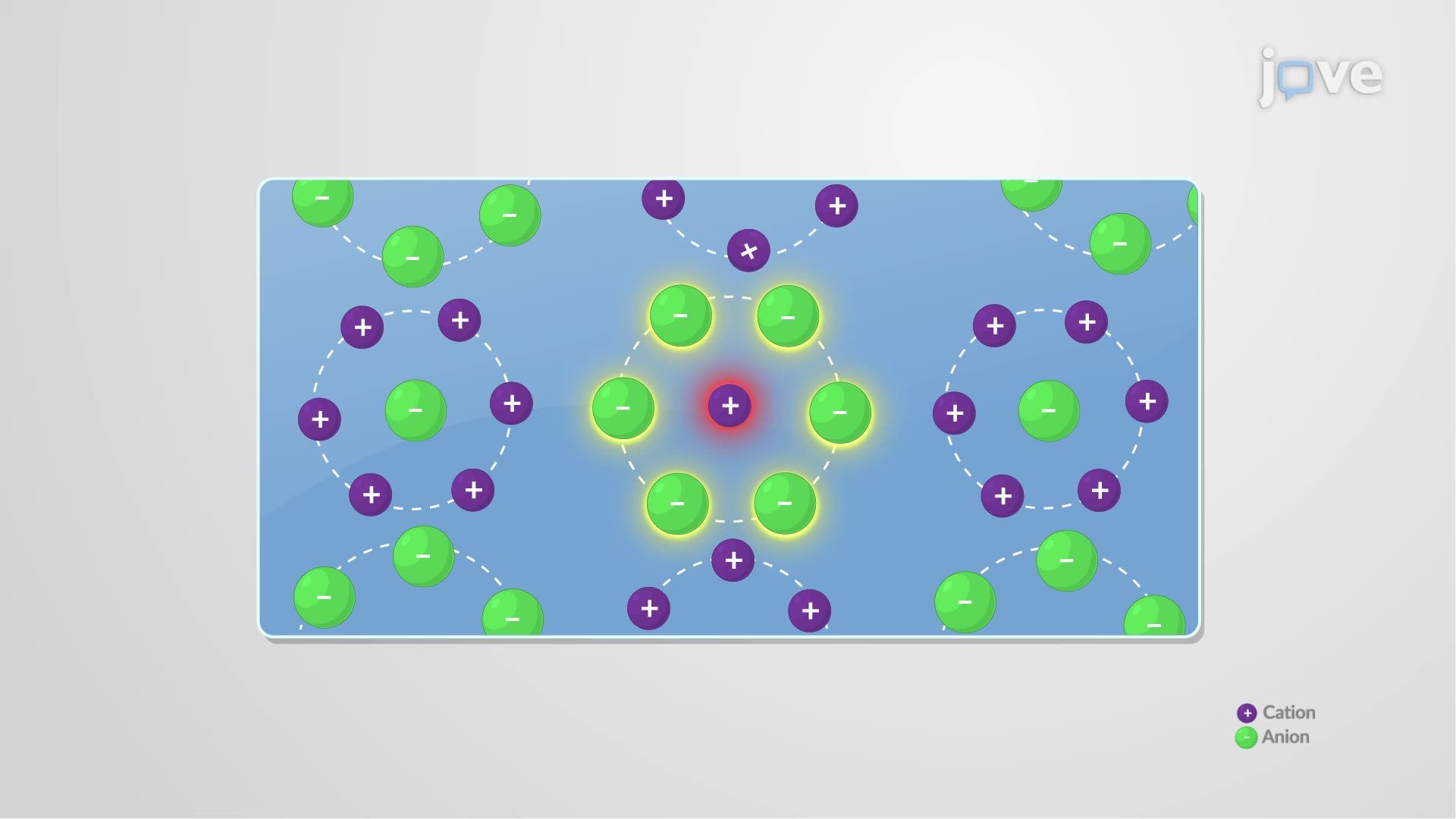
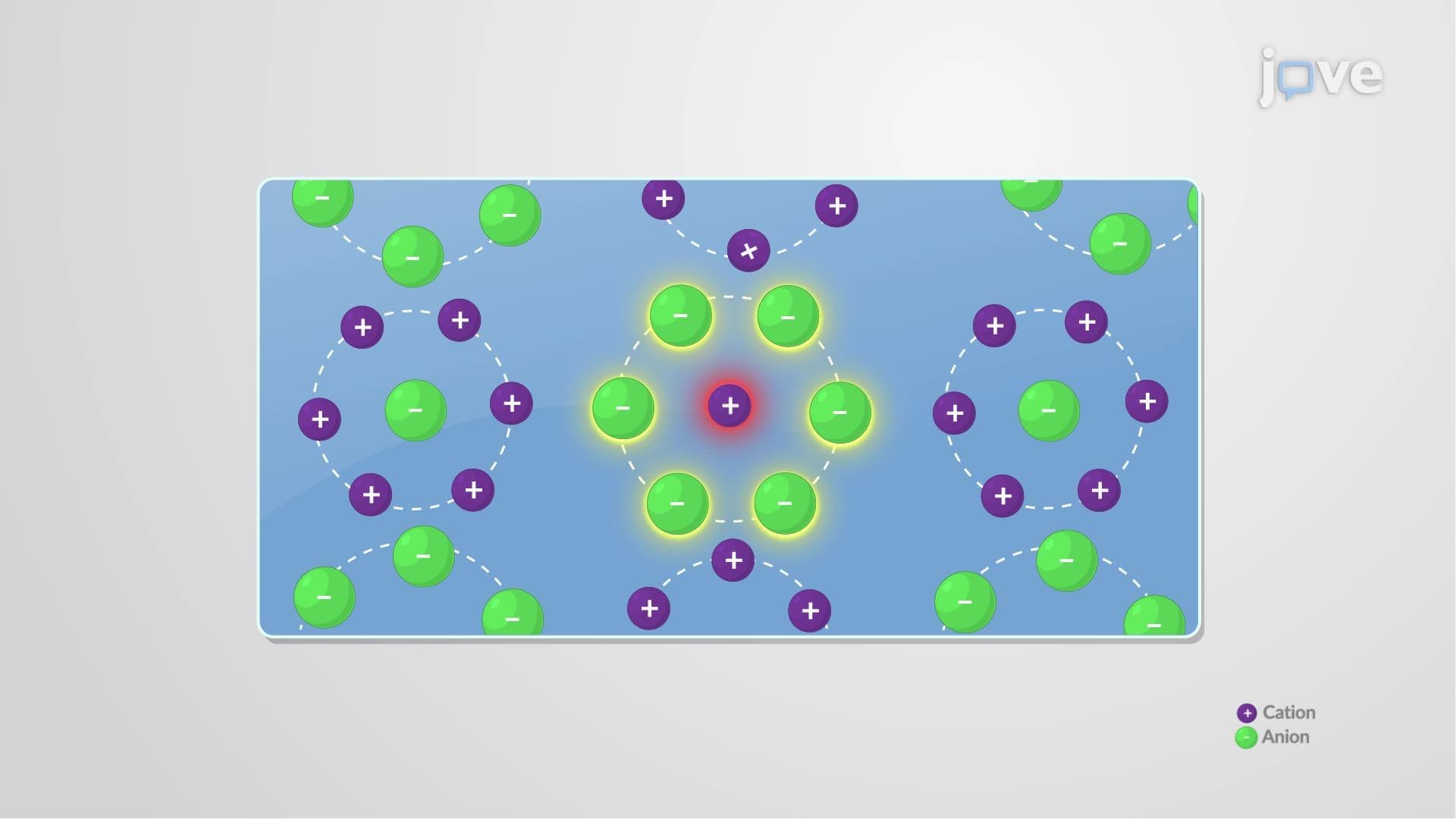
At the heart of the Debye-Hückel model is the concept of the ionic atmosphere. Because opposite charges attract (Coulomb's law), each positive ion in solution is statistically surrounded by a slight excess of negative ions, and vice versa. This diffuse cloud of counter-charge acts like an electrostatic shield around each ion, lowering its chemical potential, meaning the ion is less "available" to drive reactions than its raw concentration would suggest.
This matters enormously in practice. In US clinical and industrial settings, electrochemical measurements, such as those used in blood electrolyte panels at hospitals or in quality control testing of saline IV solutions, depend on knowing the *effective* concentration of ions, not just the total dissolved amount. That effective concentration is called activity, and it equals the measured concentration multiplied by the activity coefficient (γ).
For dilute solutions where ionic strength (I) is below approximately 0.01 mol/kg, the Debye-Hückel limiting law provides a reliable estimate of the mean activity coefficient:
log(γ±) = −A |z+ z−| √I
Here, A is a temperature-dependent constant (approximately 0.509 in water at 25°C), z+ and z− are the ion charge numbers, and I is the ionic strength defined as:
I = (1/2) Σ (mi × zi²)
This equation predicts that a plot of log(γ±) versus √I will be linear, and experimental data from salts like NaCl, MgCl₂, and MgSO₄ confirm exactly this. At very low concentrations, all electrolytes approach ideal behavior (γ± → 1), consistent with what Raoult's law predicts for ideal mixtures. As concentration rises, Coulombic interactions grow stronger and the solution becomes increasingly nonideal.
Not all electrolytes deviate equally. Ions with higher charges, such as Mg²⁺ or SO₄²⁻, experience far stronger Coulombic interactions than monovalent ions like Na⁺ or Cl⁻. The term |z+ z−| in the limiting law captures this directly: a 2:2 electrolyte like MgSO₄ produces four times the interaction strength of a 1:1 electrolyte like NaCl at the same concentration. This explains why higher-valence salts show much steeper drops in activity coefficients, representing negative deviations in effective ion behavior.
This principle connects directly to broader thermodynamic concepts. When activity coefficients deviate from 1, the solution exhibits excess thermodynamic properties, the real Gibbs energy, enthalpy, or entropy differs from what an ideal model would predict. These deviations parallel what chemists observe in vapor-pressure measurements as deviations from Raoult's law in mixed liquid systems.
The Debye-Hückel theory appears in AP Chemistry discussions of solution behavior and colligative properties, in college physical chemistry courses (commonly taught using Atkins' *Physical Chemistry*), and on the MCAT in the context of electrochemistry and solution thermodynamics. Understanding activity versus concentration is especially critical for any student working through equilibrium problems involving ionic species in real (non-dilute) solutions. Grasping this theory early builds a strong conceptual bridge between ideal solution models and the messier, more accurate reality of electrolyte chemistry.
Related Micro-courses