Loading video…

 2 Concepts
 781 views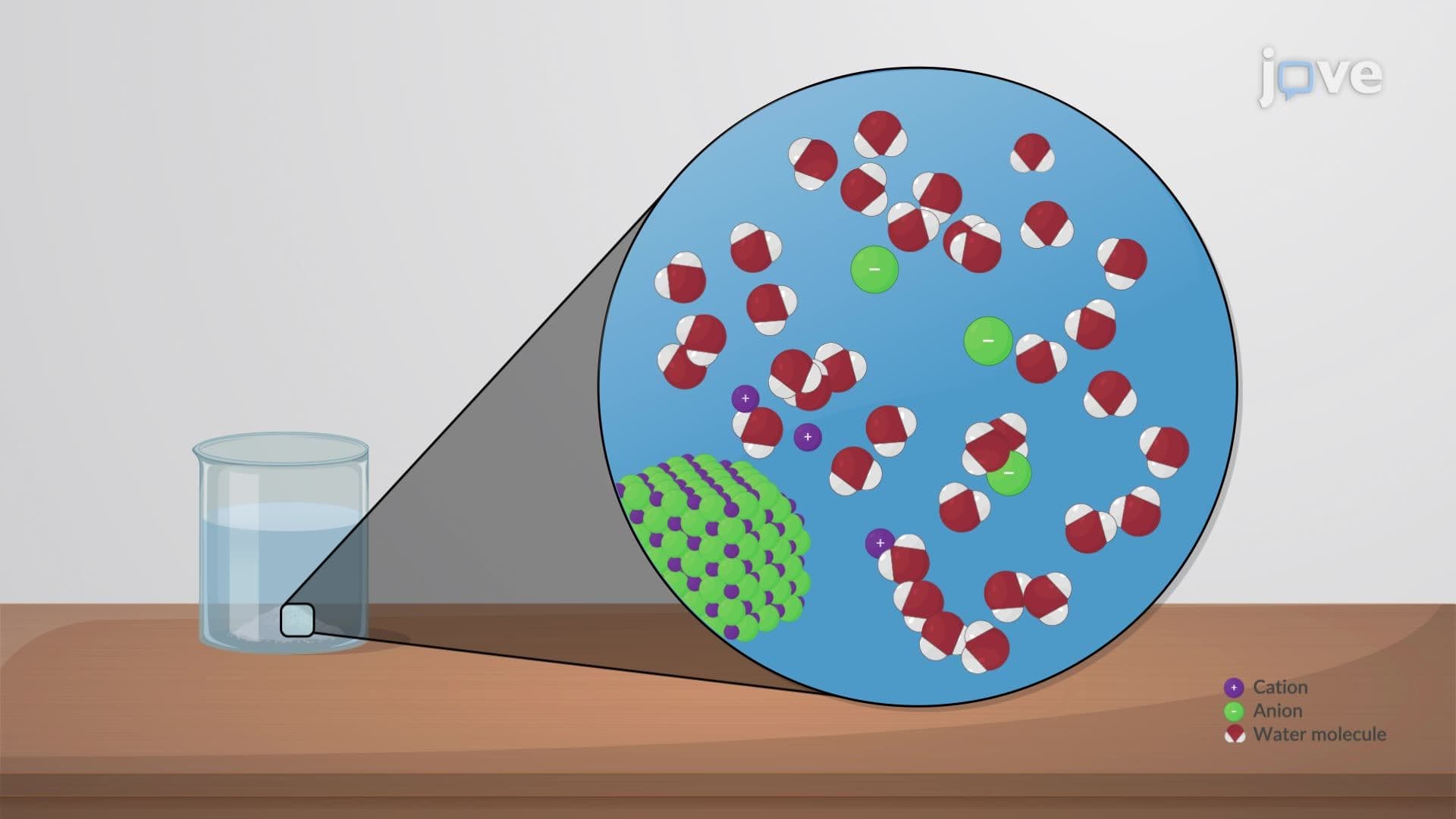

Video Summary: What Is Ionic Association
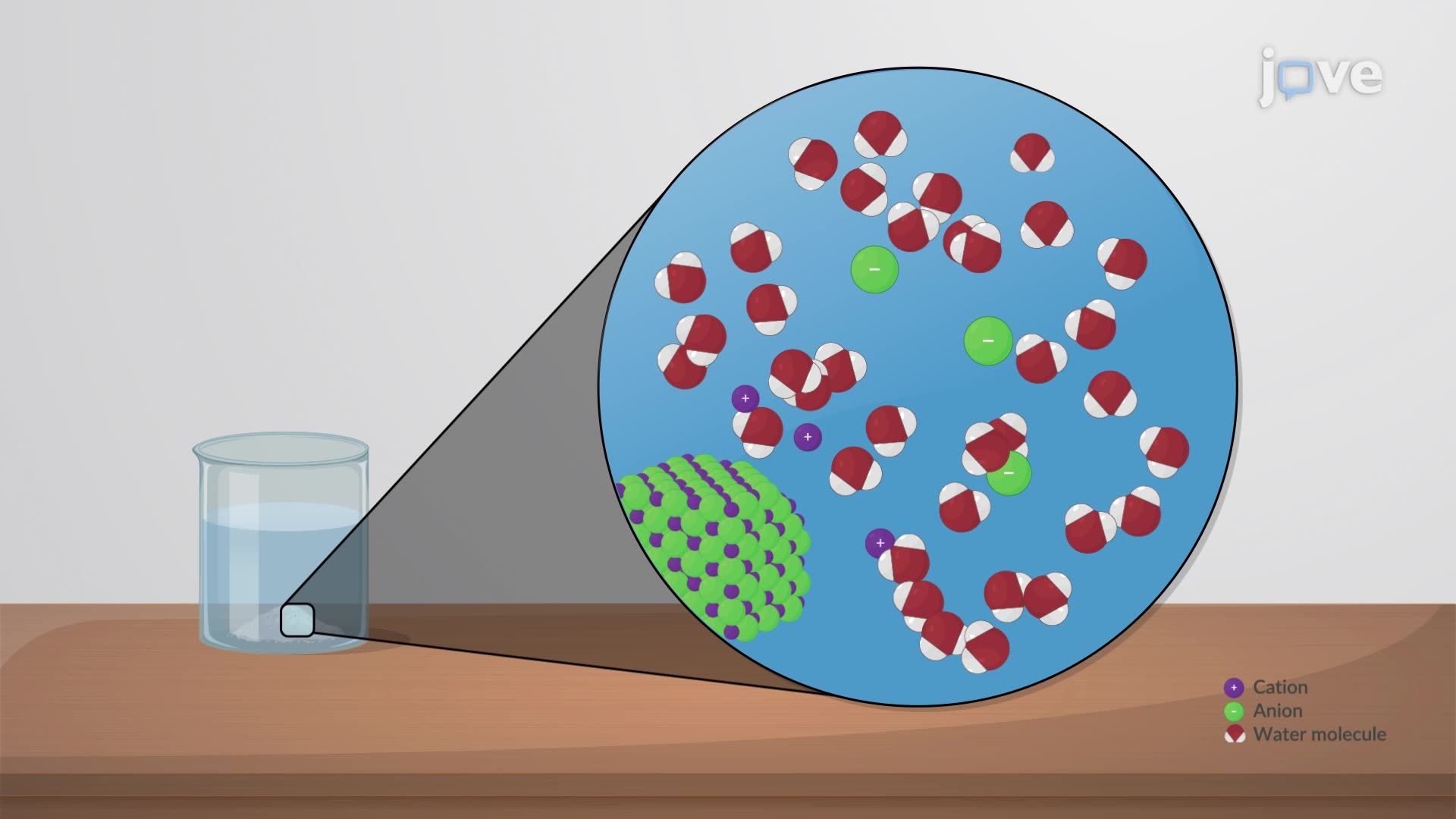
Did you know that dissolved ions in water don't always roam freely? Ionic association describes how oppositely charged ions can pair up in solution, challenging a common chemistry assumption. In seawater and industrial electrolyte solutions across the US, this pairing affects conductivity and reactivity. What is Ionic Association? It's the foundation for understanding real electrolyte behavior. Watch the full video on JoVE Coach to master this concept with expert-led visuals and step-by-step explanations.
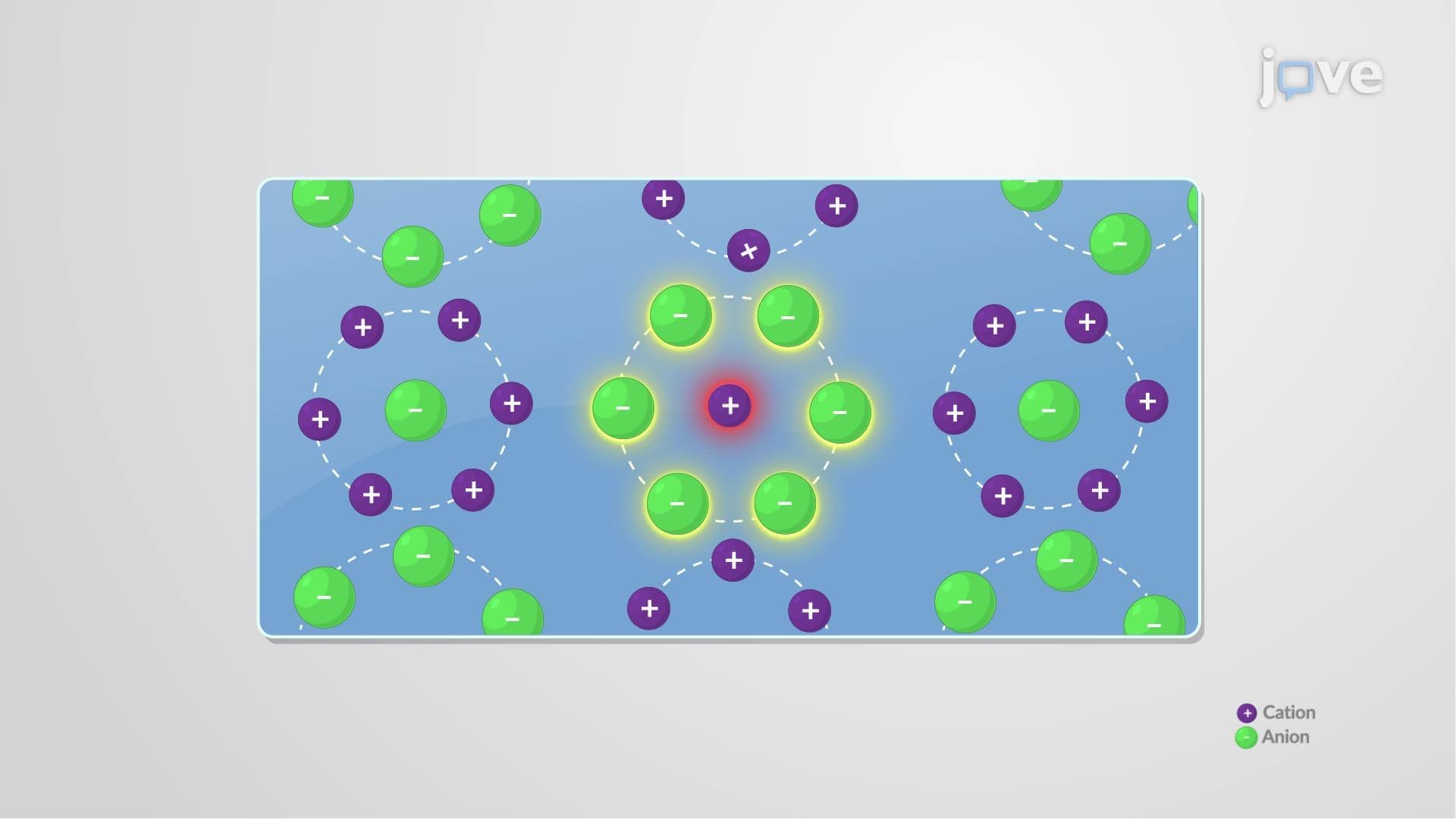
Introductory chemistry courses teach that strong electrolytes, like sodium chloride or potassium hydroxide, dissociate completely in water, producing freely moving ions. This model works well for dilute 1:1 electrolytes, but it breaks down in more concentrated solutions or with higher-charge ions. Ionic association is the phenomenon where oppositely charged ions in solution come close enough together that their mutual electrostatic attraction overcomes the randomizing effect of thermal energy. The result is the temporary formation of ion pairs, neutral or lower-charge clusters that behave differently from free ions.
The theoretical foundation for ionic association comes from Niels Bjerrum, who proposed a quantitative criterion: two ions form an ion pair when their electrostatic attraction energy exceeds twice the thermal energy, expressed as 2kT, where k is Boltzmann's constant and T is the absolute temperature in Kelvin. This threshold defines a critical distance, the Bjerrum distance, within which association is thermodynamically favorable. Below this threshold, thermal motion is strong enough to keep ions apart. Bjerrum's model gives chemists a predictive tool rather than a purely empirical one, and its predictions have been confirmed experimentally by plotting the percentage of cations in ion pairs against solution molality.
Not all electrolytes associate equally. In 1:1 electrolytes like NaCl or NaOH, ion pairing is minimal under typical aqueous conditions. But in 2:1 electrolytes (such as CaCl₂, common in US water softening systems) or 2:2 electrolytes (like MgSO₄, found in Epsom salts sold across US pharmacies), the stronger electrostatic forces between doubly charged ions dramatically increase the fraction of ion pairs, even at relatively low concentrations. This has direct consequences for measured activity coefficients, which deviate significantly from values predicted by the Debye-Hückel limiting law when ion pairing is ignored.
The solvent plays a critical and often underappreciated role. Water has one of the highest dielectric constants of any common solvent (approximately 78 at 25°C), which physically weakens the electrostatic force between ions by a factor proportional to that constant. This is why ion pairing is limited in most aqueous 1:1 systems. In contrast, solvents with low dielectric constants, such as acetone or ethanol, used in many US pharmaceutical and industrial processes, allow electrostatic forces to act over much greater distances, making ion-pair formation significant even for simple 1:1 salts. This distinction is essential for understanding why solution behavior in non-aqueous systems deviates more dramatically from Raoult's law and why excess thermodynamic properties are larger in those media.
In AP Chemistry and college-level physical chemistry courses at US universities, ionic association bridges the gap between ideal solution theory and real experimental measurements. It explains why conductivity drops at higher concentrations, why osmotic pressure measurements deviate from van't Hoff predictions, and why activity coefficients require correction beyond simple Debye-Hückel estimates. Students preparing for the MCAT will encounter solution nonideality in the context of biological fluids, where ion pairing in intracellular environments, rich in Mg²⁺ and phosphate, influences enzyme activity and membrane potential.
Related Micro-courses