Loading subject page…


8 Concepts
14 Concepts
6 Concepts
6 Concepts
9 Concepts
8 Concepts
2 Concepts
8 Concepts
8 Concepts
9 Concepts
16 Concepts
6 Concepts
 2 Concepts
 781 Views
 Popular topics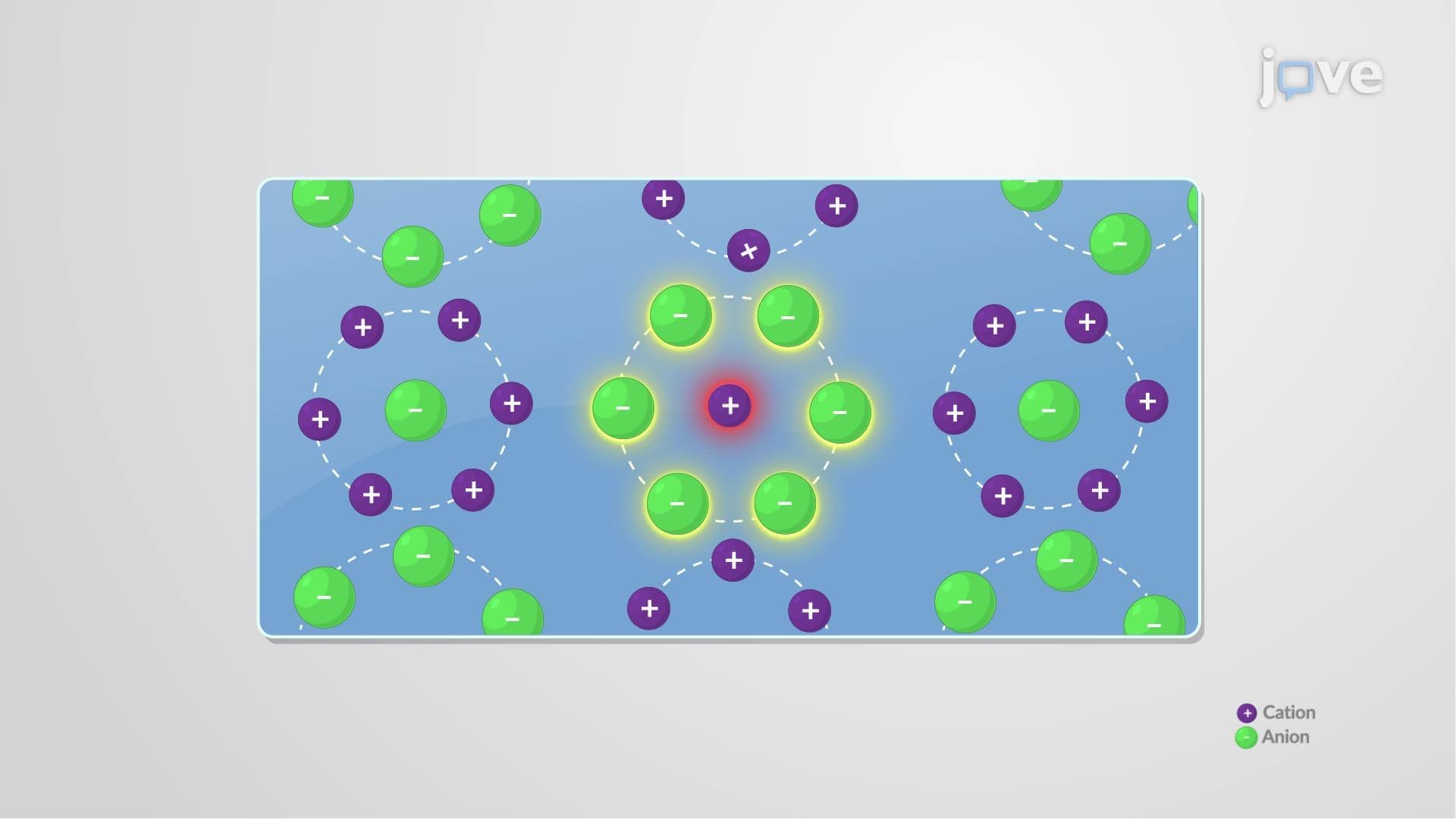
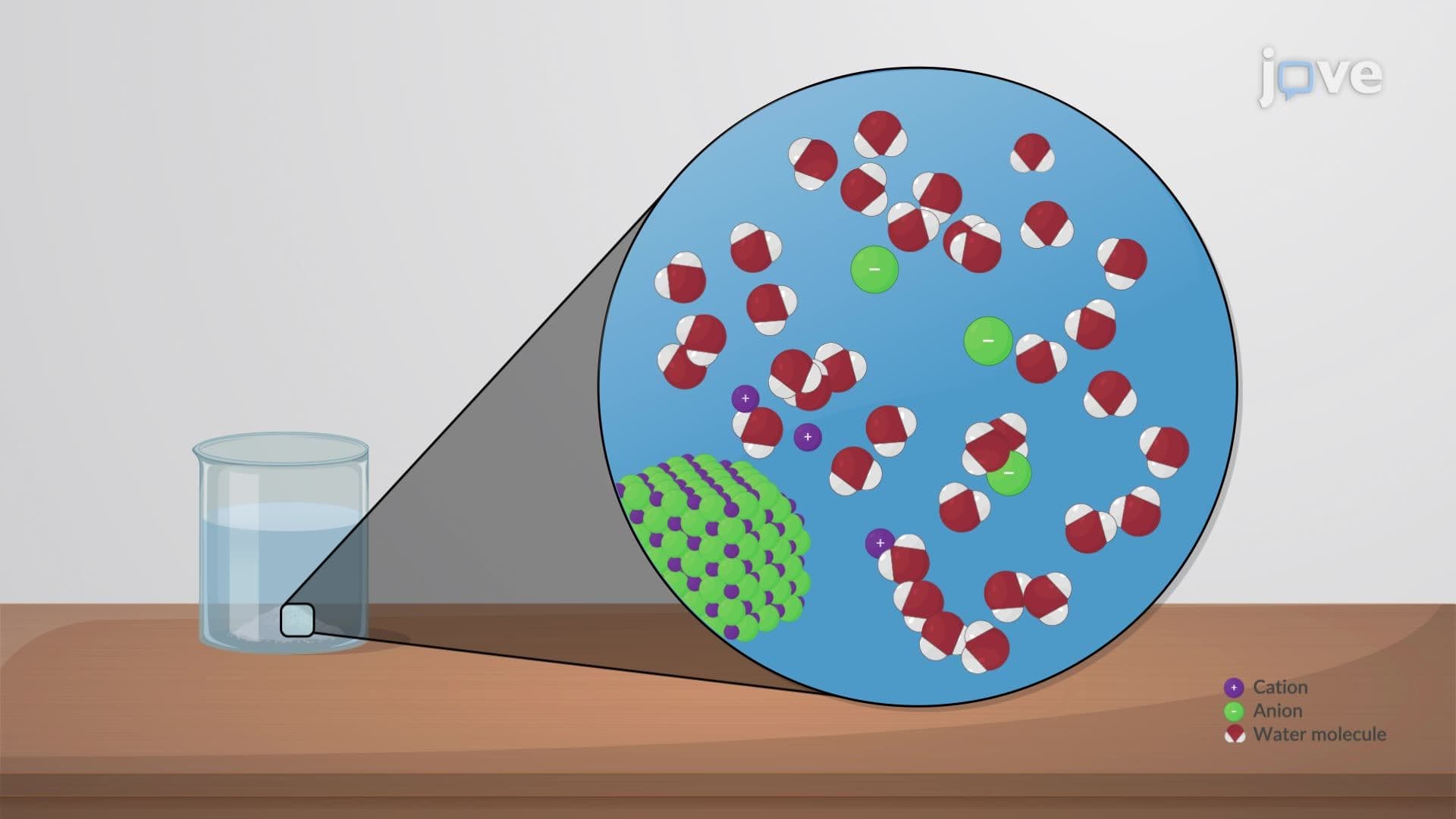
Nonideal Solutions Fundamentals explores why real electrolyte solutions deviate from ideal behavior, a critical concept in US chemistry and physical chemistry courses. Using JoVE Coach as a guide, students examine the Debye-Hückel theory, ionic atmospheres, activity coefficients, and ion-pair formation to understand the true properties of nonideal solutions across varied solvent systems and electrolyte types.
1. The Ionic Atmosphere and Debye-Hückel Theory In any electrolyte solution, ions do not exist in isolation. Positive ions attract a surrounding cloud of negative ions, and negative ions attract positive ones, forming what is called an ionic atmosphere. The Debye-Hückel theory mathematically describes this arrangement using Coulombic (electrostatic) principles. This ionic atmosphere effectively shields each central ion, lowering its chemical potential and reducing how "available" it is to participate in reactions. Understanding this concept is foundational to explaining why a 0.1 M NaCl solution does not behave the same as a 0.1 M ideal solution in thermodynamic calculations.
2. Activity Coefficients and the Debye-Hückel Limiting Law Because real ion concentrations overestimate chemical reactivity, chemists use activity coefficients to correct measured concentrations into effective concentrations called activities. The Debye-Hückel limiting law predicts that in very dilute solutions, ionic strength below approximately 0.01 mol/kg, the logarithm of the mean activity coefficient varies linearly with the square root of ionic strength. Experimental data from salts such as NaCl, MgCl₂, and MgSO₄ confirm this linear relationship. This law is a cornerstone tool used in analytical chemistry labs across the US for calculating ion activities in environmental water samples, clinical fluids, and industrial processes.
3. Effect of Ionic Charge on Nonideality Not all electrolytes deviate equally from ideal behavior. The magnitude of Coulombic attraction between ions depends on their charges. Ions with higher valence, such as Mg²⁺ paired with SO₄²⁻ in a 2:2 electrolyte, experience much stronger electrostatic forces than singly charged ions like Na⁺ and Cl⁻. As a result, 2:1 and 2:2 electrolytes show far greater deviations from ideal solution behavior even at low concentrations. This principle is directly testable on the MCAT and AP Chemistry exam and helps explain why seawater chemistry and biological fluid modeling require careful activity corrections rather than simple concentration-based calculations.
4. Ion-Pair Formation and Bjerrum's Theory Contrary to the common assumption that strong electrolytes exist exclusively as free ions, oppositely charged ions can associate into ion pairs when their electrostatic attraction surpasses thermal energy, defined by Bjerrum as exceeding 2kT, where k is Boltzmann's constant and T is absolute temperature. This phenomenon is especially significant for higher-charge electrolytes (2:1, 2:2 types). When the percentage of ions existing as pairs is plotted against molality, the results align closely with Bjerrum's theoretical predictions, providing strong experimental validation. Ion pairing has real consequences in industrial electrochemistry, battery electrolyte design, and pharmaceutical salt formulation in the US.
5. Role of Solvent Dielectric Constant in Ion Association The dielectric constant of the solvent plays a decisive role in determining whether ion pairs form. Water's exceptionally high dielectric constant (~78 at 25°C) weakens electrostatic interactions between ions, which is why most 1:1 electrolytes like NaCl and NaOH remain fully dissociated in aqueous solution. However, in solvents with lower dielectric constants, such as ethanol or acetone, which are common in US pharmaceutical and industrial chemistry settings, ion-ion attraction is much stronger, making ion-pair formation significant even for 1:1 electrolytes. This principle directly influences solubility, conductivity, and reaction equilibria in nonaqueous systems.