Loading video…


 19 Concepts
 348.6K views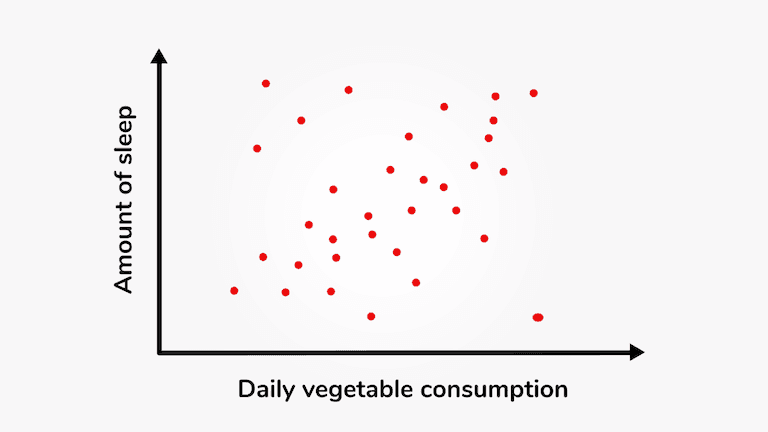

Video Summary: What Is Correlations
Did you know that researchers at Stanford University found a correlation between social media usage and sleep quality among college students? Correlations help scientists identify relationships between variables without directly manipulating them-like examining whether students who eat more vegetables sleep better or if SAT prep hours relate to test scores. This statistical concept reveals how two variables move together, measured by correlation coefficients ranging from -1 to 1. Watch the full video on JoVE Coach to master this concept with expert-led visuals and step-by-step explanations.
Correlations represent statistical relationships between two variables that researchers can measure without manipulating either factor. Unlike controlled experiments where scientists change one variable to observe effects, correlational research examines naturally occurring associations. For example, researchers at UCLA might study whether hours of sleep correlate with GPA among undergraduate students, measuring both variables as they naturally exist.
The correlations definition centers on the correlation coefficient (r), a numerical value between -1 and 1 that quantifies relationship strength and direction. A correlation of +0.8 indicates a strong positive relationship-as one variable increases, the other tends to increase proportionally. The Harvard Medical School research showing correlations between exercise frequency and mental health scores exemplifies positive correlations. Conversely, negative correlations (like -0.6) suggest inverse relationships, such as the documented correlation between screen time before bed and sleep quality.
Understanding what is correlations in detail requires recognizing correlation strength categories. Strong correlations (r > 0.7 or < -0.7) show clear linear patterns in scatterplots, while moderate correlations (0.3 to 0.7) display more scattered but discernible trends. Weak correlations (0.1 to 0.3) suggest minimal relationships. The College Board's research on SAT scores and college GPA demonstrates moderate positive correlations, helping admissions offices make informed decisions while acknowledging other contributing factors.
Correlations overview reveals widespread applications across disciplines. In healthcare, the CDC uses correlational studies to identify relationships between lifestyle factors and disease outcomes. Educational researchers examine correlations between study habits and academic performance, informing evidence-based teaching strategies. For AP Psychology students, understanding correlations proves essential for interpreting research studies and designing valid investigations. College statistics courses extensively cover correlation analysis, preparing students for advanced research methods and data interpretation in their chosen fields.
Related Micro-courses