Loading video…


 14 Concepts
 641.5K views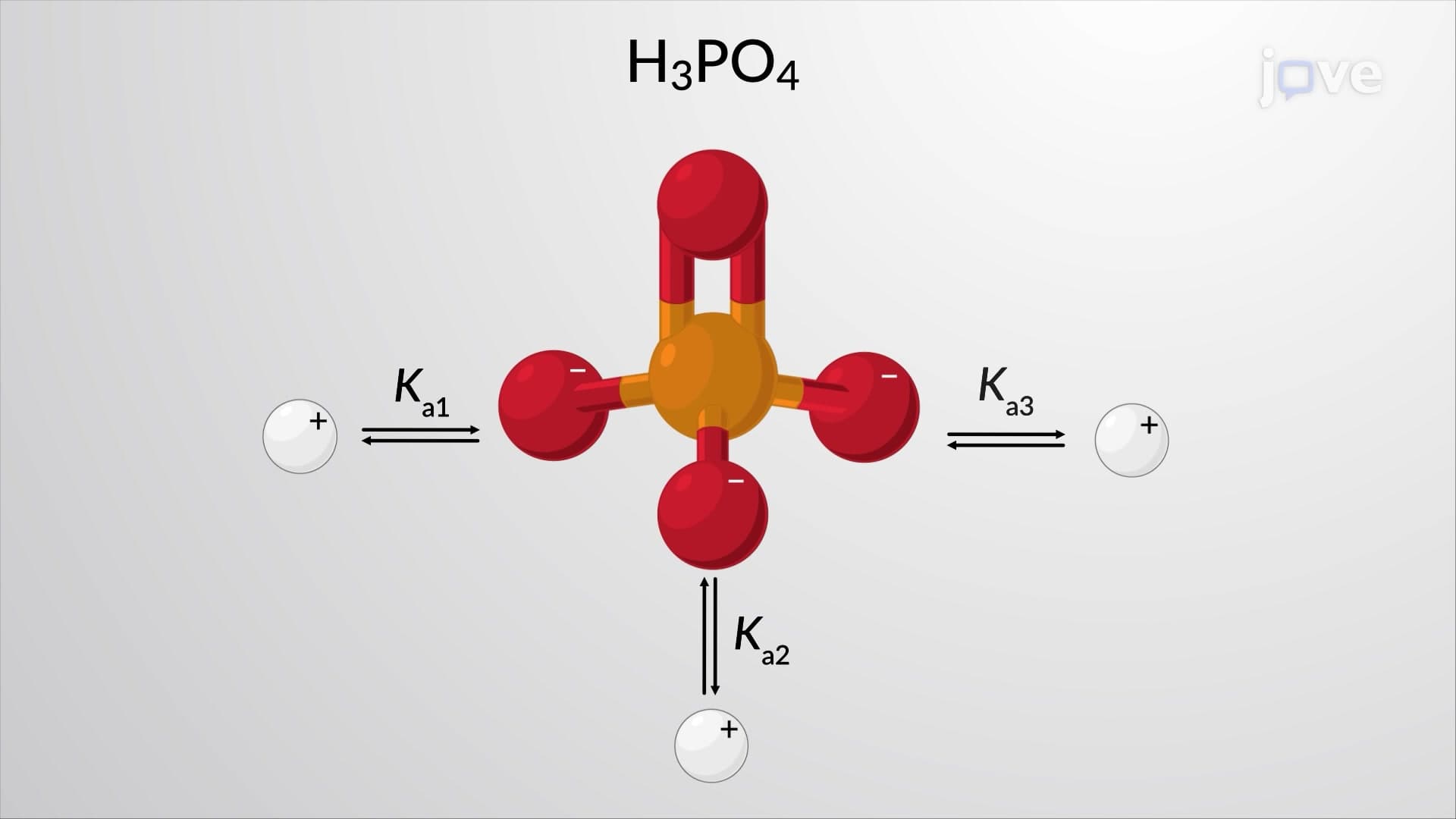

Video Summary: What are Polyprotic Acids
Ever wonder why citric acid in lemonade tastes so sour compared to vinegar? Polyprotic acids like citric acid can donate multiple protons, creating more complex pH behaviors than simple acids. Unlike monoprotic acids such as hydrochloric acid found in stomach acid, polyprotic acids undergo sequential ionization steps, each with distinct equilibrium constants. Phosphoric acid in Coca-Cola exemplifies this concept with its three ionizable protons. Watch the full video on JoVE Coach to master this concept with expert-led visuals and step-by-step explanations.
Polyprotic acids represent a fascinating class of compounds that can donate multiple protons (H⁺ ions) in aqueous solution. Unlike their simpler monoprotic counterparts such as hydrochloric acid (HCl), these acids undergo multiple, sequential ionization steps. This behavior creates complex acid-base chemistry that appears frequently in AP Chemistry exams and college-level analytical chemistry courses.
The fundamental distinction lies in molecular structure. While acetic acid (found in household vinegar) contains only one ionizable hydrogen, sulfuric acid (H₂SO₄) possesses two, and phosphoric acid (H₃PO₄) contains three. This structural difference profoundly impacts their solution chemistry and practical applications.
Types of polyprotic acids are classified by the number of ionizable protons they contain. Diprotic acids like carbonic acid (H₂CO₃) in carbonated beverages undergo two ionization steps, while triprotic acids such as citric acid in citrus fruits can release three protons sequentially.
Each ionization step occurs with decreasing ease, represented by progressively smaller acid dissociation constants: Ka1 > Ka2 > Ka3. This pattern results from electrostatic effects-removing a positively charged proton becomes increasingly difficult as the remaining ion accumulates negative charge. For phosphoric acid used in rust removal products, Ka1 = 7.5 × 10⁻³, Ka2 = 6.2 × 10⁻⁸, and Ka3 = 4.8 × 10⁻¹³.
The mathematical treatment of polyprotic acid pH calculations often simplifies significantly. When Ka1 exceeds subsequent dissociation constants by factors of 1000 or more, the first ionization step dominates the solution's pH. This approximation proves invaluable for MCAT preparation and college chemistry problem-solving.
Consider ascorbic acid (vitamin C) with Ka1 = 8.0 × 10⁻⁵ and Ka2 = 1.6 × 10⁻¹². Since Ka1/Ka2 > 1000, pH calculations can focus solely on the first dissociation step using standard ICE table methodology.
Polyprotic acids appear extensively in biological systems, industrial processes, and environmental chemistry. Carbonic acid regulates blood pH through bicarbonate buffering systems, while sulfuric acid serves as a key industrial chemical in battery acid and fertilizer production. Understanding these concepts proves essential for success on standardized exams including the MCAT, AP Chemistry exam, and college placement tests, where polyprotic acid calculations frequently appear in equilibrium and pH-related questions.
Related Micro-courses