Loading video…


 11 Concepts
 21.5K views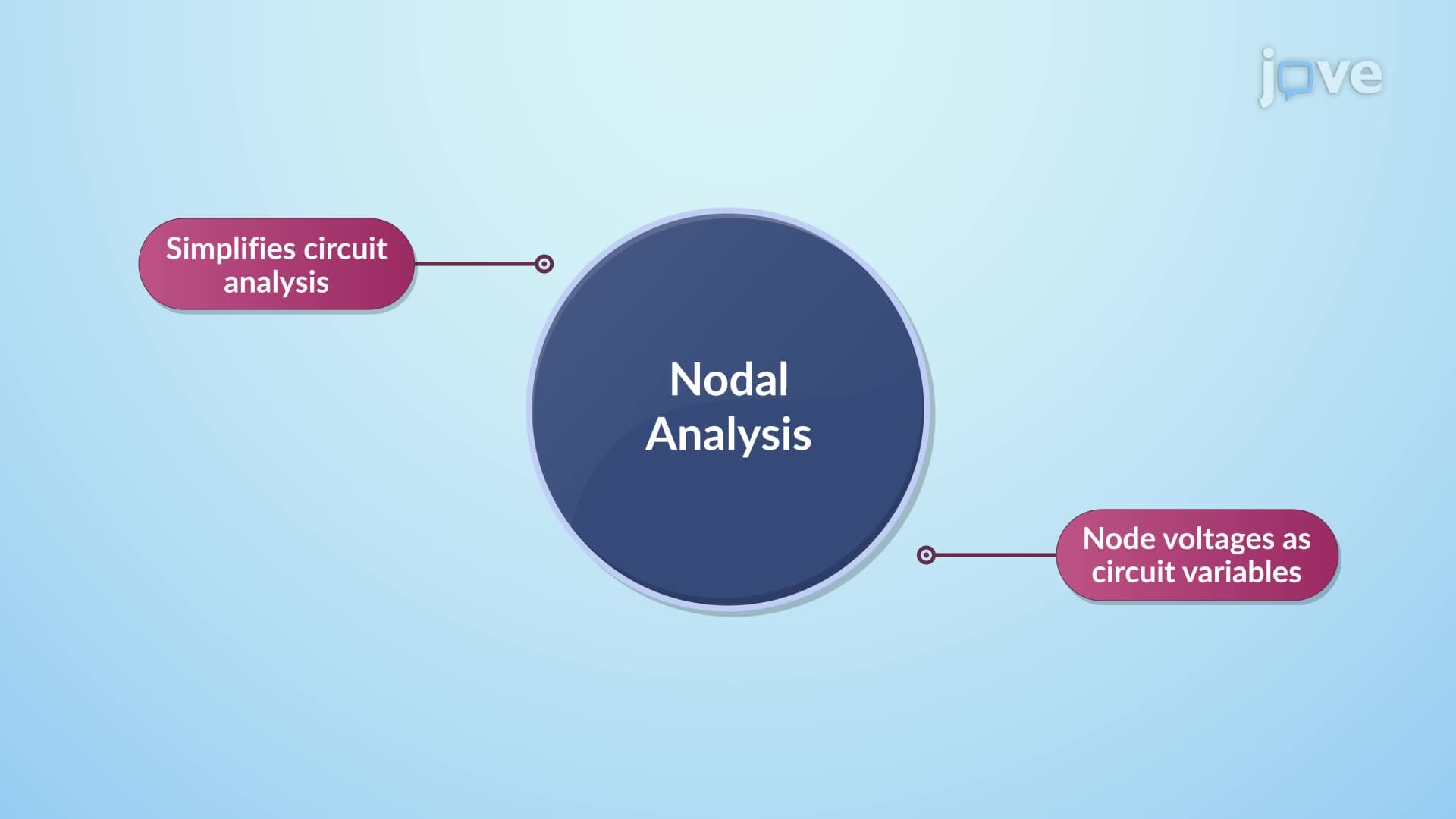

Video Summary: Nodal Analysis Method for Dc Circuit Analysis
Ever wonder how electrical engineers at Tesla or Apple design circuits for electric vehicles and smartphones? Nodal analysis with independent and dependent voltage sources provides the systematic approach they use to solve complex electrical networks. Consider the power distribution system in a typical US home-engineers use the Nodal Analysis Method for DC Circuit Analysis to determine voltages at junction points, ensuring safe 120V delivery to outlets while managing varying loads from appliances. Watch the full video on JoVE Coach to master this concept with expert-led visuals and step-by-step explanations.
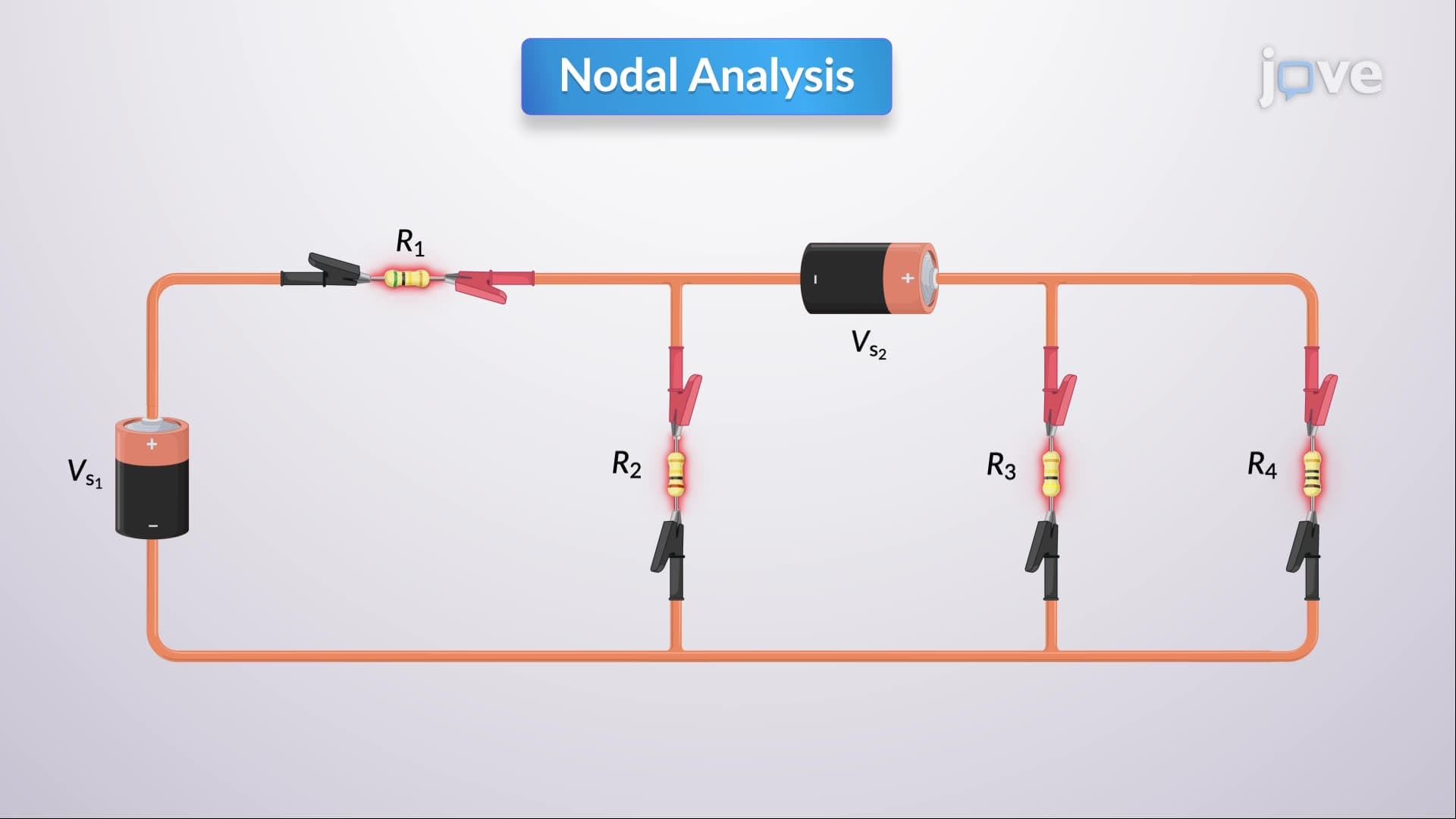
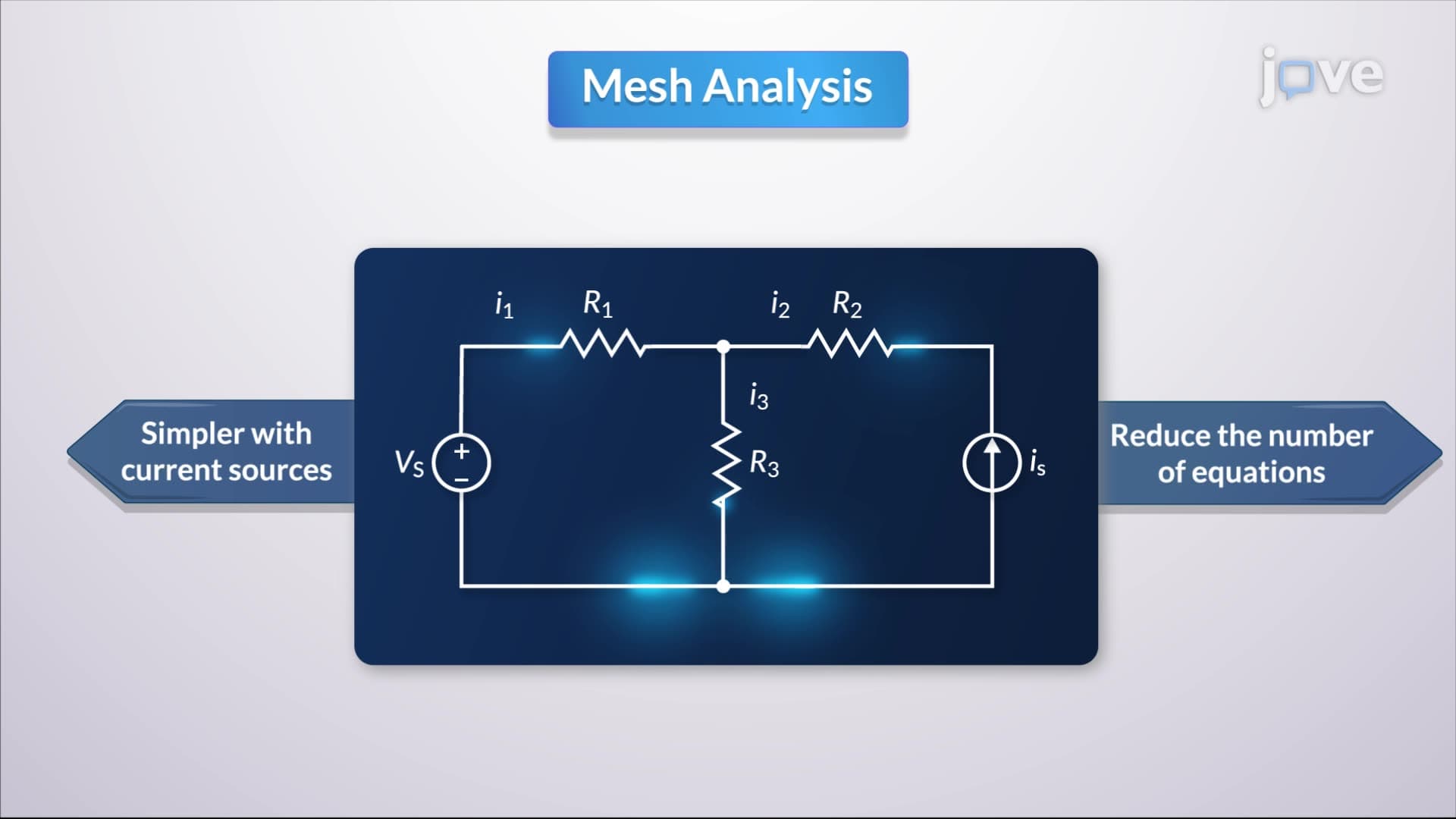
The Nodal Analysis Method for DC Circuit Analysis represents one of the most powerful systematic approaches for solving electrical circuits, particularly those encountered in AP Physics, college-level electrical engineering courses, and professional circuit design. Unlike mesh analysis, which focuses on loop currents, nodal analysis concentrates on determining the voltage at each node (junction point) within a circuit relative to a chosen reference point.
The process begins with selecting a reference node, also called the datum node, which serves as the zero-voltage reference point-similar to how sea level serves as the reference for measuring altitude. This choice is crucial because all other node voltages are measured relative to this point. In practical US applications, such as household electrical systems, the reference node often corresponds to the neutral wire or ground connection that provides the return path to the electrical panel.
For circuits with independent voltage sources (like batteries) and dependent voltage sources (such as controlled sources in amplifier circuits), engineers must carefully apply Kirchhoff's Current Law at each non-reference node. This fundamental principle states that the algebraic sum of currents entering any node equals zero-a concept that students encounter in AP Physics C and reinforces in college-level circuit analysis courses.
When nodal analysis with independent and dependent voltage sources is applied, each resistor's current is expressed using Ohm's Law in terms of the voltage difference across its terminals. For a resistor R connecting nodes with voltages V1 and V2, the current equals (V1-V2)/R. This systematic substitution transforms the circuit into a set of simultaneous linear equations-typically n-1 equations for an n-node circuit.
Consider a smartphone charging circuit: engineers use nodal analysis to ensure proper voltage levels reach the battery management system while accounting for varying load conditions. The method proves equally valuable in power grid analysis, where utilities like Pacific Gas & Electric use similar principles to maintain stable voltage delivery across distribution networks serving millions of customers.
Students preparing for the MCAT's physics section or college electrical engineering exams should recognize that nodal analysis excels when circuits contain multiple current sources or when voltage calculations are the primary objective. The method's systematic nature makes it particularly suitable for computer-aided analysis, explaining why software like SPICE (used extensively in US semiconductor companies) employs nodal analysis as its core computational engine.
Related Micro-courses