Loading subject page…

723 views

Video Summary: What are One to One Functions
Did you know that your Social Security number creates a perfect mathematical relationship where no two people share the same identifier? One to one functions work exactly like this-each input produces a completely unique output, making them essential for everything from database design to advanced calculus. In the US banking system, each account number maps to exactly one customer, demonstrating how one to one functions ensure no confusion or overlap in real-world systems. Watch the full video on JoVE Coach to master this concept with expert-led visuals and step-by-step explanations.
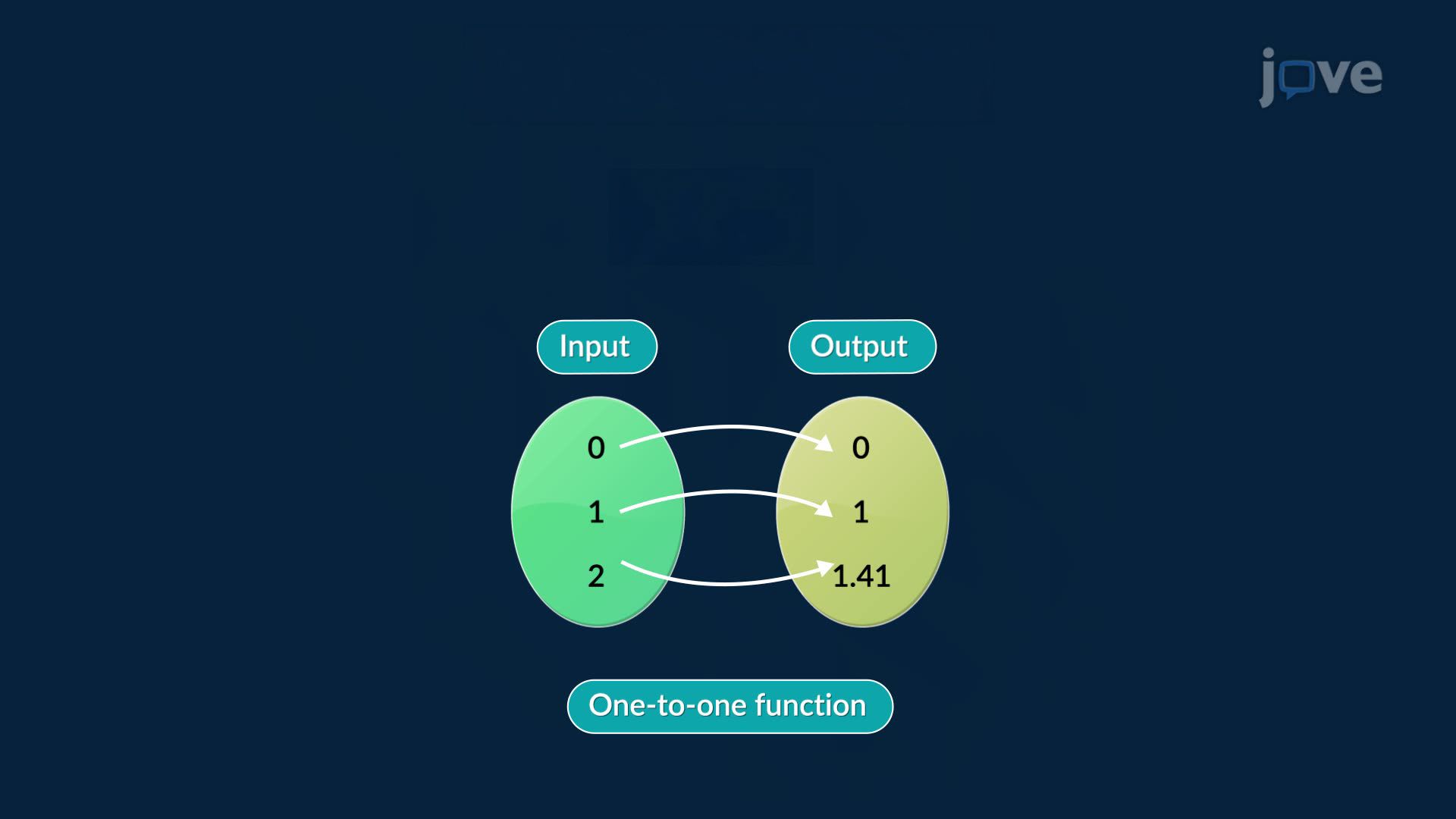
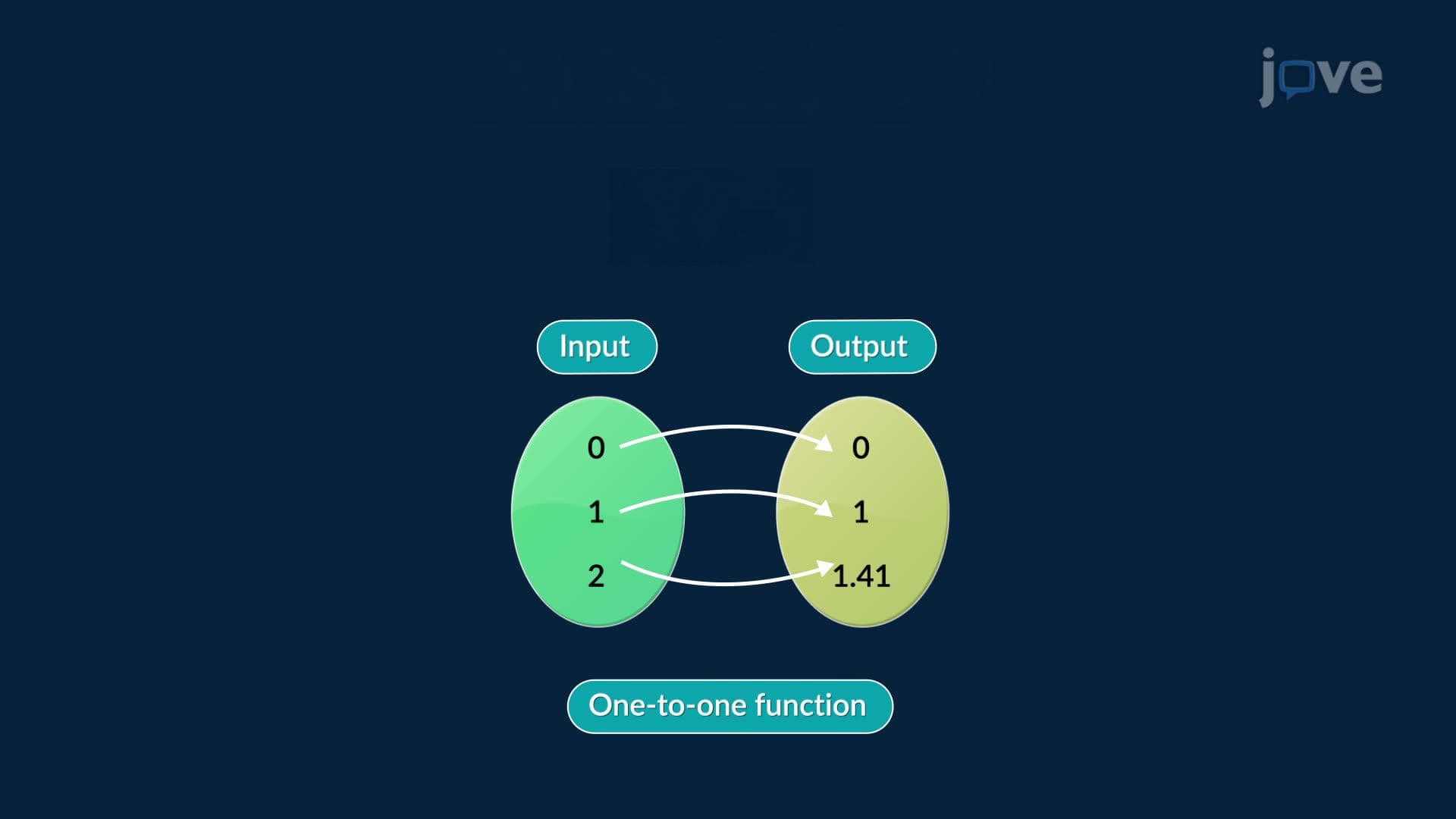
One to one functions represent a fundamental concept in mathematics where each input value corresponds to exactly one unique output value, and no two different inputs ever produce the same output. This property, also called "injective," ensures a perfect one-to-one correspondence between domain and range elements.
The horizontal line test provides the most reliable method for identifying one-to-one functions graphically. Simply draw horizontal lines across the function's graph-if any horizontal line intersects the curve more than once, the function fails the one-to-one test. Functions like y = x² fail this test because f(2) = f(-2) = 4, violating the unique output requirement.
Many common functions become one-to-one through strategic domain restrictions. The quadratic function y = x² transforms into a one-to-one function when we restrict its domain to x ≥ 0, creating the function y = x² for x ≥ 0. Similarly, trigonometric functions like sine and cosine require domain restrictions (sine: [-π/2, π/2], cosine: [0, π]) to become one-to-one for inverse function applications.
Students preparing for AP Calculus AB/BC exams frequently encounter these domain-restricted functions when studying inverse trigonometric functions. The key insight is recognizing that domain restrictions don't change the function's fundamental nature-they simply eliminate the problematic portions that create multiple outputs.
One-to-one functions are crucial because only they possess inverse functions. In practical terms, consider temperature conversion: the function F = (9/5)C + 32 converting Celsius to Fahrenheit is one-to-one, allowing us to create its inverse C = (5/9)(F - 32) for reverse conversion.
US financial systems rely heavily on one-to-one relationships. Bank routing numbers, credit card numbers, and tax identification numbers all function as one-to-one mappings, ensuring accurate record-keeping and preventing identity confusion. These real-world applications demonstrate why understanding one-to-one functions extends far beyond mathematics classrooms into critical infrastructure systems.
Related Micro-courses