Loading video…


 14 Concepts
 724 views

Video Summary: What are Rules for Defining Functions
Ever wonder why your smartphone's calculator gives you exactly one result when you input "2 + 3"? The rules for defining functions ensure that mathematical relationships behave predictably-just like how pressing a specific button on a McDonald's ordering kiosk delivers exactly one menu item, never two different burgers simultaneously. What are rules for defining functions becomes crucial when distinguishing between valid mathematical relationships and chaotic, unpredictable ones. Watch the full video on JoVE Coach to master this concept with expert-led visuals and step-by-step explanations.
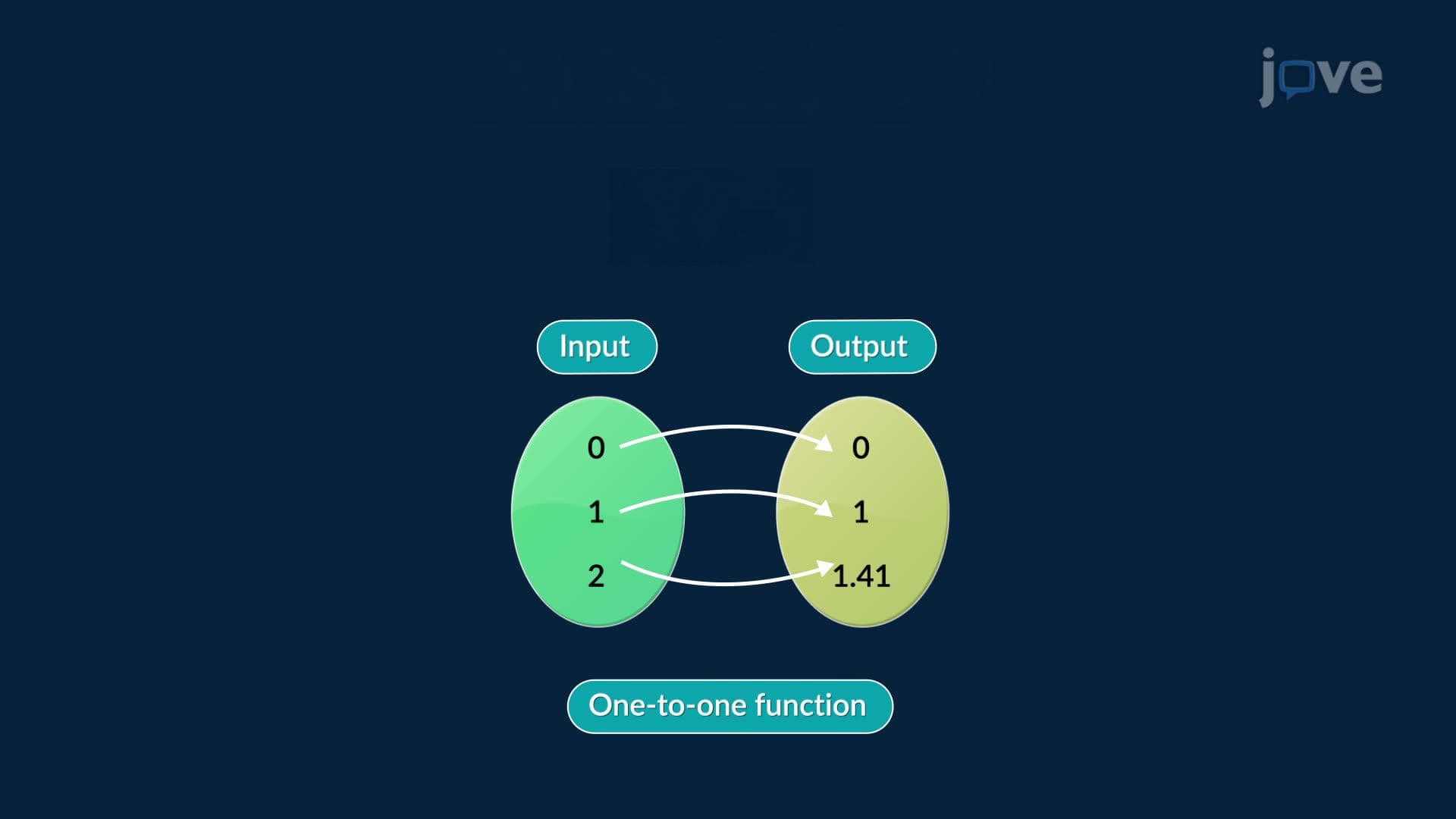
The rules for defining functions establish the fundamental principle that governs all mathematical functions: each input must produce exactly one output. This seemingly simple rule creates the foundation for everything from basic algebra to advanced calculus, making it essential for students preparing for AP Calculus, SAT Math, or college-level mathematics courses.
Types of rules for defining functions all center around this core principle, but they manifest differently across various representations. In algebraic equations, a function exists when each x-value corresponds to exactly one y-value. For instance, y = 2x + 3 represents a function because plugging in x = 4 always yields y = 11-never multiple answers. Conversely, x² + y² = 25 (a circle) fails this test because x = 3 produces both y = 4 and y = -4.
Function tables follow identical logic. Consider a table showing hours studied versus test scores: if studying 3 hours could result in both 85% and 92% scores, this wouldn't represent a function. However, real-world applications often do follow functional relationships-your Social Security number uniquely identifies you, and your student ID corresponds to exactly one academic record.
Rules for defining functions overview includes the powerful vertical line test, a visual method for identifying functions on coordinate planes. This test, frequently appearing on AP Calculus exams and college placement tests, requires drawing imaginary vertical lines across a graph. If any vertical line intersects the graph more than once, the relationship isn't a function.
Consider a sideways parabola (like x = y²): vertical lines intersect it twice, violating function rules. However, restricting the domain-perhaps taking only the upper half-creates a valid function. This concept appears regularly in college algebra courses and standardized tests, where students must identify function domains and ranges.
Understanding rules for defining functions concept extends beyond academic exercises. Modern technology relies on functional relationships: GPS coordinates correspond to unique locations, barcodes identify specific products, and your credit card number links to exactly one account. These practical applications help students grasp why mathematicians established these rules centuries ago.
For exam preparation, particularly SAT Subject Tests and AP Calculus, mastering function identification proves crucial. Questions often present multiple representations-equations, tables, and graphs-requiring students to apply these rules consistently across formats.
Related Micro-courses