Loading video…


 14 Concepts
 723 views

Video Summary: What Is Transformations of Functions I
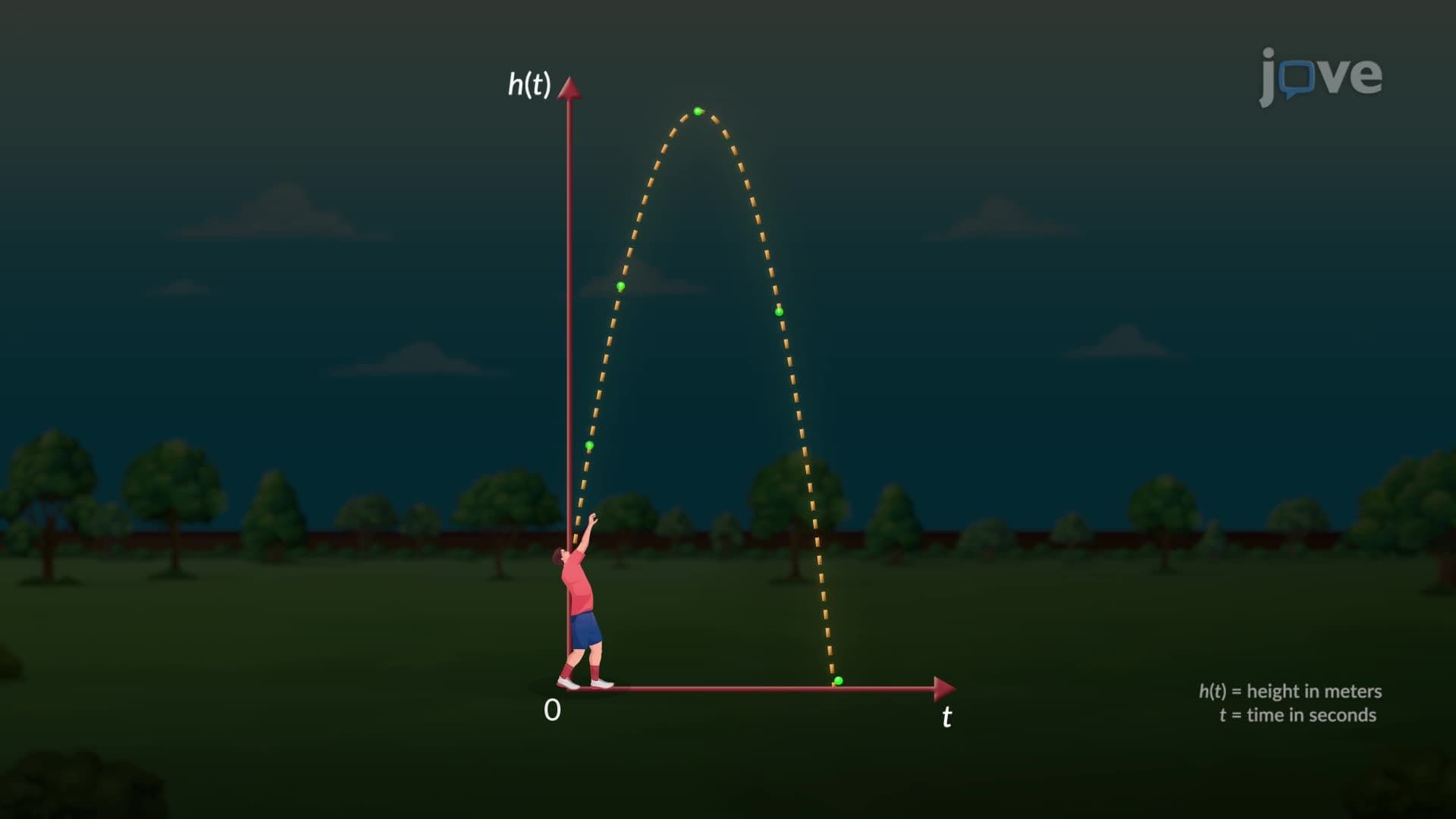
Ever notice how adjusting your car's rearview mirror doesn't change the mirror's shape, just its position? Transformations of functions I work similarly-they shift mathematical graphs without altering their fundamental shape. When engineers at NASA adjust satellite trajectories, they're essentially applying vertical shifts to parabolic flight paths, moving the entire curve up or down while preserving its U-shaped form. This foundational concept in algebra helps students understand how adding or subtracting constants from function outputs creates predictable graph movements. Watch the full video on JoVE Coach to master this concept with expert-led visuals and step-by-step explanations.
Transformations of functions I introduces students to one of algebra's most practical concepts: how mathematical functions can be moved, stretched, or flipped while maintaining their essential character. Think of transformations like adjusting a photograph-you might move it up or down on a wall, but the image itself remains unchanged. This principle appears throughout high school algebra courses, AP Calculus, and college mathematics, making it a cornerstone concept for academic success.
The most fundamental transformation covered in this introductory level is the vertical shift, represented mathematically as f(x) + k, where k is any real number constant. When k is positive, every point on the original graph moves upward by k units. When k is negative, every point shifts downward by |k| units.
Consider the parent function f(x) = x², which creates the familiar U-shaped parabola with its vertex at the origin (0,0). When we create g(x) = x² + 3, we're adding 3 to every output value, effectively lifting the entire parabola three units higher. The vertex now sits at (0,3), but the parabola's width and curvature remain identical.
This concept frequently appears on the SAT Math section and AP Calculus exams, where students must identify transformations from graphs or equations. College algebra courses build extensively on these foundations, introducing horizontal shifts, reflections, and scaling transformations that students encounter in calculus and beyond.
Vertical shifts have profound applications across multiple industries. Audio engineers routinely apply DC offset corrections-essentially vertical shifts-to center waveforms around zero, eliminating unwanted baseline drift that can distort recordings. The Grammy-winning studios in Nashville and Los Angeles rely on this principle daily.
In aerospace engineering, NASA's trajectory calculations for Mars rovers involve parabolic paths that require vertical adjustments based on gravitational fields and atmospheric conditions. Boeing's flight management systems use similar transformations when calculating optimal descent profiles for commercial aircraft approaching airports like Chicago O'Hare or Los Angeles International.
Students preparing for standardized tests should practice identifying vertical shifts in multiple representations: graphical, algebraical, and tabular. The College Board's AP Calculus exam often presents transformation problems requiring students to work backward from shifted graphs to determine original functions. Success requires recognizing that vertical shifts affect only y-coordinates while leaving x-coordinates unchanged-a pattern that appears consistently across high school and college mathematics curricula.
Related Micro-courses