Loading video…


 8 Concepts
 5.8K views

Video Summary: What Is Shearing Stress
Why do airplane wings stay attached during turbulence, and bridges remain stable under heavy traffic? The answer lies in shearing stress, the internal force that develops when materials resist sliding or tearing forces. When bolts hold steel beams together in skyscrapers like New York's One World Trade Center, they experience shearing stress as the building sways. This fundamental engineering concept explains how structures handle forces that try to cut or slide materials apart. Watch the full video on JoVE Coach to master this concept with expert-led visuals and step-by-explanations.
Shearing stress represents one of the most critical concepts in structural mechanics and materials science. Unlike tensile or compressive stress that acts perpendicular to a surface, shearing stress acts parallel to the cross-section, attempting to slide one part of a material past another. This phenomenon occurs whenever external forces create internal resistance within a material's cross-sectional plane.
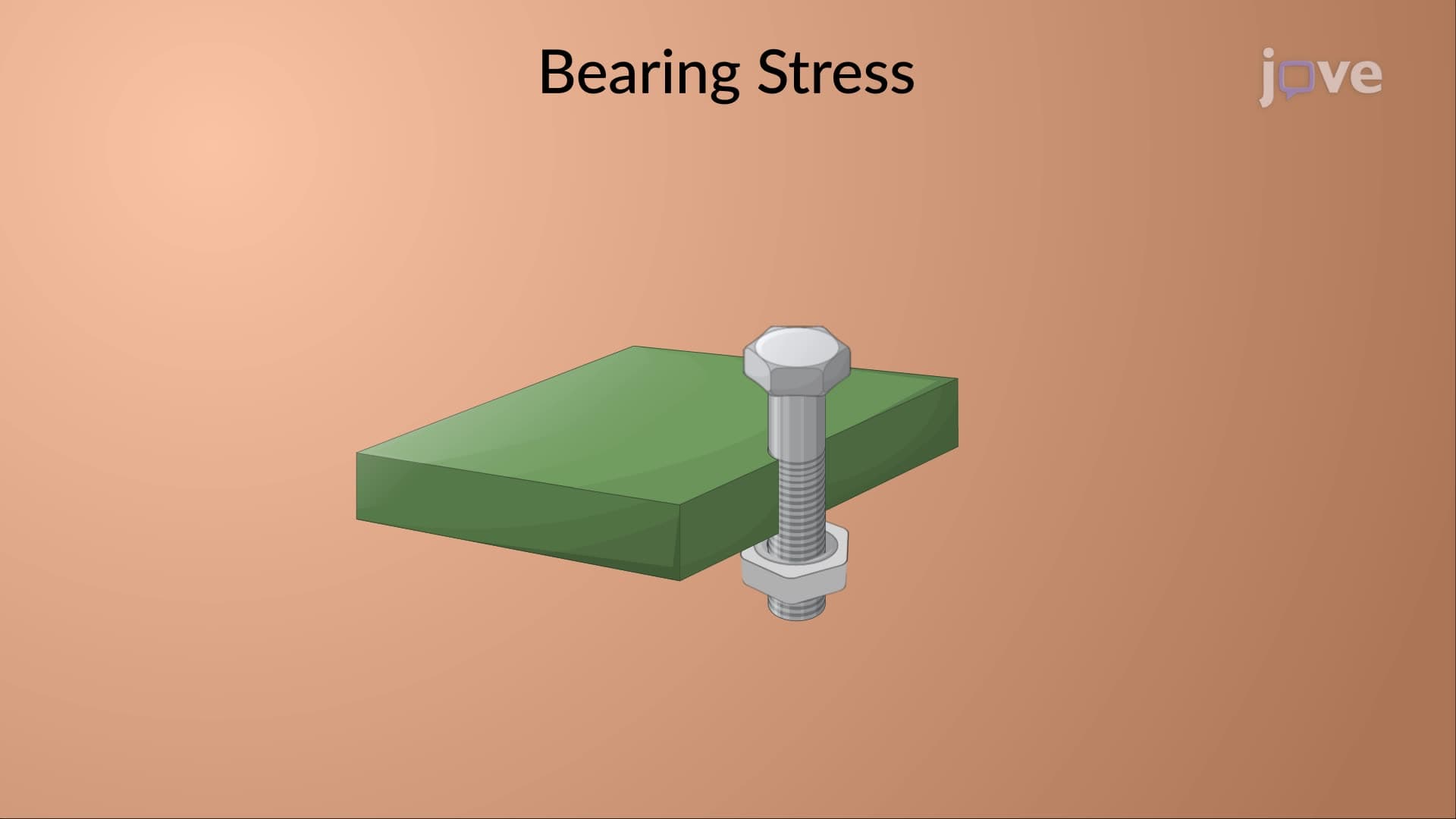
The concept becomes clearer when examining everyday structures. Consider the bolts holding together the steel framework of the Golden Gate Bridge or the rivets in aircraft fuselages. These fasteners experience shearing stress as they resist forces trying to separate connected components. The stress develops along specific planes where the material could potentially "shear off" or break apart.
Understanding shear plane configurations is essential for engineering calculations. In single shear conditions, like a bolt connecting two plates, the shearing stress occurs along one cross-sectional plane. The average shearing stress equals the applied force divided by the bolt's cross-sectional area (τ = F/A).
Double shear occurs when splice plates or additional connection elements create two potential failure planes. For example, when three plates are bolted together with the middle plate sandwiched between two outer plates, the bolt experiences shearing forces along two planes. The average shearing stress in each plane becomes F/(2A), where the force is distributed across both shear planes.
Real shearing stress distribution is non-uniform across a cross-section. At the outer surfaces, shearing stress approaches zero, while maximum values occur toward the center, often exceeding the calculated average by 50% or more. This variation is crucial for engineers designing everything from building connections to automotive components.
Students preparing for AP Physics, college-level statics courses, or engineering entrance exams should recognize that shearing stress calculations appear frequently in structural analysis problems. Understanding these concepts provides foundation knowledge for advanced topics like beam design, connection analysis, and failure prediction in mechanical systems.
Professional engineers must consider shearing stress when designing bolted connections in buildings, bridges, and machinery. Building codes specify maximum allowable shearing stresses for different materials and applications. For instance, structural steel bolts in seismic zones must withstand higher shearing stresses due to earthquake-induced lateral forces.
Related Micro-courses