Loading video…


 12 Concepts
 9.6K views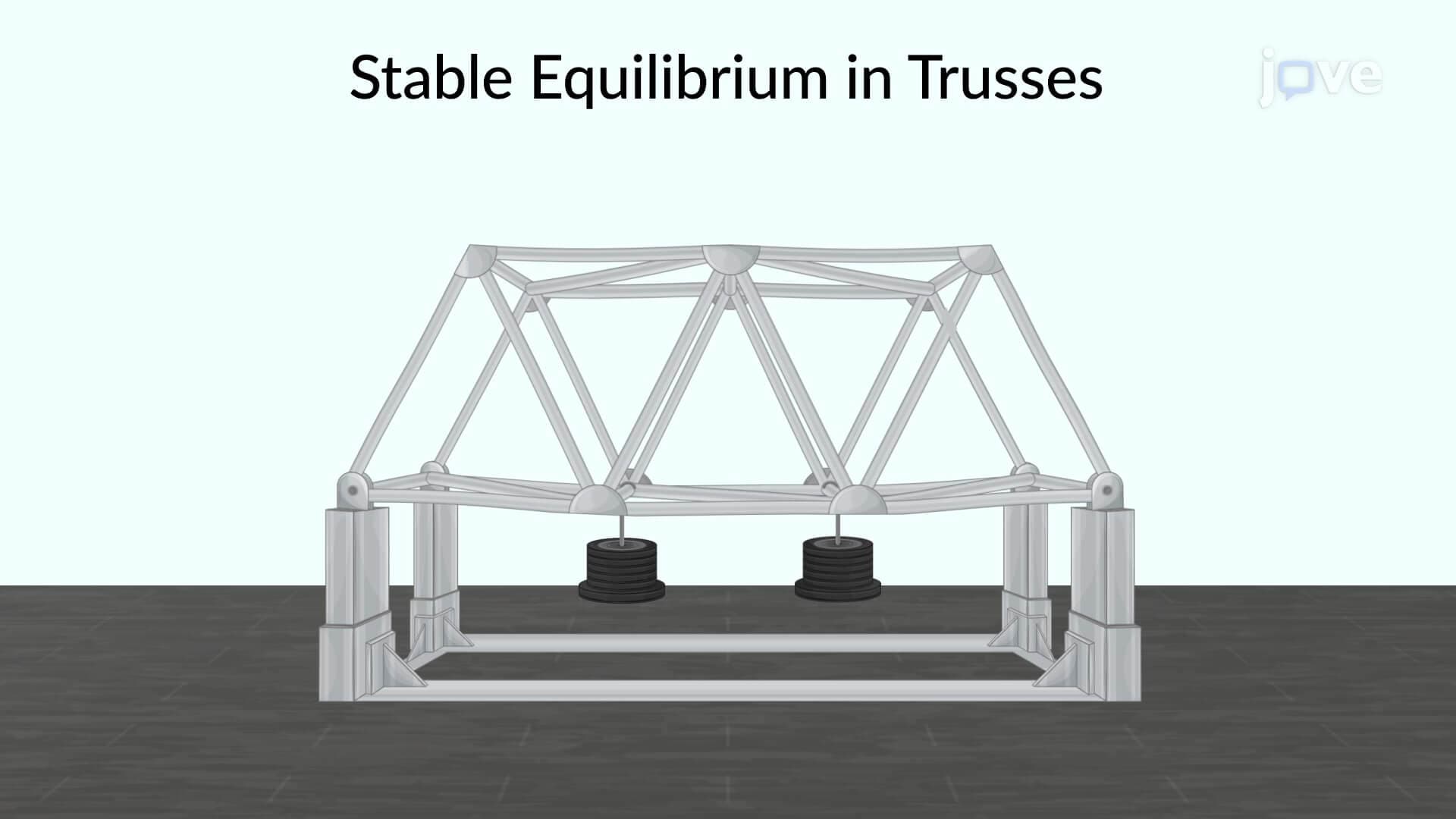

Video Summary: What Is Stability of Equilibrium Configuration
Ever wondered why the Golden Gate Bridge doesn't collapse under wind loads while a house of cards topples from a gentle breeze? The stability of equilibrium configuration determines whether structures return to their original position, stay displaced, or continue moving after disturbance. From California's earthquake-resistant buildings to NASA's rocket designs, engineers must understand these three equilibrium types-stable, neutral, and unstable-to create safe, reliable systems. Watch the full video on JoVE Coach to master this concept with expert-led visuals and step-by-step explanations.
Stability of equilibrium configuration describes how a system responds when slightly disturbed from its equilibrium position. This fundamental concept bridges theoretical physics with practical engineering applications, determining whether structures and systems remain safe under real-world conditions. The concept becomes crucial when analyzing everything from the stability of the Statue of Liberty during hurricanes to the design of International Space Station components.
Stable Equilibrium represents the safest configuration where systems naturally return to their original position after disturbance. Consider a marble resting at the bottom of a bowl-push it slightly, and it rolls back to center. In structural terms, this occurs at minimum potential energy. The Empire State Building exemplifies stable equilibrium design, swaying slightly during windstorms but always returning to vertical alignment through careful engineering that places the center of gravity well within the base of support.
Neutral Equilibrium occurs when displacement results in a new equilibrium position with unchanged potential energy. Picture a marble on a flat table-push it, and it stays wherever it stops. While less common in structural design, this principle appears in moveable bridge sections and adjustable satellite arrays where controlled repositioning is desirable.
Unstable Equilibrium represents the most dangerous configuration, where small disturbances cause systems to move progressively further from their original position. A marble balanced on an inverted bowl demonstrates this-the slightest touch sends it rolling away. This occurs at maximum potential energy points and explains why engineers avoid designs that could shift into unstable configurations under load.
Professional engineers use stability analysis throughout the design process. The 2007 Minneapolis I-35W bridge collapse highlighted how insufficient consideration of equilibrium stability under changing load conditions can lead to catastrophic failure. Modern structural analysis software incorporates stability calculations to ensure buildings, bridges, and towers maintain stable equilibrium under expected loads plus safety factors.
Students preparing for AP Physics exams frequently encounter equilibrium stability problems involving energy diagrams and force analysis. College-level statics and dynamics courses expand these concepts to include mathematical stability criteria and computational methods used in professional practice.
California's seismic building codes specifically address equilibrium stability, requiring structures to maintain stable configurations during earthquake motion. Similarly, NASA's Vehicle Assembly Building at Kennedy Space Center demonstrates massive-scale stable equilibrium design, remaining upright despite Florida's hurricane-force winds and the dynamic loads of rocket assembly operations.
Understanding these principles helps explain why suspension bridge towers use deep foundations and why skyscrapers incorporate tuned mass dampers-all strategies to maintain stable equilibrium under various loading conditions.
Related Micro-courses