Loading video…


 12 Concepts
 9.6K views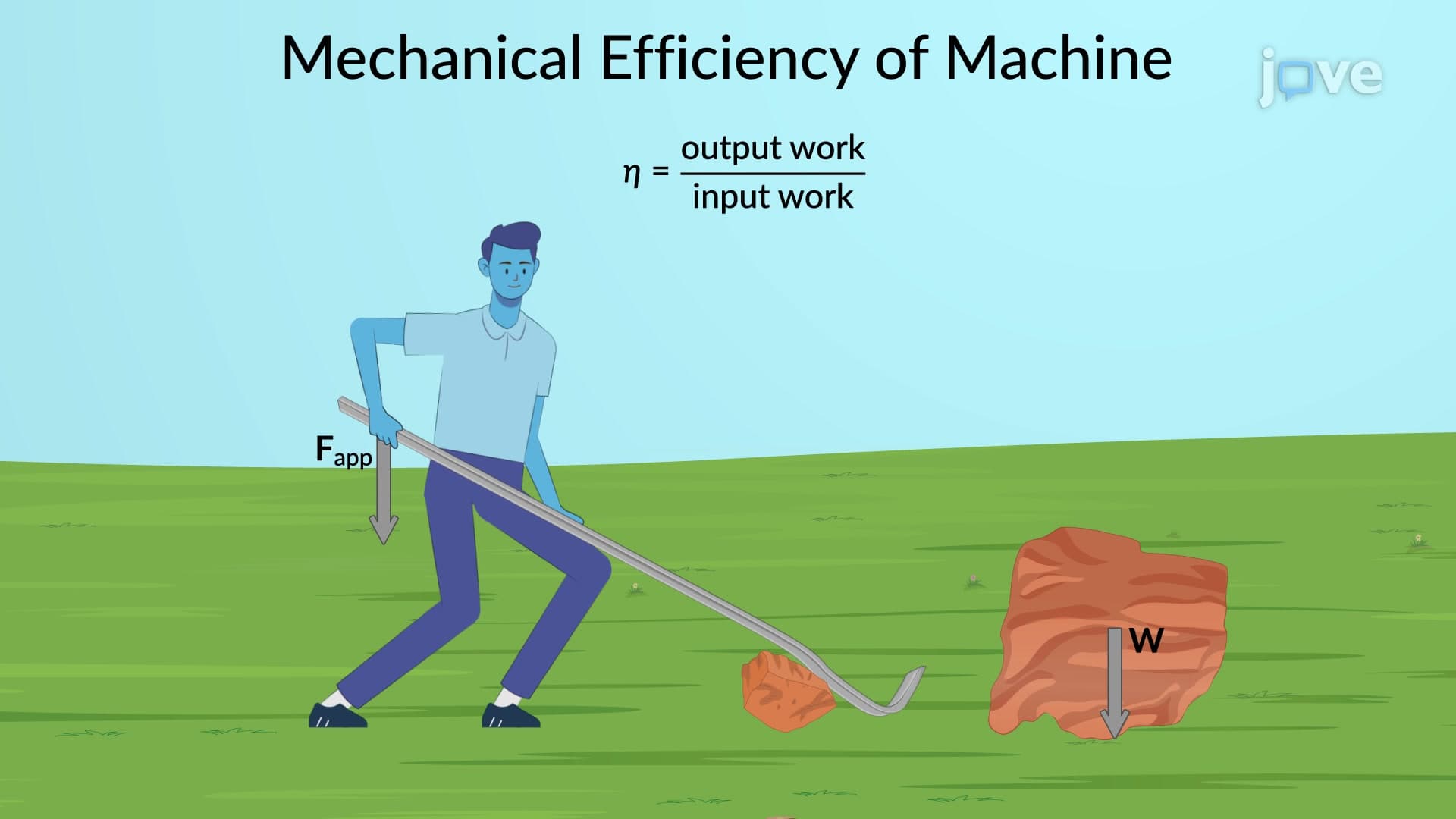

Video Summary: Mechanical Efficiency of Real Machines Explained
Why does a car engine only convert about 25% of its fuel energy into forward motion? The mechanical efficiency of real machines reveals how friction and other losses prevent perfect energy transfer in everyday devices. Unlike ideal machines that theoretically achieve 100% efficiency, real machines like hydraulic car jacks, industrial presses, and even simple hand tools lose energy to friction forces. Understanding mechanical efficiency of real machines explained helps engineers design better systems and predict performance limitations. Watch the full video on JoVE Coach to master this concept with expert-led visuals and step-by-step explanations.
Mechanical efficiency represents one of the most crucial concepts in engineering physics, bridging theoretical mechanics with practical machine design. When studying for AP Physics exams or college engineering courses, students encounter this concept as a fundamental measure of how effectively machines convert input energy into useful output work.
The core equation for mechanical efficiency is η = W(output) / W(input), where efficiency η ranges from 0 to 1 (or 0% to 100%). In ideal machines, this ratio equals exactly 1, meaning all input work converts to output work. However, real machines always experience energy losses, primarily through friction.
Consider a hydraulic car jack used in automotive repair shops across the United States. The input work comes from pumping the handle, while output work lifts the vehicle. Friction in the hydraulic cylinder, seals, and pivot points reduces the actual mechanical advantage compared to the theoretical ideal. Students preparing for MCAT physics sections frequently encounter similar examples involving pulleys, levers, and inclined planes.
Real machines lose efficiency primarily due to friction forces, which oppose motion and convert mechanical energy into heat. The frictional force magnitude depends on the normal force and coefficient of friction between contact surfaces. In toggle mechanisms like bench vises found in high school shop classes, friction creates a critical relationship with the toggle angle.
When the toggle angle equals the friction angle, efficiency drops to zero, the machine cannot produce any useful output work. If the toggle angle becomes smaller than the friction angle, efficiency turns negative, meaning the machine actually works against the intended motion. This explains why machinists and woodworkers must maintain proper operating angles in their tools.
Understanding mechanical efficiency directly impacts design decisions in American manufacturing. Ford Motor Company engineers, for example, must balance engine efficiency with performance requirements when developing new vehicles. Similarly, Boeing aerospace engineers consider efficiency losses in aircraft control systems to ensure reliable operation under various conditions.
College engineering students studying for thermodynamics midterms learn that improving mechanical efficiency often involves selecting appropriate materials, optimizing surface finishes, and implementing proper lubrication systems. These principles apply equally to massive industrial equipment and precision instruments used in medical devices manufactured by companies like Medtronic and Johnson & Johnson.
Related Micro-courses