Loading subject page…


53,059 views

Video Summary: C Nmr Distortionless Enhancement by Dept
Ever wondered how pharmaceutical companies at Pfizer identify unknown drug metabolites with pinpoint accuracy? The DEPT NMR technique revolutionizes carbon-13 spectroscopy by revealing exactly how many hydrogens are attached to each carbon atom. This distortionless enhancement by polarization transfer method uses specialized pulse sequences to distinguish between CH3, CH2, CH, and quaternary carbons-information that disappears in standard broadband-decoupled spectra. Watch the full video on JoVE Coach to master this concept with expert-led visuals and step-by-step explanations.
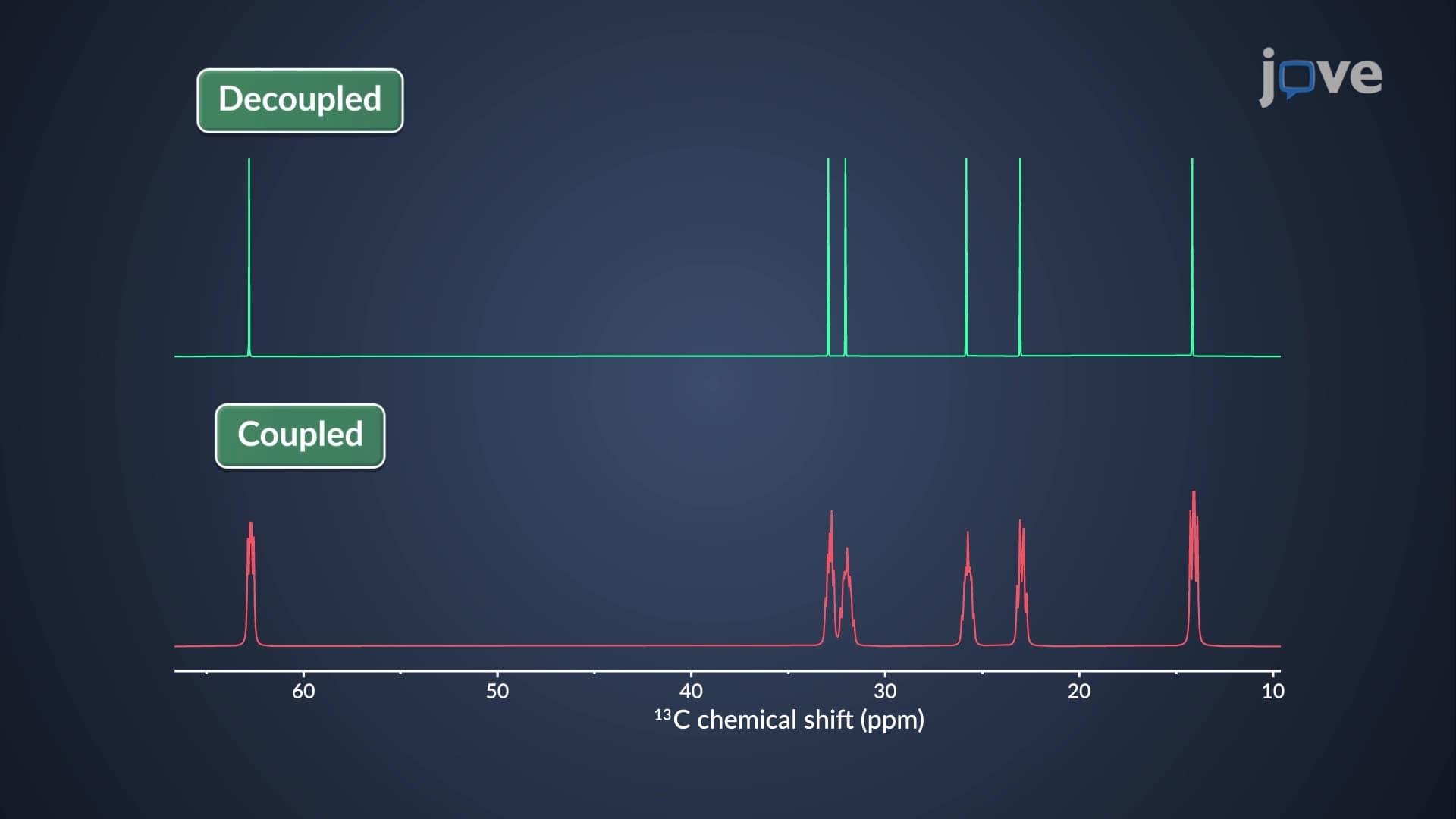
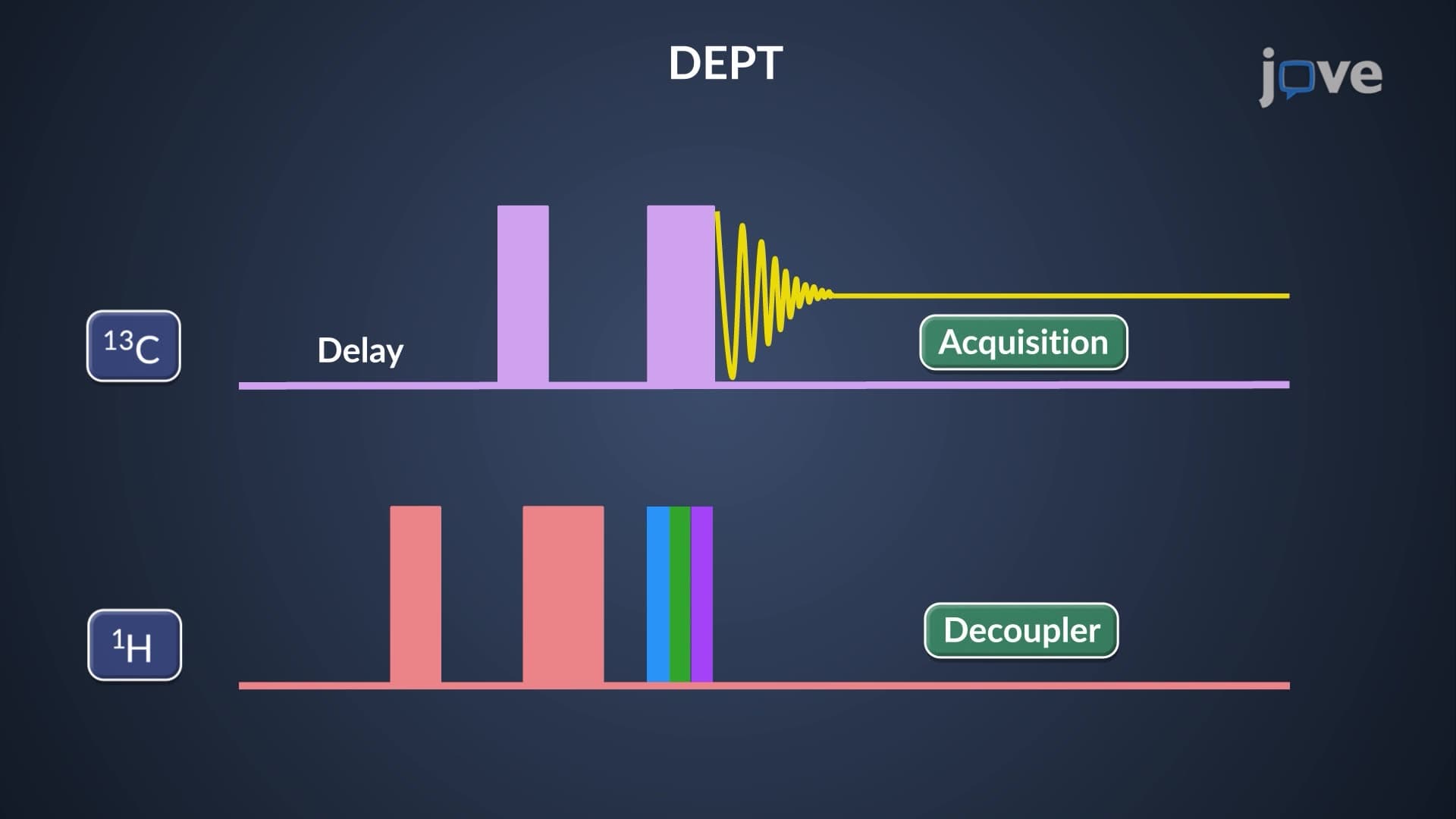
Carbon-13 NMR spectroscopy faces a fundamental trade-off: broadband proton decoupling simplifies spectra by removing complex coupling patterns, but this process eliminates crucial information about hydrogen connectivity. DEPT (Distortionless Enhancement by Polarization Transfer) solves this dilemma through sophisticated pulse sequences that preserve multiplicity information while maintaining spectral clarity.
DEPT experiments employ variable flip angles and pulse delays to selectively manipulate different carbon types. The technique relies on polarization transfer from abundant protons to rare carbon-13 nuclei, enhancing sensitivity while encoding multiplicity information. Three standard DEPT experiments-DEPT-45, DEPT-90, and DEPT-135-each reveal different aspects of carbon environments.
In DEPT-45, all protonated carbons (CH3, CH2, CH) appear as positive peaks, providing a comprehensive view of hydrogen-bearing carbons. DEPT-90 displays only methine (CH) carbons, making tertiary carbon identification straightforward. DEPT-135 creates the most informative spectrum: methyl and methine carbons appear positive, while methylene carbons appear negative-an elegant phase encoding of multiplicity.
Consider analyzing ibuprofen metabolites in pharmaceutical research. Standard carbon-13 NMR shows seven distinct carbon signals, but DEPT reveals which carbons bear hydrogens and their specific multiplicities. This information proves invaluable for FDA drug approval processes, where complete structural characterization is mandatory.
Students preparing for the MCAT encounter DEPT in organic chemistry sections, particularly in spectroscopy-based structure problems. AP Chemistry students may see simplified DEPT concepts in advanced placement exams. College organic chemistry courses extensively use DEPT for unknown identification labs-a staple of sophomore-level coursework across institutions like UCLA, University of Texas, and Ohio State.
DEPT's primary limitation involves quaternary carbons, which produce no signal due to lack of attached protons. This characteristic actually becomes diagnostic-missing peaks in DEPT experiments compared to broadband-decoupled spectra identify fully substituted carbons. Modern NMR combines DEPT with techniques like HSQC and HMBC for comprehensive structural analysis, particularly in natural product research at institutions like Scripps Research and Harvard Medical School.
Related Micro-courses