Loading subject page…


53,059 views

Video Summary: Other Nuclides 31p 19f 15n Nmr Explained
Did you know that 31P 19F 15N NMR nuclides can reveal molecular secrets invisible to traditional proton NMR? These special atomic nuclei act like molecular detectives, each with unique "fingerprints" that help chemists identify unknown compounds and monitor biological processes. For instance, researchers at Johns Hopkins University use fluorine-19 NMR to track drug metabolism in real-time within living cells. Other Nuclides 31P 19F 15N NMR Explained demonstrates how nitrogen-15, fluorine-19, and phosphorus-31 provide crucial structural information through their distinct chemical shift patterns and coordination behaviors. Watch the full video on JoVE Coach to master this concept with expert-led visuals and step-by-step explanations.
Heteronuclear NMR spectroscopy extends beyond the familiar proton NMR by examining other magnetic nuclei with spin-1/2 properties. While proton NMR dominates introductory chemistry courses, advanced analytical chemistry increasingly relies on phosphorus 31P NMR spectroscopy, fluorine 19F NMR chemical shift analysis, and nitrogen 15N NMR analysis for comprehensive molecular characterization. These techniques prove essential for students preparing for advanced placement chemistry exams and college-level analytical chemistry courses.
Nitrogen-15 presents unique analytical challenges due to its mere 0.37% natural abundance compared to the dominant nitrogen-14 isotope. This low abundance necessitates longer acquisition times and higher sample concentrations for reliable spectra. The nucleus exhibits a negative magnetogyric ratio, meaning its magnetic moment opposes the applied field direction-a concept frequently tested on MCAT physical chemistry sections.
Nitrogen 15N NMR analysis reveals fascinating chemical shift behavior. Saturated nitrogen environments (like primary amines) display the most upfield signals, while electronegative substituents shift signals downfield. However, the lone electron pair's ability to coordinate with solvents or undergo protonation creates significant chemical shift variability. For example, pharmaceutical companies like Pfizer routinely use nitrogen-15 NMR to monitor drug-protein interactions where coordination state changes indicate binding events.
Fluorine 19F NMR chemical shift patterns are dominated by paramagnetic shielding effects, making them highly sensitive to molecular environment changes. Unlike proton NMR, where diamagnetic shielding predominates, fluorine's chemical shifts reflect electron density variations around the nucleus more dramatically.
Most organofluorine compounds cluster within a 350 ppm range, significantly broader than typical proton NMR windows. This expanded range provides exceptional resolution for distinguishing similar fluorinated structures. Pharmaceutical research at companies like Merck extensively uses fluorine-19 NMR since approximately 25% of modern drugs contain fluorine atoms, and this technique can monitor drug metabolism and distribution without invasive procedures.
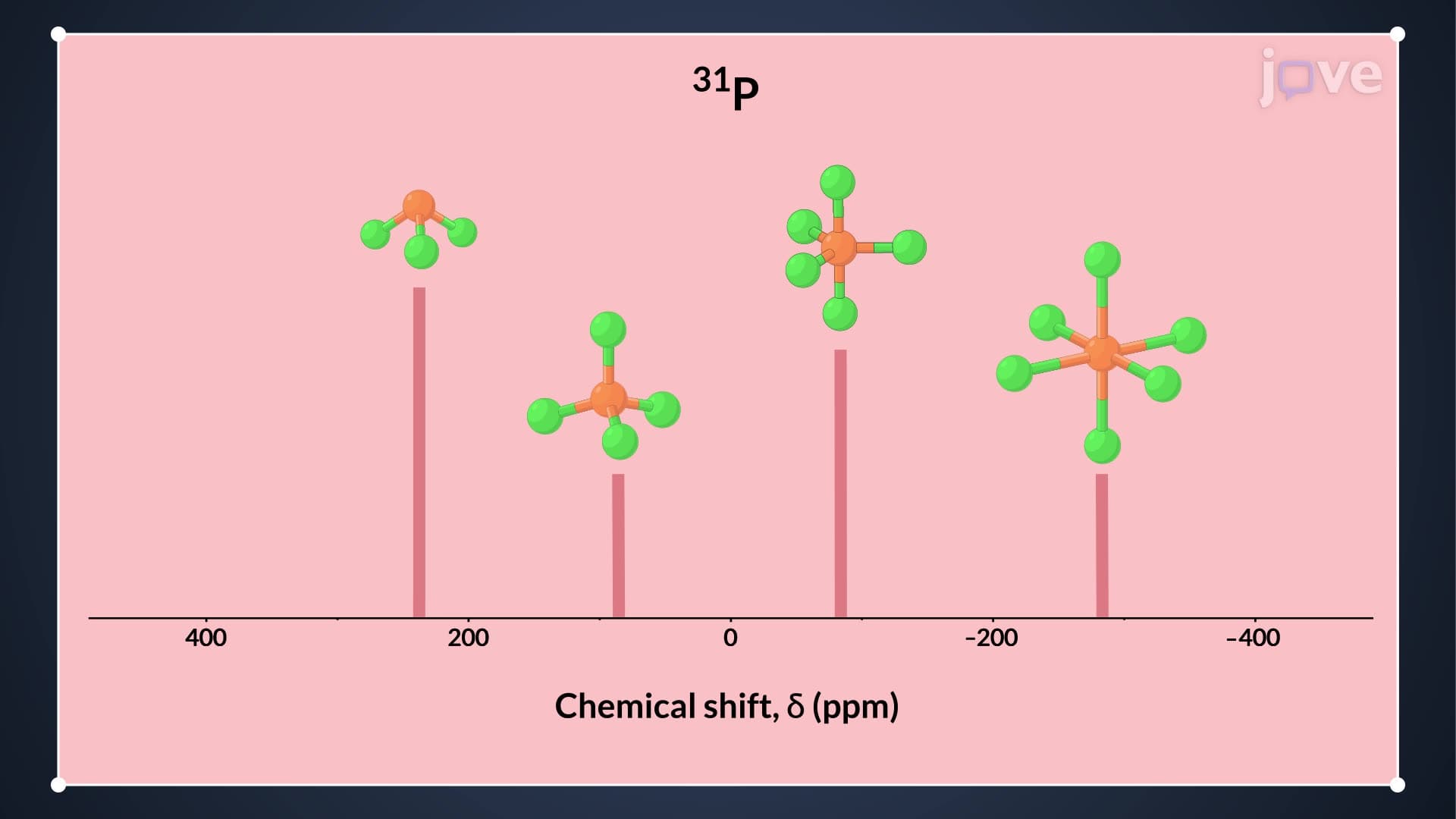
Phosphorus 31P NMR spectroscopy reveals a surprising principle: coordination number affects chemical shifts more significantly than electronegative substituents. This concept challenges students' intuition from proton NMR, where electronegativity strongly correlates with chemical shift position.
Phosphorus coordination environments range from three-coordinate phosphines to six-coordinate phosphates, each producing characteristic chemical shift ranges. Biochemistry students encounter this principle when studying ATP hydrolysis, where phosphorus-31 NMR monitors the conversion between different phosphate coordination states during enzymatic reactions.
These heteronuclear NMR applications appear frequently in advanced chemistry coursework and standardized exams. AP Chemistry students encounter conceptual questions about nuclear magnetic properties, while college organic chemistry lab courses often include multinuclear NMR interpretation exercises. Pre-medical students preparing for the MCAT must understand how different nuclei provide complementary structural information for complex biological molecules.
Related Micro-courses