Loading subject page…


411,800 views

Video Summary: Osmosis and Osmotic Pressure of Solutions Explained
Did you know that the IV fluids administered in US hospitals must be precisely calibrated to match your blood's osmotic pressure? Understanding osmosis and osmotic pressure of solutions is crucial for explaining how water moves across cell membranes and why dehydration affects cellular function. This fundamental concept appears in AP Chemistry, MCAT preparation, and college-level chemistry courses. Watch the full video on JoVE Coach to master this concept with expert-led visuals and step-by-step explanations.
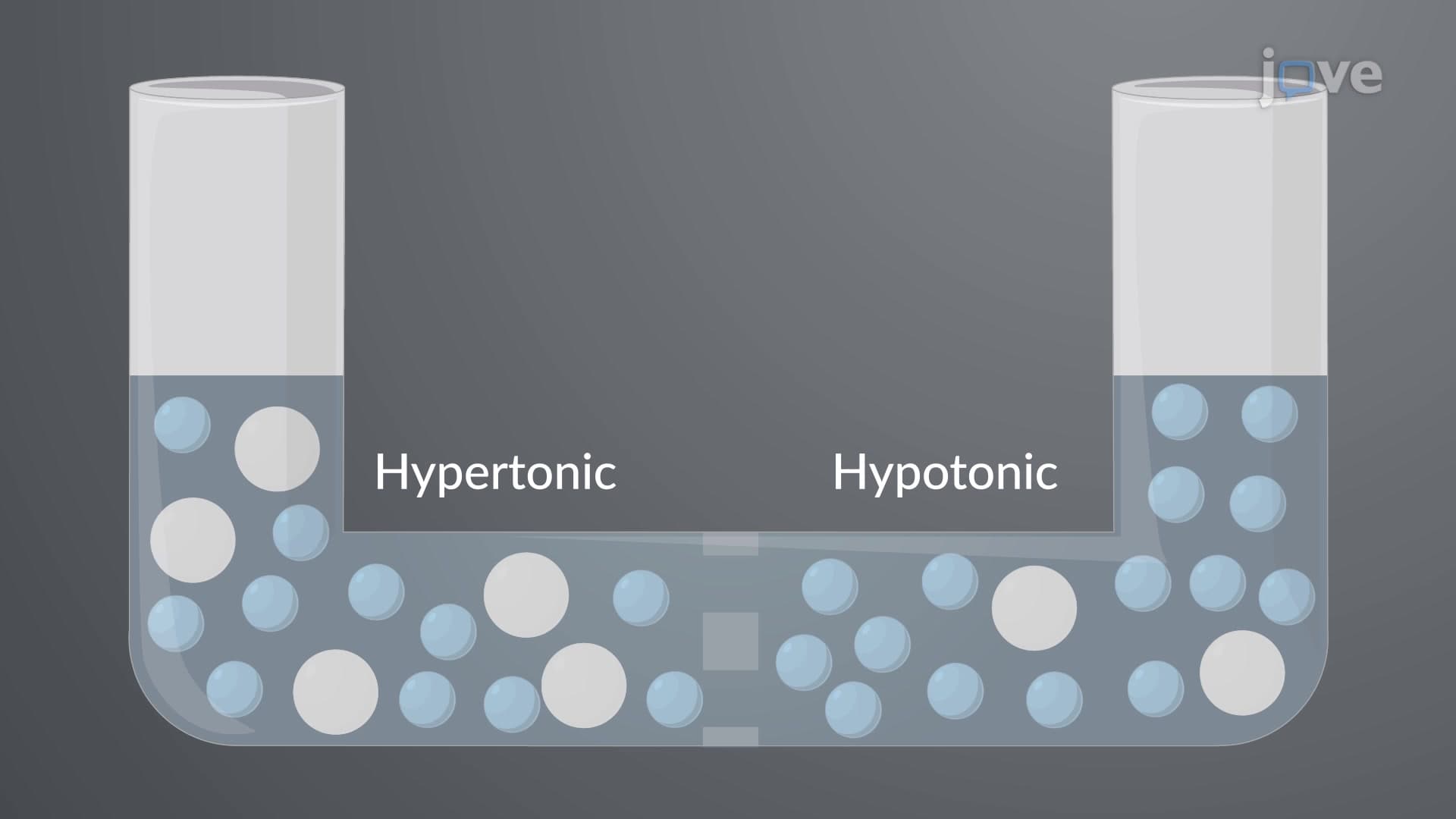
Osmosis represents one of nature's most elegant solutions to concentration imbalances. When a semipermeable membrane separates solutions of different concentrations, water molecules naturally move toward the region with higher solute concentration. This process continues until equilibrium is established or until opposing pressure halts the flow.
The driving force behind this phenomenon lies in the kinetic behavior of water molecules. In pure water, molecules move randomly in all directions. However, when solute particles are present, they occupy space and reduce the effective concentration of water molecules. This concentration gradient creates the thermodynamic driving force for osmosis.
Osmotic pressure follows the van't Hoff equation: π = MRT, where π represents osmotic pressure, M is molarity, R is the ideal gas constant (0.0821 L·atm/mol·K), and T is absolute temperature in Kelvin. This equation reveals osmosis as a colligative property-the magnitude depends only on particle concentration, not particle identity.
For example, a 1.00 M glucose solution at 25°C (298 K) generates an osmotic pressure of 24.5 atmospheres. This substantial pressure explains why osmotic effects are so pronounced in biological systems. Students preparing for the MCAT or AP Chemistry exam frequently encounter these calculations, particularly when analyzing physiological scenarios.
Medical professionals routinely apply osmotic principles when administering IV fluids. Normal saline (0.9% NaCl) serves as the standard isotonic solution because its osmotic pressure matches that of human blood plasma. This careful matching prevents cellular damage during treatment.
When red blood cells encounter hypertonic solutions, water exits the cells through membrane pores, causing crenation-the characteristic shriveling observed under microscopic examination. Conversely, hypotonic environments cause water influx, leading to cellular swelling and eventual hemolysis. These concepts appear frequently on nursing exams like the NCLEX and HESI A2, where understanding IV fluid selection is critical.
Emergency medicine provides compelling examples of osmotic pressure applications. Paramedics use isotonic crystalloid solutions like lactated Ringer's to restore blood volume without disrupting cellular osmotic balance. Research laboratories employ osmotic pressure measurements to determine molecular weights of large biomolecules, particularly proteins and polymers that cannot be analyzed through traditional methods.
Related Micro-courses