Loading…
Loading video…

9,204 views
Ever wonder how your smartphone's touchscreen responds instantly to your finger? Exponential and sinusoidal signals form the foundation of digital communication, but pulse functions like rectangular and triangular pulses serve as the building blocks for signal processing in devices from cardiac monitors at Johns Hopkins Hospital to radar systems used by the FAA. The Rectangular And Triangular Pulse Function Explained reveals how these mathematical tools transform continuous signals into the discrete digital data that powers modern technology. Watch the full video on JoVE Coach to master this concept with expert-led visuals and step-by-explanations.
Pulse functions represent some of the most fundamental building blocks in signal processing and electrical engineering. These mathematical tools allow engineers to model and analyze discrete events that occur over specific time intervals, from the brief electrical pulses in computer processors to the radar signals used by air traffic control systems across the United States.
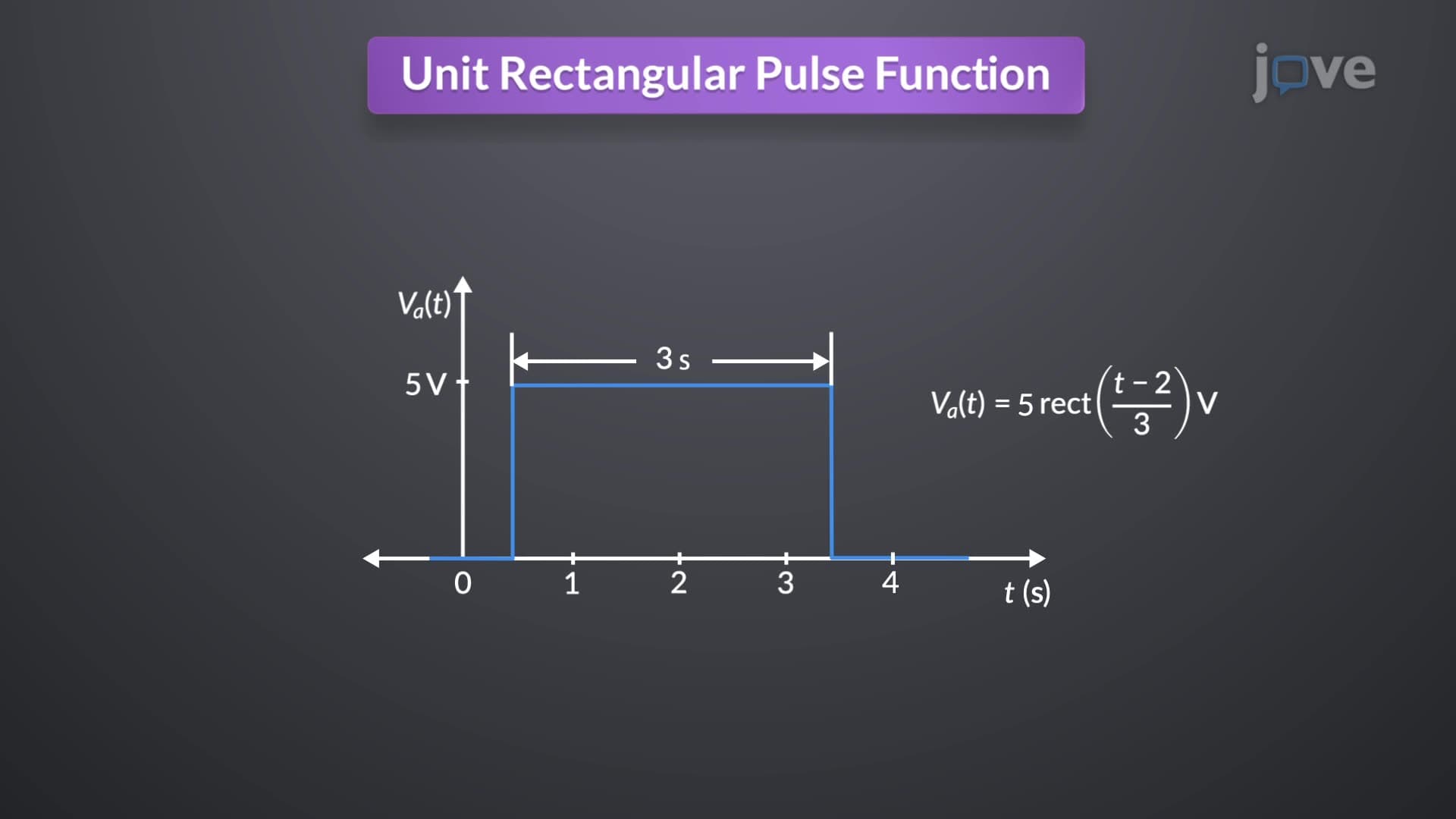
The rectangular pulse function serves as a mathematical representation of signals that maintain constant amplitude over a defined duration. This function proves essential in digital communications, where information is transmitted as discrete packets of data. Consider how your Netflix stream delivers video data—each packet can be modeled as a rectangular pulse with specific timing and amplitude characteristics.
Rectangular pulse functions are defined by three critical parameters that determine their behavior in time-domain analysis. The amplitude parameter sets the signal strength, while the duration parameter defines how long the pulse remains active. The center location parameter determines where the pulse occurs along the time axis, allowing engineers to model sequential events or synchronized operations.
For types of exponential and sinusoidal signals analysis, understanding pulse functions becomes crucial when examining how continuous sinusoidal waves interact with discrete sampling systems. In practical applications, such as the digital signal processors used in hearing aids manufactured by companies like Phonak in Illinois, rectangular pulses help convert continuous sound waves into discrete digital samples.
Triangular pulse functions offer different characteristics compared to their rectangular counterparts, providing smoother transitions that reduce high-frequency components in signal spectra. These functions prove particularly valuable in applications requiring gradual signal changes, such as the ramping circuits used in MRI machines at medical centers like the Mayo Clinic.
The mathematical expression of triangular pulses involves similar parameters to rectangular functions but creates a peaked waveform that rises linearly to maximum amplitude before declining symmetrically. This shape characteristic makes triangular pulses ideal for modeling natural phenomena and reducing signal distortion in communication systems.
Students preparing for AP Physics C exams or college-level electrical engineering courses encounter pulse functions as foundational concepts for understanding more complex signal processing topics. These functions appear frequently in SAT Subject Test Mathematics Level 2 questions and form the basis for advanced topics covered in undergraduate courses at institutions like MIT and Stanford.
In professional applications, understanding what are exponential and sinusoidal signals overview requires grasping how pulse functions interact with continuous signals. Engineers at companies like Texas Instruments and Intel utilize these concepts daily when designing the digital signal processing chips that power everything from smartphones to automotive control systems. The ability to decompose complex signals into simpler pulse components enables the sophisticated signal processing that makes modern technology possible.
Frequently Asked Questions
A rectangular pulse function is a mathematical tool that represents signals with constant amplitude over a specific time duration, while triangular pulses create peaked waveforms with linear rise and fall characteristics. Both serve as fundamental building blocks for analyzing discrete signals in electrical engineering and digital communications. These functions help model real-world phenomena like data transmission packets and sensor readings.
AP Physics C frequently tests pulse function concepts through problems involving signal analysis, wave superposition, and time-domain calculations. Students must demonstrate ability to sketch pulse waveforms, calculate parameters like amplitude and duration, and analyze how multiple pulses interact when combined. The College Board emphasizes understanding both mathematical representation and physical interpretation of these functions.
Advanced signal processing topics include Fourier analysis, convolution operations, and frequency domain representation of pulse trains. Students should explore how pulse functions relate to sampling theory, digital filter design, and modulation techniques used in telecommunications. These concepts appear in upper-level electrical engineering courses and graduate school entrance exams.
Pulse functions appear in numerous applications including cardiac pacemakers manufactured by Medtronic in Minneapolis, radar systems used by NOAA weather stations, and the digital signal processors in automotive systems produced by companies like General Motors in Detroit. These functions help engineers design everything from smartphone touchscreens to the communication systems used by NASA for space missions.
Pulse functions build naturally on basic algebra and graphing concepts taught in high school mathematics courses. Students with solid understanding of linear functions and coordinate geometry can readily grasp pulse function fundamentals. The visual nature of pulse waveforms makes these concepts more accessible than many advanced mathematics topics.
Focus on practicing waveform sketching, parameter identification, and step function manipulation techniques. Create study cards showing different pulse configurations and their mathematical expressions. Work through problems involving time shifts, amplitude scaling, and pulse combination operations. Many college physics and engineering programs use pulse functions extensively in laboratory exercises and theoretical problem sets.
Pulse functions often serve as input signals for systems that respond with exponential decay characteristics, such as RC circuits or biological processes. Understanding how rectangular and triangular inputs produce exponential outputs helps students analyze system behavior in both time and frequency domains. This relationship appears frequently in circuit analysis and system response problems.
Digital communication relies on pulse functions to represent binary data, with rectangular pulses commonly encoding ones and zeros in transmission systems. Companies like Verizon and AT&T use sophisticated pulse shaping techniques based on these fundamental concepts to maximize data transmission rates while minimizing interference. Understanding pulse functions provides the foundation for studying advanced modulation schemes used in 5G networks.
Related Micro-courses
Related Subjects
 Civil Engineering 30 micro-courses›Mechanical Engineering 28 micro-courses›