Loading video…


 16 Concepts
 3K views


Video Summary: The Quantity Theory of Money I Explained
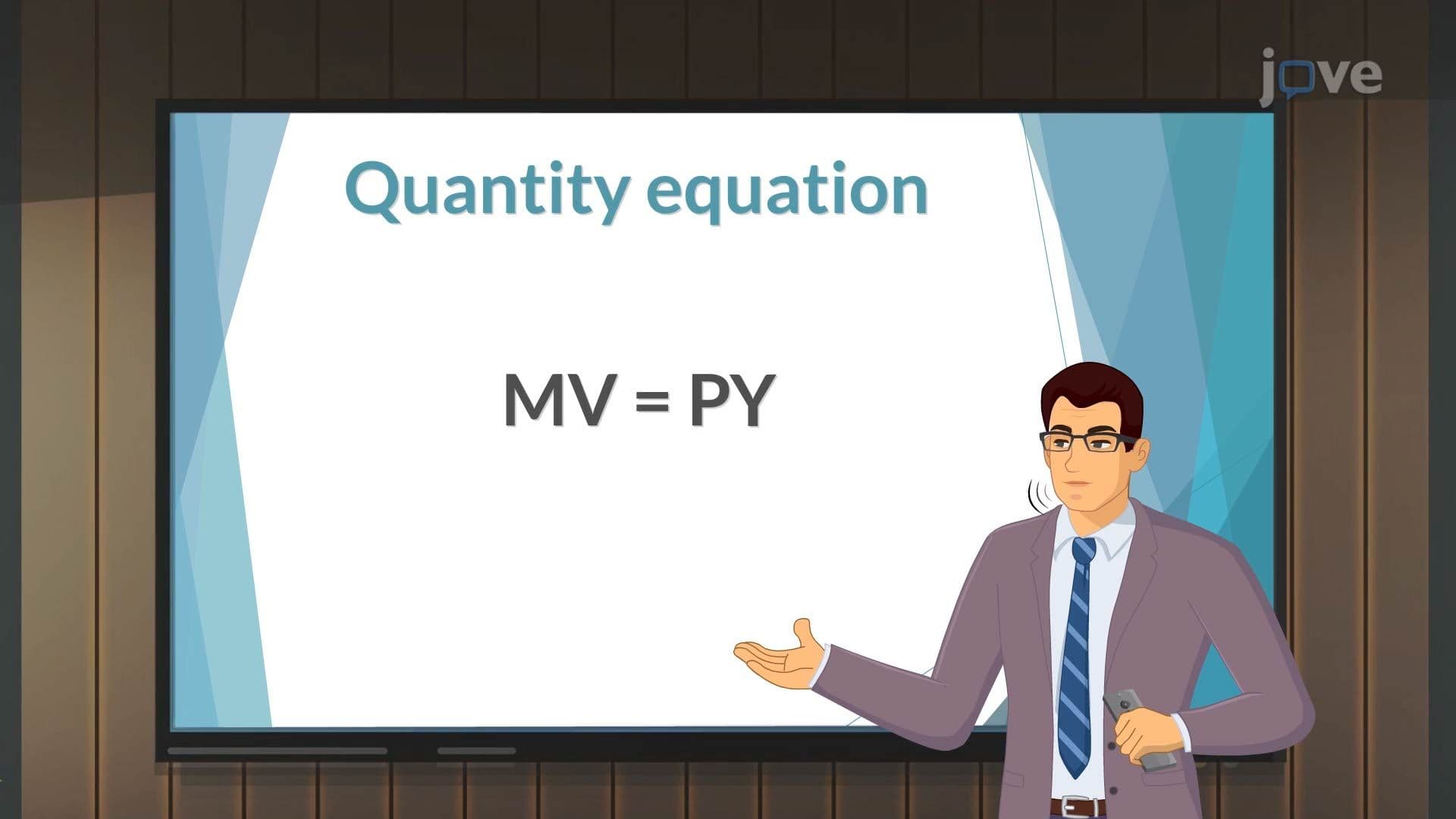
Ever wonder why a gallon of gas cost $0.30 in 1970 but over $3.00 today? The Quantity Theory of Money I explains this connection between money supply and price changes through a simple equation: MV = PT. Using a relatable example of a single dollar moving through a small town-from buying pizza to paying for carnival rides to purchasing comic books-this foundational economic concept shows how money velocity and supply directly impact what we pay for goods and services. Watch the full video on JoVE Coach to master this concept with expert-led visuals and step-by-step explanations.
The Quantity Theory of Money I represents one of economics' most fundamental principles, establishing a clear mathematical relationship between monetary variables and economic activity. This theory provides the foundation for understanding inflation, monetary policy, and price determination in market economies.
At its core, the theory revolves around four critical variables. The money supply (M) represents the total amount of money circulating in an economy-think of all the cash, checking accounts, and readily accessible funds available to consumers. Velocity (V) measures how frequently each dollar changes hands within a specific time period, essentially capturing the speed of economic activity. The price level (P) indicates the average cost of goods and services, while transactions (T) represents the total volume of economic exchanges.
The equation MV = PT elegantly captures these relationships. Consider the Federal Reserve's role in the US economy: when they increase the money supply by printing more dollars or lowering interest rates, this directly impacts M. If velocity and transactions remain relatively stable-a key assumption of the theory-then increases in M must result in proportional increases in P, leading to inflation.
This principle explains major economic events in US history. During the 1970s stagflation period, rapid money supply growth contributed to double-digit inflation rates. Conversely, the Federal Reserve's tight monetary policy in the early 1980s helped reduce inflation by controlling money supply growth.
For AP Economics students, this concept frequently appears in macroeconomics questions about monetary policy and inflation. College-level courses expand on these foundations, exploring how the theory applies to modern banking systems and international trade. The concept also appears in business school curricula when studying corporate finance and investment decisions.
Modern applications include cryptocurrency markets, where limited supply (like Bitcoin's 21 million coin cap) creates deflationary pressures, and quantitative easing programs where central banks inject money into economies during recessions. Understanding these relationships helps students analyze Federal Reserve decisions and their broader economic impacts.
While powerful, the Quantity Theory of Money I makes simplifying assumptions that don't always hold in complex modern economies. Velocity can fluctuate significantly during economic crises, as seen during the 2008 financial crisis when people held onto cash rather than spending it. Similarly, the relationship between money supply and inflation can be complicated by factors like international trade, technological advancement, and changing consumer behaviors.
Related Micro-courses