Loading…
Loading video…

6,845 views
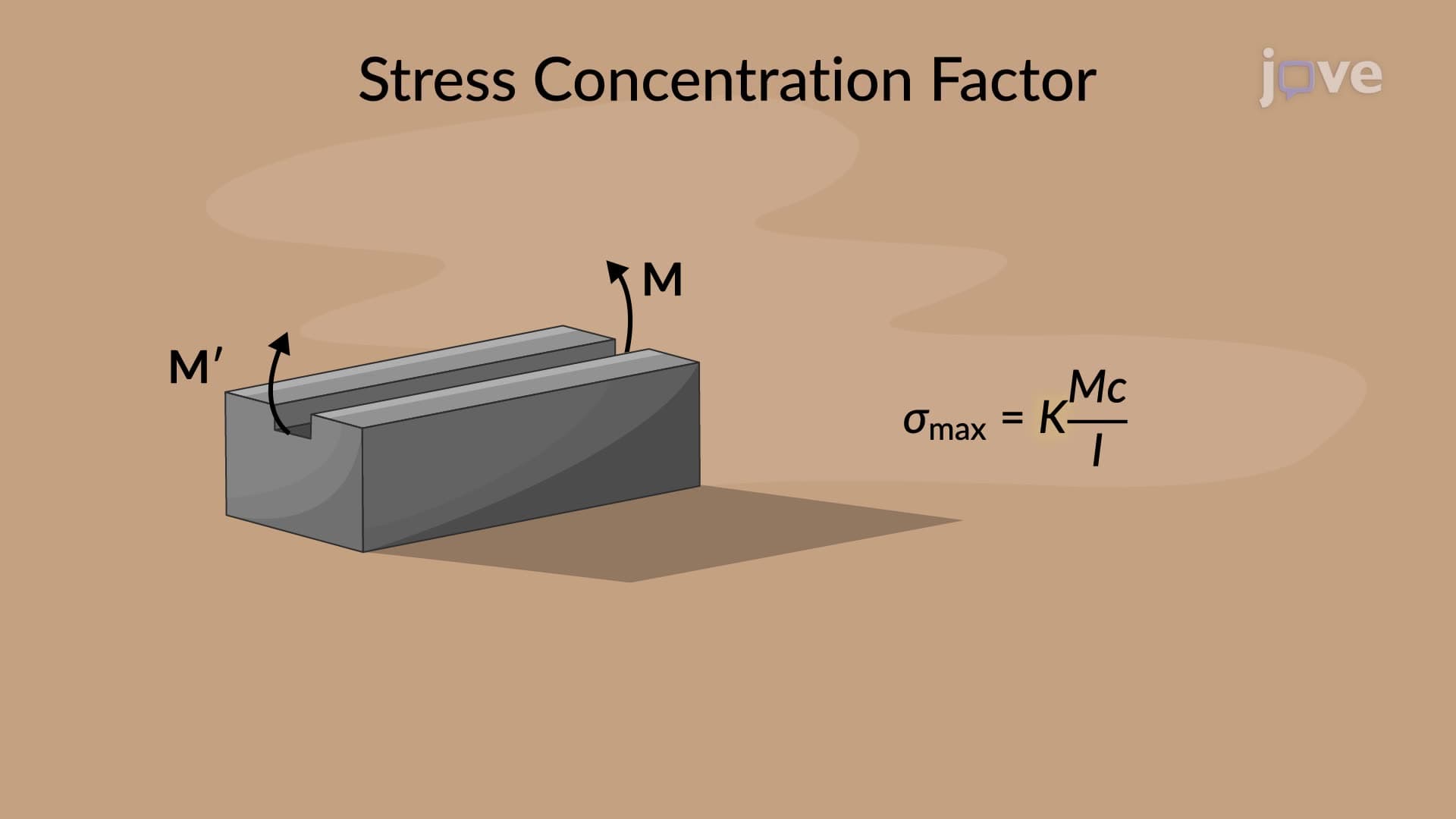
Ever wonder why airplane wings don't snap despite extreme forces? Stress concentrations occur when geometric features like holes, notches, or grooves cause stress to intensify at specific points rather than distribute evenly across a material's cross-section. Boeing engineers must carefully calculate these concentration factors when designing aircraft components to prevent catastrophic failure. The stress concentration factor quantifies how much the maximum stress exceeds the nominal stress in these critical areas. Watch the full video on JoVE Coach to master this concept with expert-led visuals and step-by-step explanations.
Stress concentrations represent one of the most critical concepts in materials science and mechanical engineering. When engineers assume uniform stress distribution across a material's cross-section, they're working with an idealized scenario. In reality, any geometric discontinuity—whether intentional like bolt holes or unintentional like manufacturing defects—creates localized areas where stress becomes significantly amplified.
The fundamental principle behind stress concentrations lies in how forces flow through materials. Think of stress lines like water flowing through a pipe: when the pipe suddenly narrows or encounters an obstacle, the water must squeeze through, creating higher pressure. Similarly, when stress encounters a geometric irregularity, it must "flow around" the discontinuity, resulting in higher stress values at specific locations.
The stress concentration factor (K) provides engineers with a quantitative tool to predict these stress amplifications. This dimensionless ratio compares the maximum stress occurring at a discontinuity to the nominal stress calculated using standard formulas for uniform cross-sections:
K = Maximum Stress / Nominal Stress
For a flat plate with a circular hole under tensile loading, the stress concentration factor can reach values of 3.0 or higher, meaning the actual stress is three times greater than the calculated nominal stress. This knowledge proves essential for AP Physics students tackling mechanics problems and college engineering majors preparing for materials science exams.
American infrastructure provides countless examples of stress concentration management. The Golden Gate Bridge's cable anchorages feature carefully designed transitions to minimize stress concentrations where cables attach to concrete structures. Similarly, aerospace manufacturers like Lockheed Martin must account for stress concentrations around rivet holes and access panels in aircraft fuselages.
In the automotive industry, Detroit's Big Three automakers extensively analyze stress concentrations in engine components. Connecting rods, for instance, feature carefully designed fillet radii at geometric transitions to prevent fatigue failures that could cause catastrophic engine damage.
Successful stress concentration management involves several strategies. Engineers can modify geometric features by adding fillet radii to sharp corners, gradually transitioning between different cross-sectional areas, or strategically placing reinforcement materials around high-stress regions. These principles appear frequently in MCAT physics sections and college-level statics courses, where students must demonstrate understanding of how geometric modifications affect structural performance.
Frequently Asked Questions
Stress concentrations occur when geometric features like holes, notches, or sharp corners cause stress to amplify beyond normal levels in localized areas. They matter because these high-stress regions often become failure initiation points, making them critical for ensuring structural safety and preventing catastrophic failures in everything from bridges to aircraft components.
These concepts frequently appear in mechanics problems involving stress analysis, material failure predictions, and design optimization scenarios. Students might encounter problems asking them to calculate stress concentration factors, compare different geometric configurations, or explain why certain design features help minimize stress concentrations in real structures.
Nominal stress represents the theoretical stress calculated assuming uniform distribution across a cross-section, while maximum stress is the actual highest stress occurring at geometric discontinuities. The stress concentration factor quantifies this difference, helping engineers predict where failures might occur.
NASA's Space Shuttle program extensively managed stress concentrations in the external tank design, where propellant lines attached to the main structure. Engineers used gradual geometric transitions and reinforcement rings to distribute loads and prevent the high stress concentrations that could lead to structural failure during launch.
While the mathematical calculations can be complex, the basic concept is quite intuitive—stress naturally increases around geometric irregularities, just like water pressure increases when flowing through a narrow opening. With proper foundation in basic physics and algebra, most students can grasp these fundamental principles.
Focus on understanding the relationship between geometry and stress amplification, practice calculating stress concentration factors using standard formulas, and work through problems involving different geometric configurations. Create visual aids showing how stress lines flow around various discontinuities to reinforce conceptual understanding.
Stress concentrations often serve as fatigue crack initiation sites because the amplified stress values exceed material endurance limits during cyclic loading. This connection explains why aircraft manufacturers pay such careful attention to stress concentrations around fastener holes and other geometric features subjected to repeated loading cycles.
Consider exploring fracture mechanics, which builds on stress concentration principles to predict crack propagation behavior. Finite element analysis methods for complex geometries and advanced materials like composites also represent natural progressions from fundamental stress concentration theory.
Related Micro-courses
Related Subjects
 Civil Engineering 30 micro-courses›Electrical Engineering 33 micro-courses›