Loading…
Loading video…

16,974 views
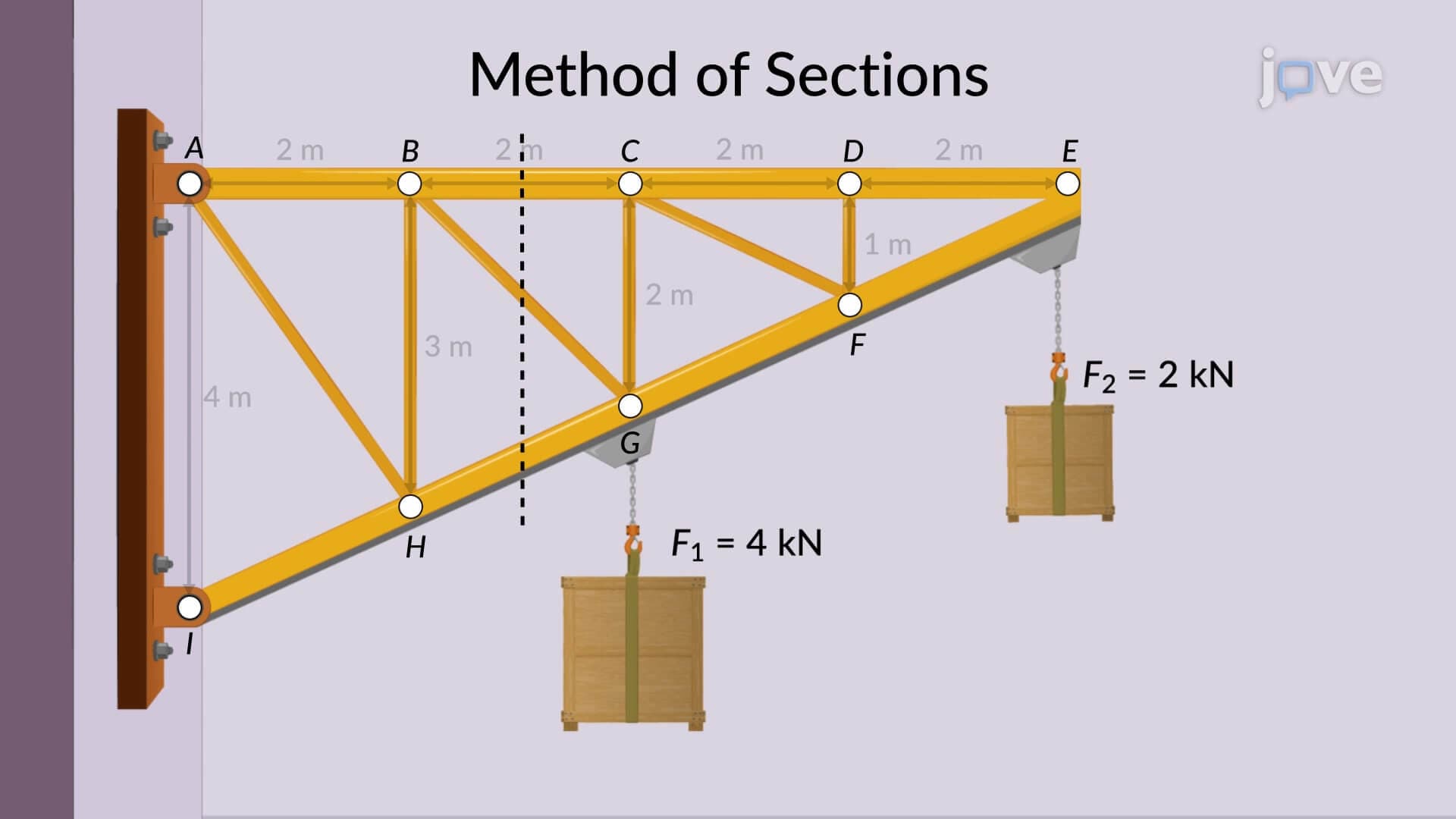
Ever wondered how engineers ensure the Golden Gate Bridge can withstand both traffic loads and earthquake forces? The method of sections problem solving ii technique allows structural engineers to calculate internal forces in specific truss members by strategically cutting through the structure. This advanced approach proves essential when analyzing complex frameworks like those found in California's seismic-resistant buildings, where precise force calculations determine safety margins. Watch the full video on JoVE Coach to master this concept with expert-led visuals and step-by-step explanations.
The Method of Sections Problem Solving II Guide represents an advanced structural analysis technique that extends beyond basic sectioning methods. This approach becomes particularly valuable when analyzing statically determinate trusses with complex loading patterns, such as those found in modern skyscrapers or long-span bridges across American cities.
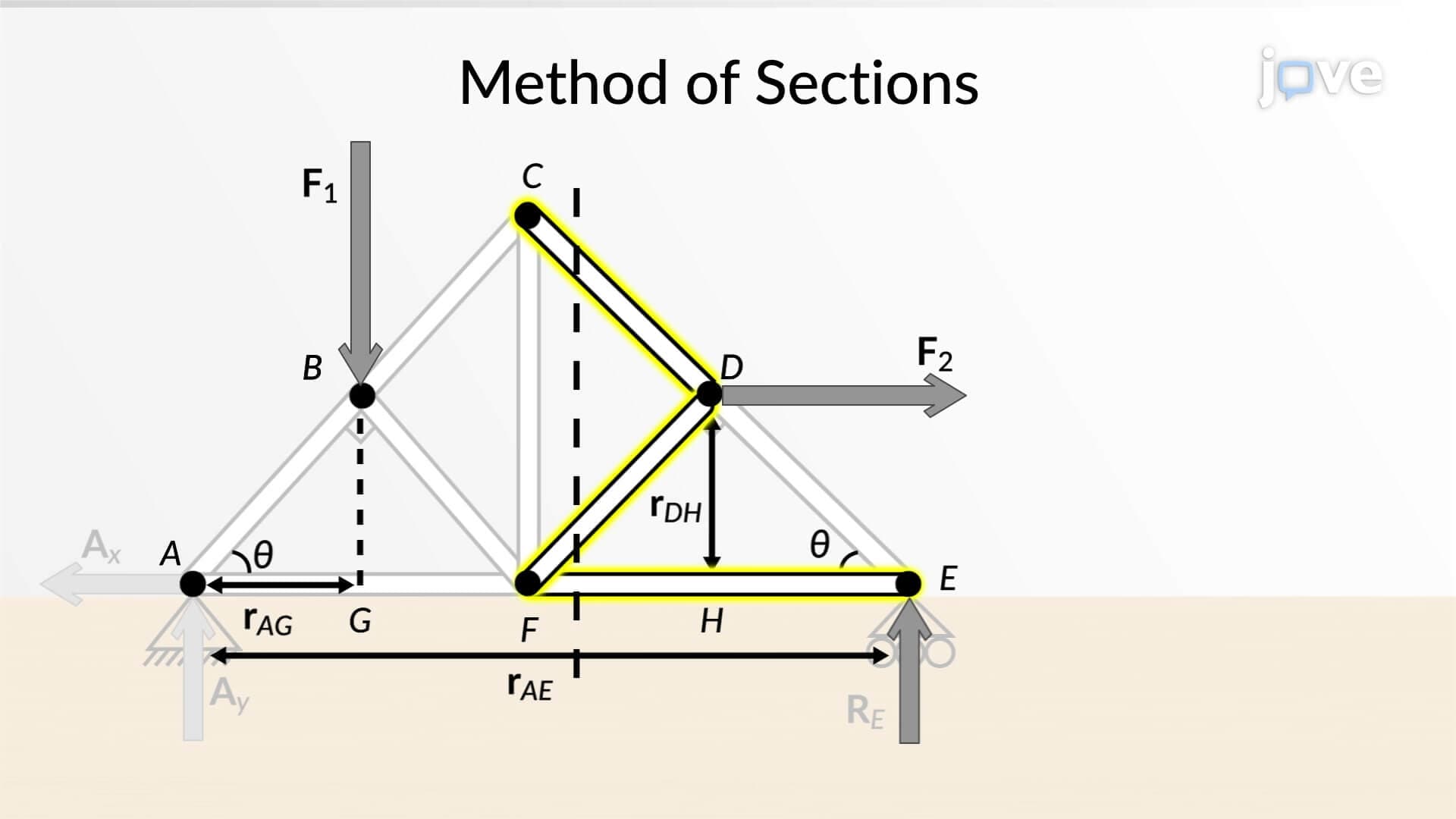
The foundation of successful sectioning lies in strategic cutting plane placement. Engineers must visualize the truss structure and identify which members require analysis, then position the cutting plane to intersect exactly three unknown members. This limitation stems from the three equilibrium equations available: two force equilibrium equations (horizontal and vertical) and one moment equilibrium equation.
When analyzing structures like the pedestrian bridges commonly found on college campuses such as UCLA or MIT, the cutting plane typically intersects diagonal, vertical, and horizontal members simultaneously. The resulting free-body diagram of one section becomes the key to unlocking internal forces.
The moment equilibrium equation serves as the most powerful tool in the method of sections arsenal. By strategically selecting the moment center point, engineers can eliminate two unknown forces from the equation, solving directly for the third. For instance, taking moments about point G in a truss system eliminates forces that pass through that point, leaving only one unknown force in the equation.
This technique proves invaluable in AP Physics C courses and engineering statics classes, where students must demonstrate mastery of equilibrium principles. The positive or negative result indicates whether the assumed force direction was correct, with positive values confirming tension and negative values indicating compression.
After determining one force through moment equilibrium, the remaining two forces emerge through simultaneous solution of the horizontal and vertical force equilibrium equations. This systematic approach mirrors problem-solving techniques emphasized in SAT Subject Test Mathematics Level 2 and college-level engineering coursework.
The final step involves proper force interpretation. Tension forces (positive values) indicate members under stretching stress, while compression forces (negative values) show members under squeezing stress. This distinction becomes critical in structural design, where different materials handle tension and compression differently – steel excels in tension, while concrete performs better in compression.
Frequently Asked Questions
The method of sections problem solving ii is an advanced structural analysis technique that uses strategic cutting planes and systematic equilibrium equations to determine internal forces in truss members. Unlike basic methods, it emphasizes optimal cutting plane selection and sophisticated equation-solving strategies. This approach proves essential for complex trusses with multiple loading conditions.
AP Physics C Mechanics exams frequently test sectioning concepts through equilibrium problems involving bridges or building frames. College engineering statics courses expand this to include complex loading scenarios and require students to justify cutting plane selection. Expect problems involving both graphical free-body diagrams and algebraic equation manipulation.
The SAT Subject Test in Physics (now discontinued but still relevant for practice) and AP Physics C Mechanics exam both feature structural analysis problems. College engineering programs test these concepts in statics courses, often as prerequisite material for the Fundamentals of Engineering (FE) exam. Many state university systems include sectioning problems in placement exams.
Engineers analyzing earthquake-resistant buildings in California use sectioning methods to verify that steel framework can handle seismic forces. Bridge designers working on projects like Seattle's SR 520 floating bridge apply these techniques to ensure cable and truss systems meet safety standards. The method helps determine whether structural members need reinforcement or redesign.
Students need solid algebra skills for simultaneous equations and basic trigonometry for slope triangles and force components. Familiarity with vector addition and equilibrium principles from introductory physics helps significantly. Most high school students taking AP Physics or Pre-Calculus possess adequate mathematical preparation for these concepts.
Practice drawing clear, labeled free-body diagrams and work systematically through equilibrium equations rather than jumping to calculations. Create a consistent problem-solving checklist: identify the cutting plane, draw the free-body diagram, write equilibrium equations, and check signs for physical meaning. Review multiple problem types to recognize optimal cutting plane patterns.
Students should explore method of virtual work for complex structures and matrix methods for computer-aided structural analysis. Advanced courses cover influence lines for moving loads and dynamic analysis for earthquake and wind loading. These topics form the foundation for structural engineering specialization in civil engineering programs.
The method of sections requires more strategic thinking than joint analysis but offers greater flexibility for complex problems. Students typically find the concept moderately challenging, requiring practice to develop intuition for cutting plane placement. The algebraic manipulation resembles familiar simultaneous equation solving from algebra courses.
Related Micro-courses
Related Subjects
 Civil Engineering 30 micro-courses›Electrical Engineering 33 micro-courses›