Loading…
Loading video…

16,974 views
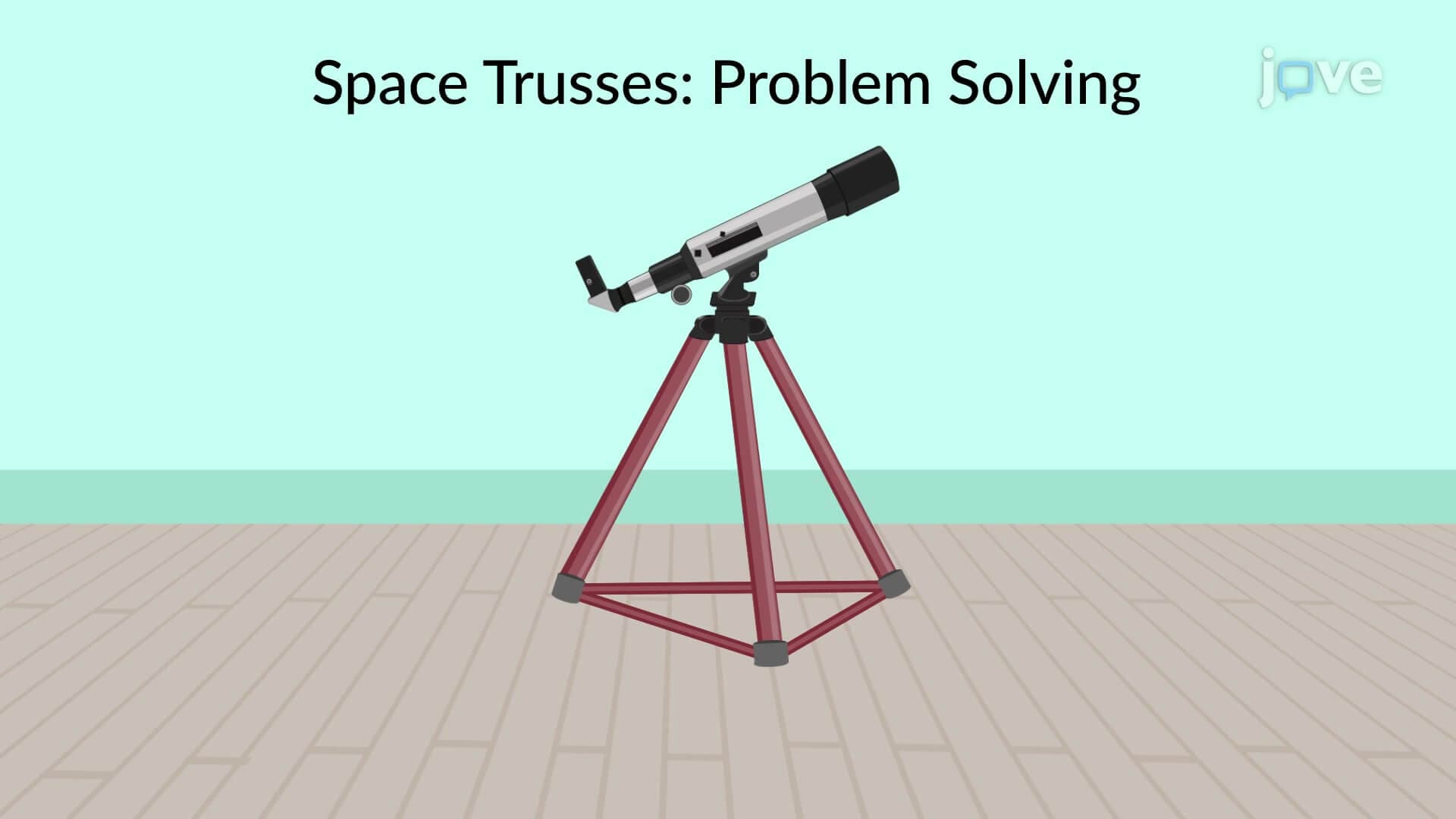
Ever wondered how engineers ensure the Golden Gate Bridge's towers can withstand massive wind loads and seismic forces? Space trusses problem solving is the structural analysis method that makes these calculations possible, using three-dimensional force equilibrium to determine internal member forces in complex frameworks. This systematic approach involves creating free-body diagrams, applying moment and force equilibrium conditions, and using position vectors to solve for unknown forces in tetrahedral and other 3D truss configurations. Watch the full video on JoVE Coach to master this concept with expert-led visuals and step-by-step explanations.
Space trusses problem solving represents a critical structural analysis technique that extends traditional 2D truss analysis into three-dimensional space. Unlike planar trusses that operate in a single plane, space trusses involve members oriented in multiple directions, creating complex load paths that require sophisticated mathematical treatment. This problem-solving approach is essential for analyzing real-world structures like transmission towers, space frames in modern buildings, and offshore drilling platforms.
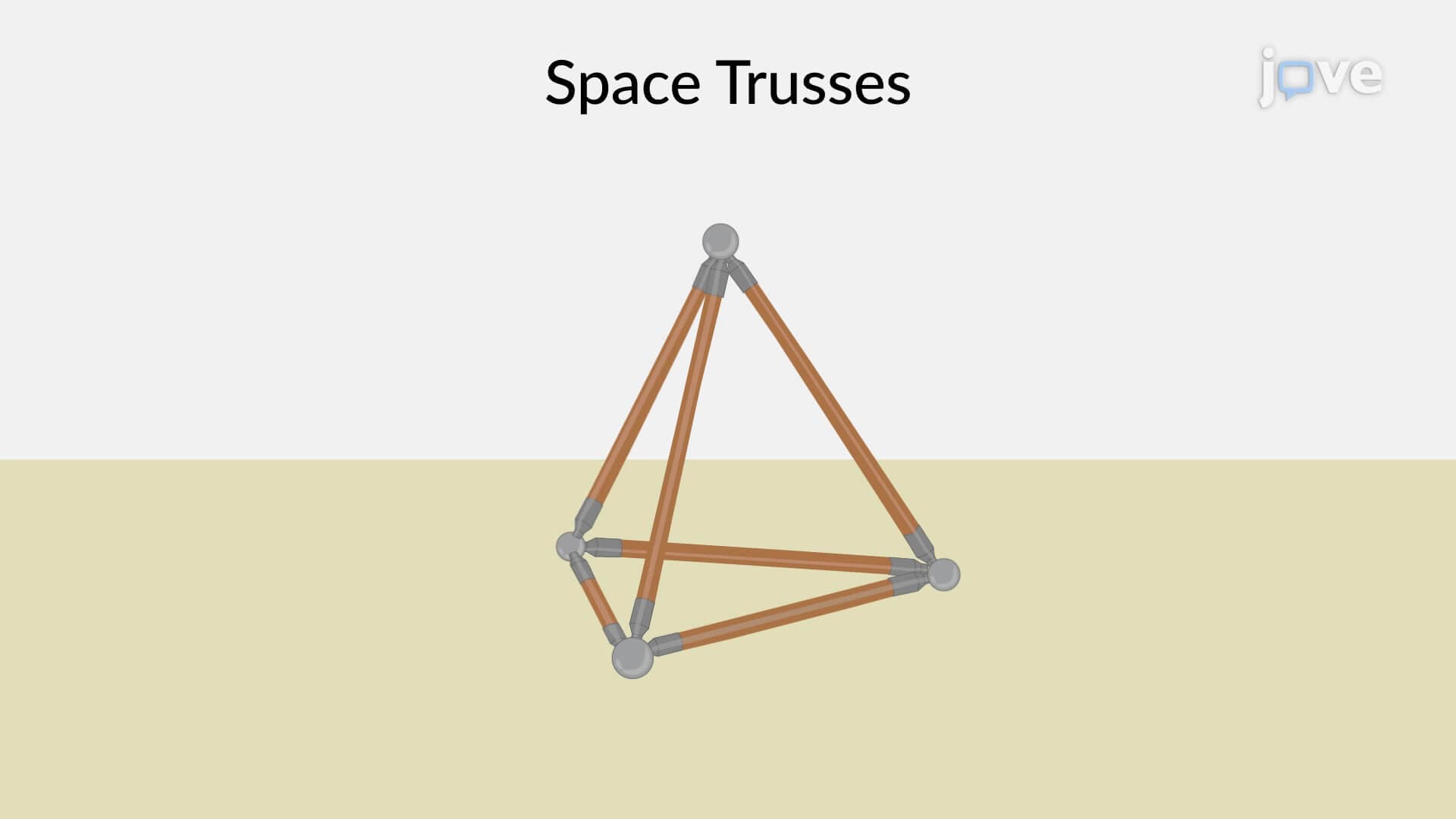
The foundation of space trusses problem solving lies in creating accurate free-body diagrams that isolate individual joints or sections of the structure. For a tetrahedral space truss with ball-and-socket joints, engineers must account for three translational degrees of freedom at each connection point. The equilibrium conditions require that the sum of forces equals zero in all three directions (ΣFx = 0, ΣFy = 0, ΣFz = 0) and the sum of moments equals zero about any point (ΣM = 0). This systematic approach ensures that all internal forces and reactions are properly accounted for in the analysis.
Modern space trusses problem solving heavily relies on position vector mathematics to express member orientations and force directions. By defining position vectors between joints, engineers can establish unit direction vectors that simplify force component calculations. For example, if member BC connects points B and C, the unit vector along BC helps decompose the member force into i, j, and k components. This vector-based approach is particularly powerful when dealing with complex geometries where traditional trigonometric methods become unwieldy.
Students encounter space trusses problem solving concepts in AP Physics C courses, college-level statics classes, and engineering mechanics examinations. The tetrahedral truss example—commonly featuring a tripod configuration with applied loads—appears frequently on structural analysis exams because it demonstrates all key principles while remaining computationally manageable. Understanding this problem-solving methodology prepares students for advanced topics in structural engineering, aerospace design, and mechanical system analysis where three-dimensional force systems are the norm rather than the exception.
Frequently Asked Questions
Space trusses problem solving is a structural analysis method for determining forces in three-dimensional truss systems using equilibrium equations and vector mathematics. Unlike 2D truss analysis that considers forces in a single plane, space trusses involve members oriented in multiple directions, requiring consideration of force components along three perpendicular axes. This approach is essential for analyzing real structures like transmission towers, space frames, and complex building frameworks.
Space trusses problems typically appear as multi-part questions involving tetrahedral or pyramidal configurations with applied loads and support reactions. Students must draw free-body diagrams, apply equilibrium conditions, and solve systems of equations to find member forces. These problems test understanding of 3D force systems, vector mathematics, and systematic problem-solving approaches that are fundamental to engineering mechanics.
The tetrahedral configuration provides an ideal balance of complexity and solvability for educational purposes. Ball-and-socket joints eliminate moment transfer between members, simplifying the analysis to pure force equilibrium conditions. This setup allows students to focus on the essential concepts of 3D force resolution and equilibrium without getting overwhelmed by additional rotational effects.
Engineers apply these principles when designing large-span structures such as the roof systems at AT&T Stadium in Texas or MetLife Stadium in New Jersey. The analysis helps determine member sizes needed to safely carry wind loads, snow loads, and dead loads while ensuring the structure remains stable under all loading conditions. This same methodology applies to designing transmission towers, communication arrays, and offshore platforms.
While space trusses involve 3D thinking and vector mathematics, the fundamental concepts are accessible to students with solid algebra and trigonometry backgrounds. The key is starting with simple configurations like tetrahedral trusses and building understanding systematically. Many AP Physics C students successfully master these concepts when presented with clear visual aids and step-by-step solution procedures.
Focus on drawing clear, detailed free-body diagrams and systematically applying equilibrium equations in a consistent order. Practice identifying member orientations using position vectors, and always check your answers by verifying that all equilibrium conditions are satisfied. Work through multiple example problems with different loading scenarios to build pattern recognition and solution confidence.
Students can advance to studying space frames with rigid joints that transmit moments, indeterminate space trusses requiring additional compatibility equations, and dynamic analysis of 3D structures. These topics appear in advanced structural analysis courses and prepare students for specialized areas like aerospace structures, seismic design, and advanced mechanical system analysis.
Related Micro-courses
Related Subjects
 Civil Engineering 30 micro-courses›Electrical Engineering 33 micro-courses›