Loading…
Loading video…

62,490 views
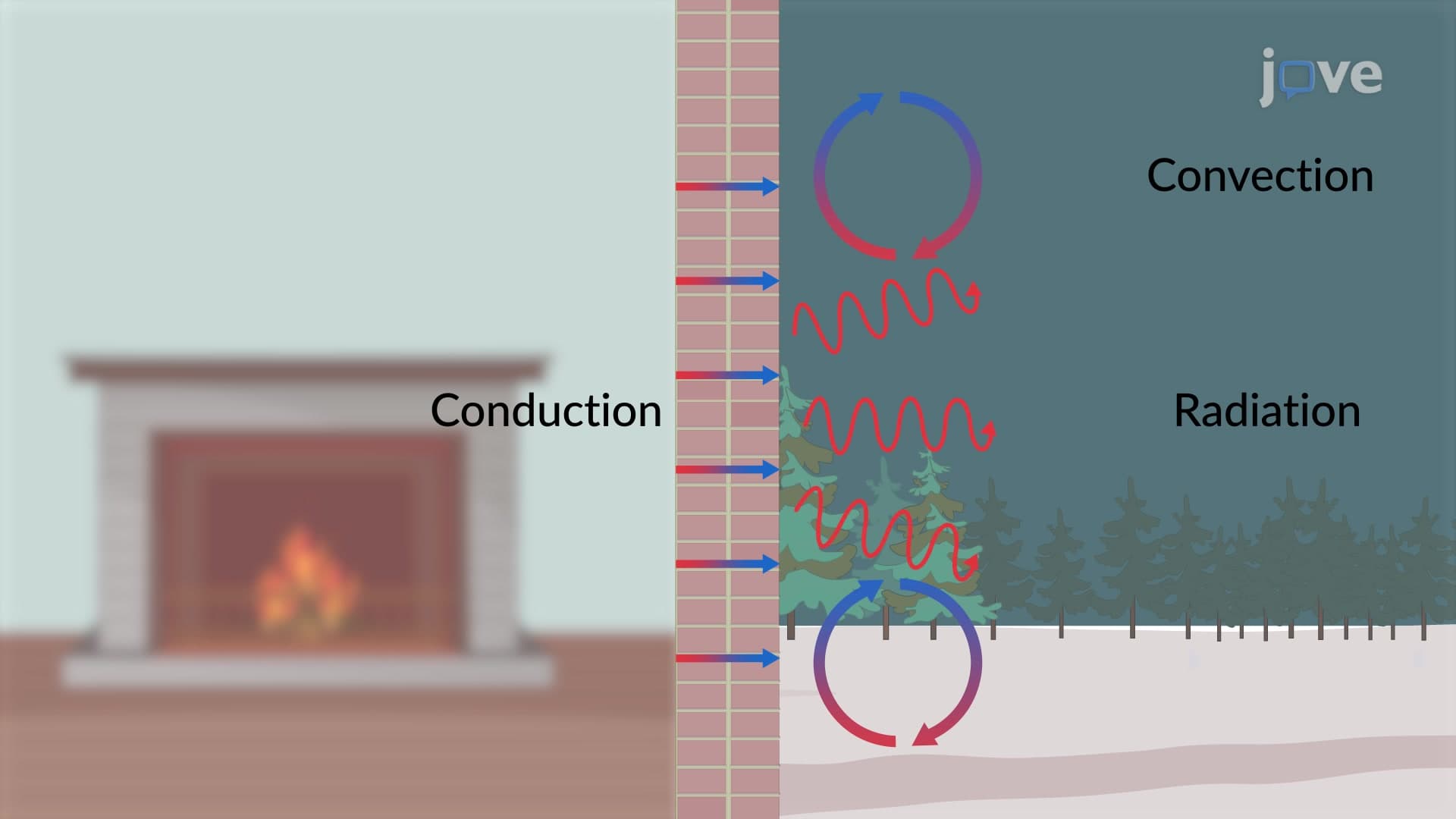
Ever wonder why your house loses heat even with perfect insulation? Conduction convection and radiation problem solving reveals how all three heat transfer mechanisms work simultaneously in real structures. Consider a typical home in Minnesota during winter—heat escapes through walls via conduction, air currents create convective losses, and surfaces radiate energy to the cold outdoors. This comprehensive approach to Conduction Convection And Radiation Problem Solving Explained demonstrates how engineers calculate total heat loss by analyzing each mechanism systematically. Watch the full video on JoVE Coach to master this concept with expert-led visuals and step-by-step explanations.
When tackling complex thermal problems, engineers must consider all three heat transfer mechanisms working together. Unlike simplified textbook problems that isolate individual modes, real-world scenarios—from NASA spacecraft thermal management to energy-efficient building design—require comprehensive analysis of conduction, convection, and radiation simultaneously.
The key to mastering conduction convection and radiation problem solving lies in methodical analysis. Start by identifying each heat transfer mode present in your system. For the wall problem presented, conduction occurs through the solid material (using Fourier's law: q = kA(ΔT)/L), while convection and radiation happen at the outer surface. Convection follows Newton's law of cooling (q = hA(ΔT)), and radiation uses the Stefan-Boltzmann equation (q = εσA(T₁⁴ - T₂⁴)).
Students preparing for AP Physics or college-level heat transfer courses should practice breaking down complex problems into these fundamental components. The conservation of energy principle ensures that heat conducted through the wall equals the sum of convective and radiative heat losses at the surface.
This conduction convection and radiation problem solving concept appears frequently in practical applications. Building codes in states like California require thermal analysis for energy efficiency compliance. HVAC engineers use these principles when designing systems for hospitals, where precise temperature control is critical. Similarly, automotive engineers apply combined heat transfer analysis when designing engine cooling systems or electric vehicle battery thermal management.
For students tackling MCAT physics sections or engineering thermodynamics exams, focus on the problem-solving methodology rather than memorizing specific numbers. Practice identifying which equations apply to each mode, understanding when radiation becomes significant (typically at high temperatures or large temperature differences), and recognizing that convection coefficients vary dramatically based on fluid properties and flow conditions.
The understanding conduction convection and radiation problem solving framework builds critical thinking skills essential for advanced engineering courses and professional practice in thermal sciences.
Frequently Asked Questions
Conduction convection and radiation problem solving is the integrated analysis of all three heat transfer mechanisms occurring simultaneously in real systems. You study them together because most practical thermal problems—from home insulation to spacecraft design—involve multiple modes operating at once, making isolated analysis incomplete and inaccurate.
AP Physics typically includes multi-step thermal problems requiring you to identify different heat transfer modes and apply appropriate equations. You might encounter scenarios like calculating heat loss through building walls or analyzing thermal equilibrium in complex systems. Practice breaking problems into component parts and applying conservation of energy principles.
The challenge lies in simultaneously managing multiple equations with different variables and units while applying conservation principles correctly. College exams often feature complex geometries, variable properties, and coupled thermal systems. Success requires systematic problem decomposition and careful attention to boundary conditions.
Engineers apply these principles when calculating HVAC loads, designing insulation systems, and ensuring compliance with energy codes like ASHRAE standards. For example, designing a hospital in Texas requires analyzing heat gain through windows (radiation), heat conduction through walls, and convective losses to properly size air conditioning systems.
Basic algebra and understanding of scientific notation suffice for most introductory problems. The key is methodical thinking rather than complex mathematics. Focus on identifying which heat transfer mode applies, selecting correct equations, and applying conservation of energy systematically.
Create a systematic checklist: identify heat transfer modes present, write governing equations for each mode, apply conservation principles, and verify units throughout calculations. Practice with diverse problem types from textbooks like Incropera & DeWitt, focusing on methodology over memorizing specific solutions.
Advance to computational heat transfer methods, transient thermal analysis, or specialized applications like heat exchangers and thermal management systems. Consider exploring finite element analysis software used in engineering practice for complex thermal problems.
The MCAT physics section tests your understanding of heat transfer principles through passage-based questions often involving biological systems or medical applications. Focus on conceptual understanding of each mode and practice applying conservation of energy to physiological scenarios like body temperature regulation.
Mechanical engineering, aerospace engineering, chemical engineering, and architecture all require these skills. Specific applications include designing thermal management for electronics, developing energy-efficient buildings, creating medical devices requiring precise temperature control, and optimizing industrial heating and cooling processes.
Related Micro-courses


Related Subjects
 Math Fundamentals 11 micro-courses›
 Statistics 17 micro-courses›