Loading…
Loading video…

4,292 views

Did you know that statistical process control helped reduce surgical site infections by over 50% at major US hospitals? Statistical process control is a powerful quality management system that uses data analysis to monitor and improve processes across industries. From Boeing's aircraft manufacturing to Mayo Clinic's patient safety protocols, this methodology transforms how organizations maintain consistent quality standards. What is Statistical Process Control becomes clear when you see its real-world impact on reducing defects and improving outcomes. Watch the full video on JoVE Coach to master this concept with expert-led visuals and step-by-step explanations.
Statistical Process Control represents a systematic approach to quality management that revolutionized modern industry. At its core, SPC uses statistical techniques to monitor, control, and improve processes by distinguishing between common cause variation (natural fluctuations) and special cause variation (abnormal changes requiring investigation). This statistical process control definition emphasizes data-driven decision making over subjective judgment calls.
The methodology originated during World War II when Walter Shewhart developed control charts to improve manufacturing consistency. Today, understanding what is statistical process control in detail requires recognizing its universal applicability across sectors. From pharmaceutical companies ensuring drug potency to food manufacturers maintaining safety standards, SPC provides the framework for consistent quality delivery.
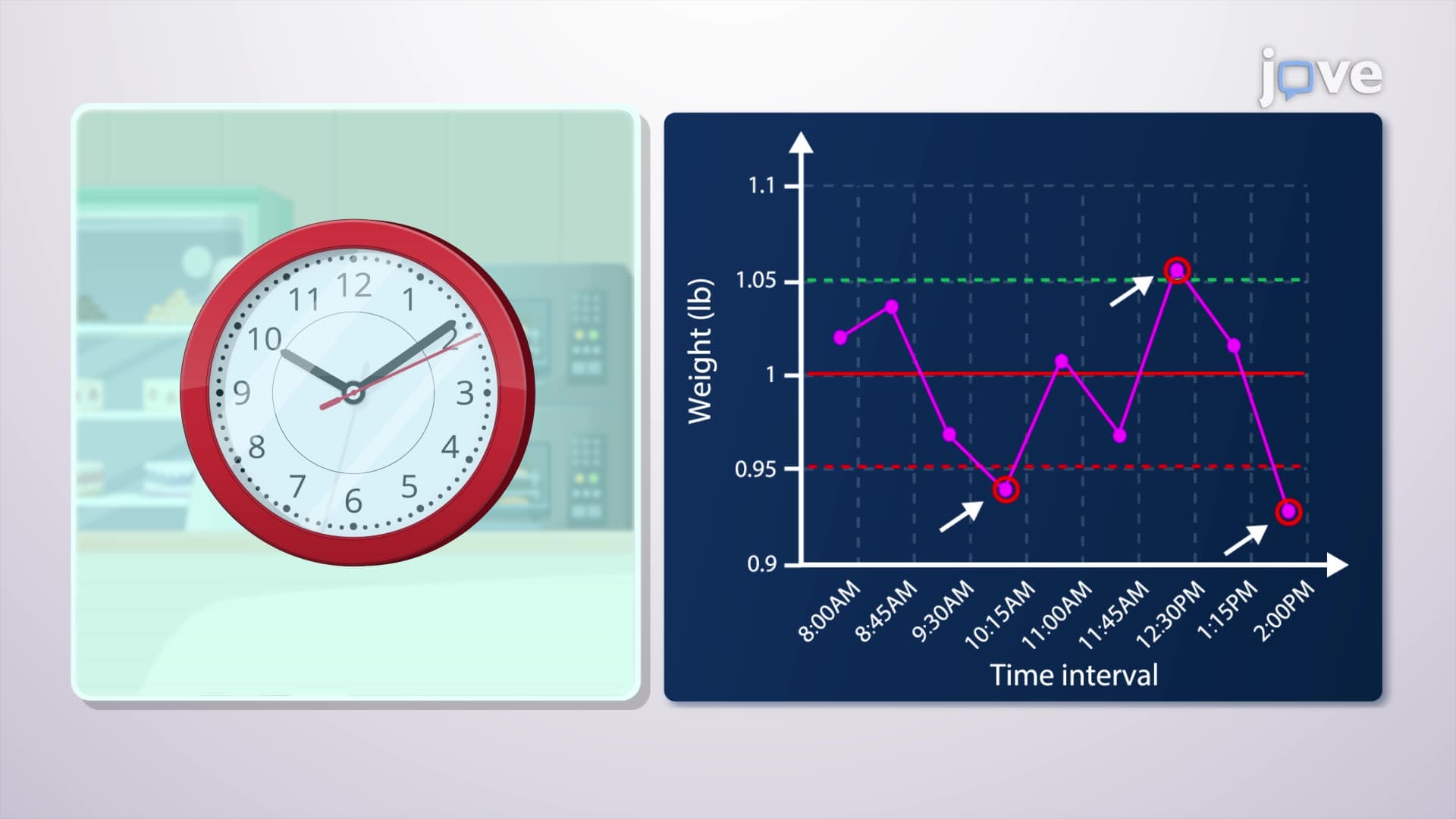
Control charts serve as the primary tool for statistical process control overview, displaying process data over time with statistically calculated upper and lower control limits. These visual representations help operators identify when processes drift outside acceptable parameters. For example, a hospital laboratory might use X-bar and R charts to monitor blood test accuracy, ensuring results remain within clinically acceptable ranges.
Different chart types serve specific purposes: X-bar charts track process averages, R charts monitor variation ranges, and p-charts handle attribute data like defect rates. Students preparing for AP Statistics or college-level quality management courses should understand these distinctions, as they frequently appear in exam scenarios involving process capability analysis.
In manufacturing, companies like General Electric use SPC to maintain jet engine component tolerances within microscopic specifications. Healthcare systems implement SPC for infection control monitoring, medication error tracking, and patient satisfaction improvements. Service industries apply these principles to reduce customer wait times and improve service consistency.
The statistical process control concept extends beyond traditional quality control into business analytics and performance management. Modern SPC software integrates with enterprise systems, providing real-time monitoring capabilities that enable immediate corrective actions when processes show signs of instability.
For students pursuing STEM careers, statistical process control basics form essential knowledge for quality engineering, operations management, and data science roles. College courses in industrial engineering, business operations, and healthcare administration frequently include SPC modules. Professional certifications like ASQ's Certified Quality Engineer examination test comprehensive SPC understanding, making this statistical process control study guide relevant for career advancement in quality-focused industries.
Frequently Asked Questions
Statistical Process Control is a quality management methodology that uses statistical tools to monitor and control processes, ensuring consistent output quality. It's important because it helps organizations reduce defects, minimize waste, and make data-driven improvements rather than relying on guesswork. SPC saves companies millions annually by preventing quality issues before they become costly problems.
AP Statistics and college statistics exams often include SPC problems involving control chart interpretation, calculating control limits, and identifying out-of-control conditions. Students might analyze real manufacturing data to determine process stability or calculate process capability indices. These questions test understanding of normal distributions, hypothesis testing, and data interpretation skills.
Quality management exams typically feature X-bar and R charts, p-charts for attribute data, c-charts for count data, and individual moving range charts. Exam questions often require identifying appropriate chart types for specific situations, interpreting control chart patterns, and calculating control limits using provided formulas. Understanding when processes are in statistical control versus out-of-control is crucial for certification success.
Hospitals use SPC to monitor infection rates, medication errors, patient wait times, and readmission rates through control charts that track these metrics over time. When control charts show unusual patterns, healthcare teams investigate root causes and implement corrective measures. For example, surgical departments might track infection rates weekly, using SPC to identify when new protocols successfully reduce complications.
Statistical Process Control builds on basic statistics concepts like mean, standard deviation, and normal distributions that high school students already learn. While the applications can be complex, the fundamental concepts are accessible with proper guidance. Students with strong algebra skills and basic statistics knowledge can successfully master SPC principles through practice and real-world examples.
Focus on understanding control chart interpretation through practice problems using real industrial data sets. Create flashcards for different chart types and their applications, practice calculating control limits by hand, then verify using software. Work through case studies from manufacturing and healthcare to see practical applications. Form study groups to discuss challenging scenarios and quiz each other on chart pattern recognition.
Statistical Process Control forms a foundational element within Six Sigma's DMAIC (Define, Measure, Analyze, Improve, Control) framework, particularly in the Measure and Control phases. Six Sigma practitioners use SPC tools to establish baseline measurements and maintain improvements over time. Understanding SPC prepares students for advanced quality methodologies and Lean Six Sigma certifications that are valuable in engineering and business careers.
Quality engineers, manufacturing engineers, healthcare quality managers, data analysts, and operations managers all use SPC regularly in their roles. Industries like aerospace, pharmaceuticals, automotive, and healthcare specifically seek professionals with SPC expertise. Companies like Boeing, Johnson & Johnson, and Ford Motor Company list SPC knowledge as preferred qualifications for engineering and management positions.
Related Micro-courses



Related Subjects
 Physics 33 micro-courses›
 Math Fundamentals 11 micro-courses›