Loading video…

 15 Concepts
 651 views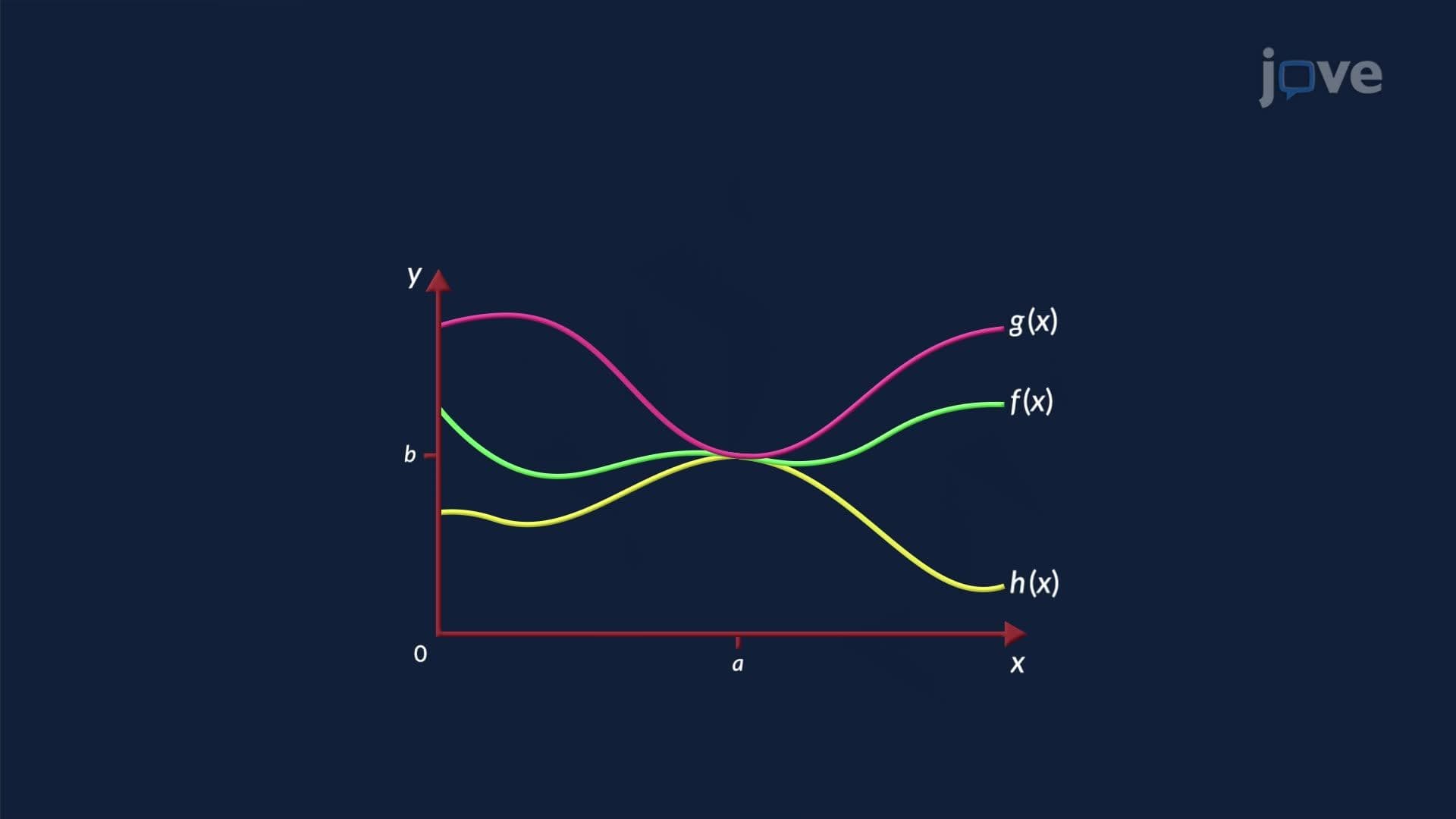

Video Summary: What Is the Squeeze Theorem
Ever wondered how GPS systems calculate your exact position when satellite signals fluctuate wildly? The squeeze theorem provides the mathematical foundation for such precision by determining limits when functions oscillate unpredictably between bounds. This powerful calculus concept shows how a function trapped between two converging boundaries must also converge to the same limit. Engineers at companies like Boeing use this principle to ensure aircraft navigation systems maintain accuracy despite signal interference. Watch the full video on JoVE Coach to master this concept with expert-led visuals and step-by-step explanations.
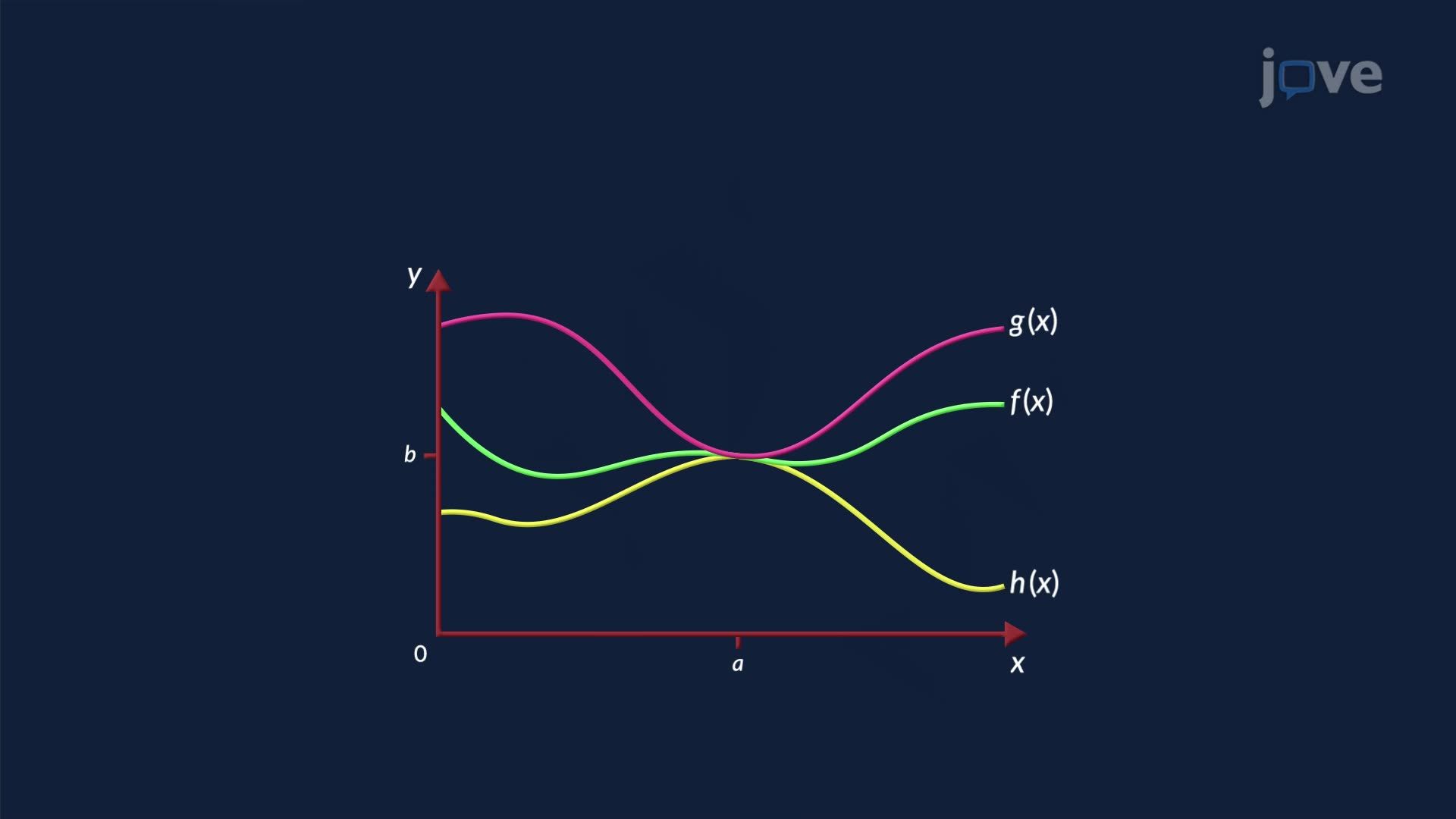
The squeeze theorem (also called the sandwich theorem) represents one of calculus's most elegant limit-finding tools. When a function f(x) remains trapped between two bounding functions g(x) and h(x) near a specific point, and both bounds approach the same limit L, then f(x) must also approach L. This concept proves invaluable when direct substitution or algebraic manipulation cannot determine a limit.
For the squeeze theorem to work, three conditions must be satisfied: First, g(x) ≤ f(x) ≤ h(x) for all x in an interval containing point a (except possibly at a itself). Second, both lim(x→a) g(x) = L and lim(x→a) h(x) = L must exist and equal the same value. Third, when these conditions hold, lim(x→a) f(x) = L automatically follows. This mathematical sandwich forces the middle function to converge, regardless of how chaotically it behaves between the bounds.
The most common squeeze theorem applications involve trigonometric functions with indeterminate forms. Consider lim(x→0) x²sin(1/x), which cannot be evaluated directly since sin(1/x) oscillates infinitely as x approaches zero. However, since -1 ≤ sin(1/x) ≤ 1 for all x ≠ 0, multiplying by x² gives -x² ≤ x²sin(1/x) ≤ x². Both bounds approach zero as x approaches zero, forcing the middle function to zero as well. Students preparing for AP Calculus exams frequently encounter such problems, where recognizing the squeeze theorem application becomes crucial for success.
Beyond academic settings, the squeeze theorem concept appears throughout engineering and science. NASA engineers use bounded estimation techniques when calculating spacecraft trajectories, where measurement uncertainties create upper and lower bounds for position calculations. Similarly, structural engineers at firms like Skidmore, Owings & Merrill apply squeeze theorem principles when analyzing building stress patterns, using conservative upper and lower estimates to ensure safety margins. Financial analysts also employ similar bounded convergence concepts when modeling market volatility, particularly in derivatives pricing where oscillating values must converge within calculated ranges.
Related Micro-courses