Loading subject page…
- New Manager Essentials
- Aligning People and Roles in Teams
New Manager Essentials
All Micro-courses:13

1.
Transitioning from Individual Contributor to Manager
6 Concepts
2.
Building a Managerial Mindset
7 Concepts
3.
Setting Clear Goals and Expectations
9 Concepts
4.
Aligning People and Roles in Teams
5 Concepts
5.
How to Delegate Work with Clarity and Accountability
7 Concepts
6.
Coaching and Developing Teams
7 Concepts
7.
How to Manage Team Performance and Feedback
13 Concepts
8.
How Can You Lead with Emotional Intelligence
5 Concepts
9.
How to Handle Difficult Conversations
5 Concepts
10.
How to Motivate and Recognize Teams
8 Concepts
11.
Managing Team Operations and Priorities
9 Concepts
12.
How to Build Trust and Collaboration
6 Concepts
13.
How Can You Manage Upward and Across Teams Effectively
6 Concepts
Aligning People and Roles in Teams
 5 Concepts
 2.7K Views
 Popular topics
Concepts: 5

01:27
788 views
01:28
975 views
01:23
493 views

01:26
107 views

01:25
298 views
Aligning people and roles in teams becomes critical when managers inherit unclear responsibilities, overlapping ownership, or new team members struggling to contribute effectively. Many first-time managers face projects stalling despite hard-working teams, client communications creating confusion, and hiring decisions that miss the mark. This JoVE Coach micro-course provides frameworks for role clarity, structured decision-making, and systematic onboarding that transform team coordination and accelerate productivity in real workplace environments.
- Build comprehensive team charters that establish clear purpose, deliverables, and operating guidelines from project inception
- Eliminate role confusion by assigning single points of contact and establishing ownership protocols for client-facing processes
- Apply the RACI method to clarify who is responsible, accountable, consulted, and informed for each critical task
- Conduct behavioral interviews using structured questioning and the STAR method to assess candidate performance patterns
- Design onboarding experiences using the 4C framework to accelerate new hire productivity and integration
- Facilitate stakeholder alignment on communication channels, escalation procedures, and response-time expectations
- Navigate hiring decisions beyond resume evaluation to predict actual workplace performance
- Manage team coordination through documented processes that prevent duplicate work and inconsistent messaging
1. Creating Comprehensive Team Charters A team charter serves as the foundational document that aligns everyone on project purpose, individual contributions, and operational guidelines before work begins. For managers, this prevents the common scenario where team members work diligently but in different directions, creating coordination breakdowns and missed deadlines. When a department head launches a cross-functional initiative involving marketing, sales, and product teams, the charter establishes who owns each deliverable, how decisions get made, and what communication protocols ensure seamless collaboration. This proactive alignment reduces mid-project confusion and keeps teams focused on shared outcomes.
2. Eliminating Role Confusion Through Clear Ownership Role confusion emerges when multiple team members believe they own the same responsibility, creating duplicate work, inconsistent messaging, or critical tasks falling through cracks. Managers address this by establishing single points of contact and backup protocols for key processes. When a customer service team has three representatives responding to the same client complaint with different solutions, a team lead assigns one primary contact per account with documented handoff procedures. This systematic approach ensures accountability while maintaining service continuity, particularly crucial in client-facing roles where inconsistency damages relationships.
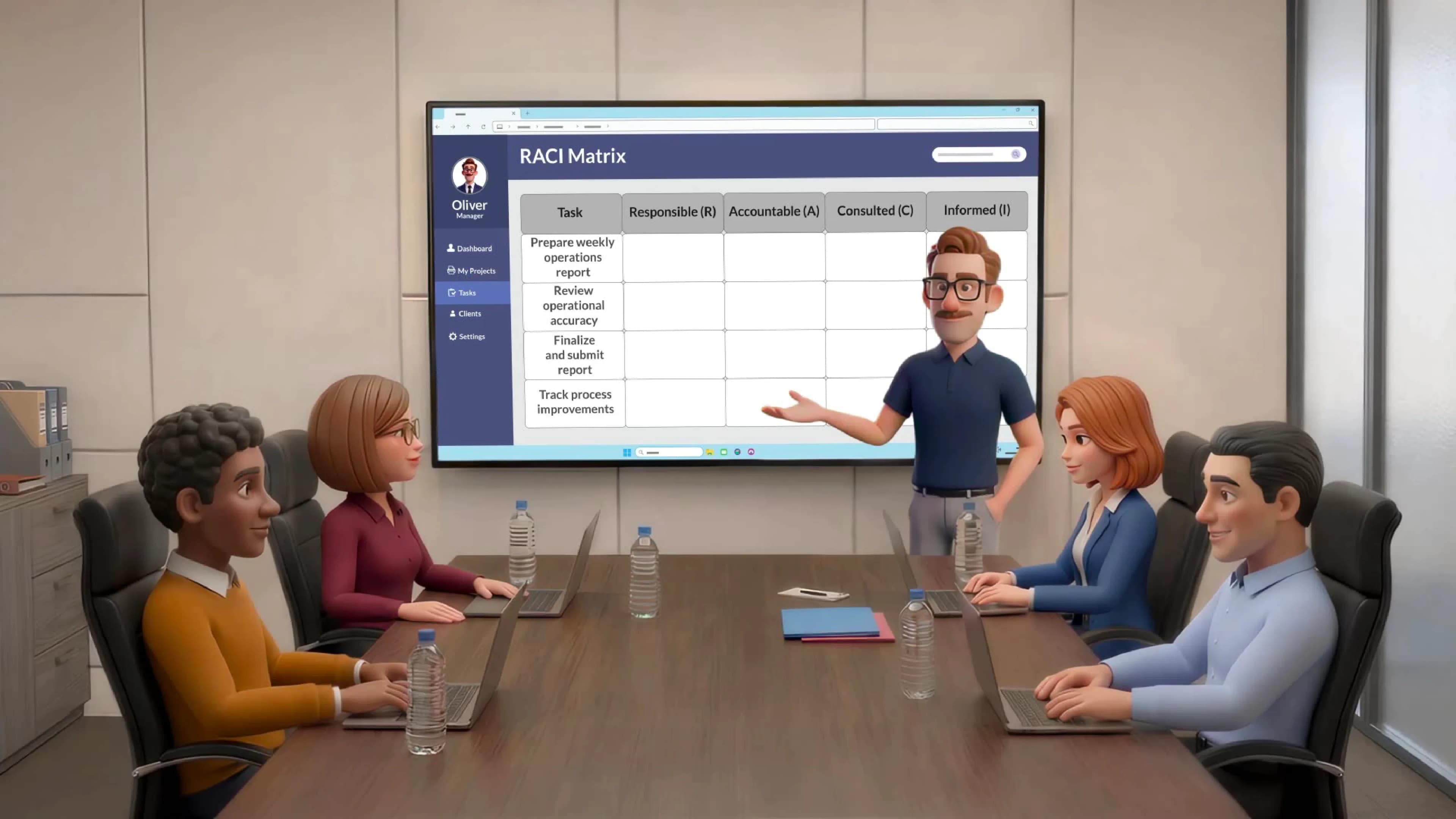
3. RACI Method for Decision-Making Clarity The RACI matrix (Responsible, Accountable, Consulted, Informed) provides managers with a structured approach to assign task ownership and streamline decision-making processes. This framework becomes essential when projects stall not from lack of effort, but from unclear authority and excessive consultation requirements. When a product launch involves engineering, marketing, legal, and executive stakeholders, RACI clarifies who executes each component, who makes final decisions, whose input is required, and who receives status updates. This prevents decision paralysis and accelerates project momentum by eliminating ambiguous ownership.
4. Behavioral Interviewing for Performance Prediction Behavioral interviewing moves beyond resume credentials to assess how candidates have actually handled workplace situations similar to those they'll encounter in the role. Managers use structured questions and the STAR method (Situation, Task, Action, Result) to evaluate past performance patterns as predictors of future success. When hiring for a team coordination role, asking "Describe how you managed competing priorities from multiple stakeholders" reveals problem-solving approaches, communication skills, and stress management capabilities that traditional interviews miss. This systematic evaluation improves hiring accuracy and reduces costly mis-hires.
5. Structured Onboarding Using the 4C Framework The 4C framework (Clarification, Compliance, Culture, Connection) provides managers with a systematic approach to accelerate new hire productivity and integration. Rather than informal orientation that leaves new team members uncertain about expectations, this method ensures comprehensive role understanding and support system establishment. When onboarding a new project coordinator, clarification covers specific task ownership and reporting requirements, compliance provides necessary system access and templates, culture explains team communication norms and decision-making processes, while connection establishes mentorship relationships and regular check-in schedules for ongoing support and feedback.