Loading…
Loading video…

118,400 views

Did you know that 68% of American college students' SAT scores fall within a predictable range? The empirical method to interpret standard deviation makes this statistical prediction possible by revealing how data spreads around the average in bell-shaped distributions. For instance, if US manufacturing quality control finds product weights averaging 500 grams with an 8-gram standard deviation, this method predicts exactly how many items fall within acceptable limits. Watch the full video on JoVE Coach to master this concept with expert-led visuals and step-by-step explanations.
The empirical method to interpret standard deviation, commonly known as the empirical rule or three-sigma rule, serves as a cornerstone of statistical analysis for normally distributed data. This powerful tool transforms abstract standard deviation values into concrete, interpretable percentages that reveal how data clusters around the mean. Unlike complex statistical calculations, this method provides an intuitive framework that high school and college students can readily apply across multiple disciplines.
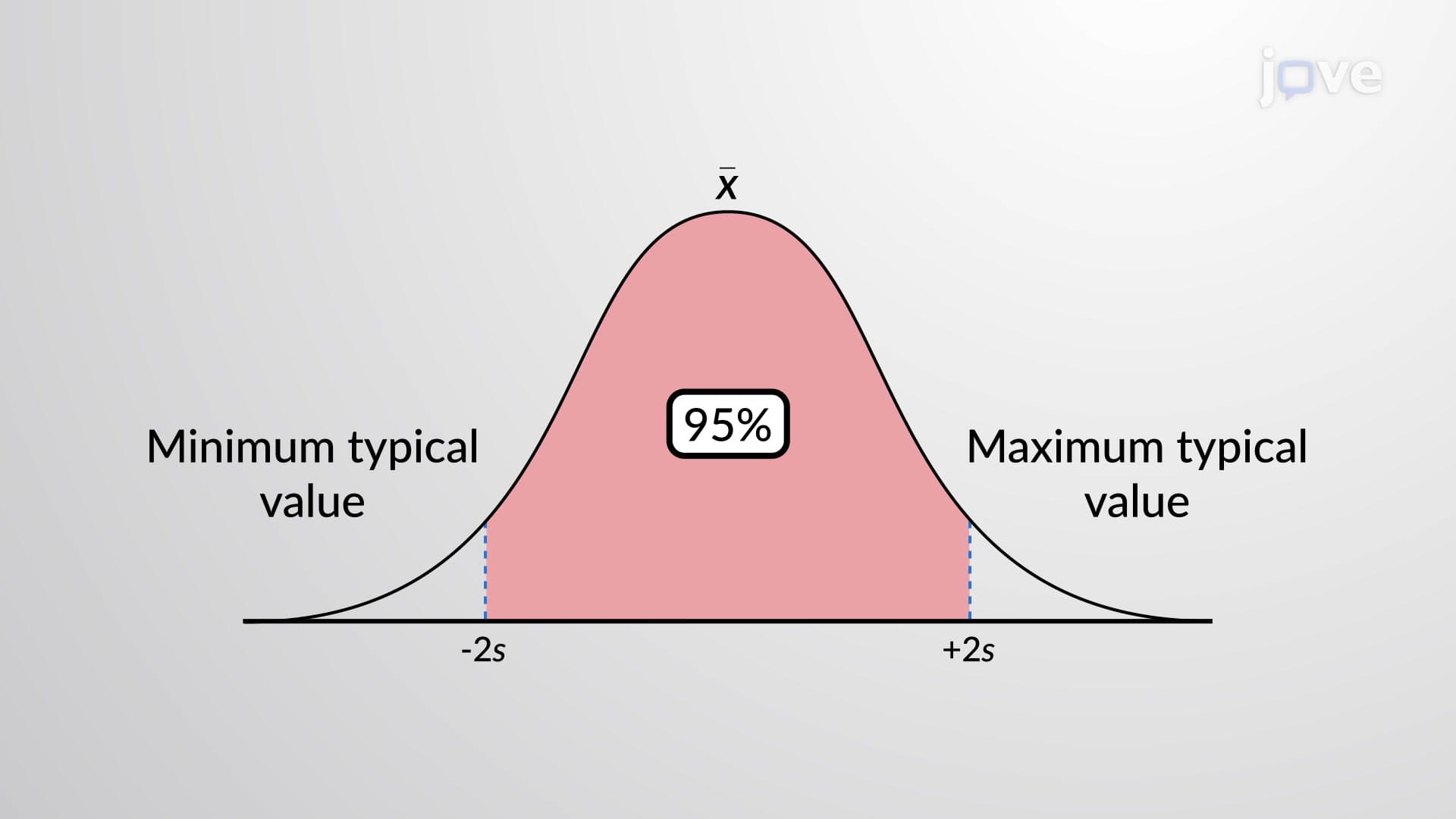
The empirical rule operates on three fundamental principles. Within one standard deviation of the mean, approximately 68% of all data points reside. Expanding to two standard deviations captures roughly 95% of values, while three standard deviations encompass 99.7% of the dataset. Consider US standardized testing: if SAT math scores average 520 with a standard deviation of 115, this rule predicts that 68% of test-takers score between 405 and 635 points. This predictive power makes the empirical method invaluable for educational assessment and college admissions planning.
US quality control managers extensively utilize this empirical method across manufacturing sectors. Boeing aircraft engineers might monitor component tolerances where bolt diameters average 2.50 inches with a 0.02-inch standard deviation. The empirical rule immediately reveals that 95% of acceptable bolts measure between 2.46 and 2.54 inches, establishing clear quality thresholds. Similarly, pharmaceutical companies use this method to ensure drug dosages remain within FDA-approved ranges, while agricultural researchers apply it to crop yield predictions across American farming regions.
Students preparing for AP Statistics, college statistics courses, or standardized exams benefit tremendously from mastering this concept. The empirical method frequently appears on AP exams, where students must interpret real datasets and make predictions. Medical school applicants encounter similar applications on the MCAT, particularly in behavioral sciences sections. Understanding this method also proves essential for business majors analyzing market research data and psychology students interpreting experimental results. The key to exam success lies in recognizing when data follows normal distribution patterns and confidently applying the 68-95-99.7 percentages to solve complex problems.
Frequently Asked Questions
The empirical method to interpret standard deviation is a statistical rule that helps predict data distribution in bell-shaped datasets using three key percentages. It states that 68% of data falls within one standard deviation, 95% within two, and 99.7% within three standard deviations of the mean. This method transforms standard deviation measurements into meaningful predictions about data spread and probability ranges.
The empirical rule is a high-frequency topic on AP Statistics exams, typically appearing in 2-3 questions per test. College statistics courses emphasize this concept heavily in introductory chapters, with most midterm exams including at least one comprehensive problem. Students should expect to apply this rule to interpret real datasets, calculate percentages, and determine outliers across various statistical contexts.
Yes, the MCAT frequently tests empirical rule understanding in Psychological, Social, and Biological Foundations sections. Questions often involve interpreting research data, clinical trial results, or population health statistics. Medical school applicants should master this concept for analyzing normal distributions in biological measurements like blood pressure, hormone levels, and diagnostic test scores.
US companies apply the empirical rule extensively in quality control, inventory management, and performance evaluation. For example, Amazon uses it to predict delivery times, Starbucks monitors coffee brewing temperatures, and General Motors ensures assembly line consistency. Financial institutions rely on this method for risk assessment, while retail chains use it to forecast sales patterns and optimize staffing levels.
No advanced mathematics is required beyond basic algebra and percentage calculations. Students with Algebra I background can successfully master this concept through practice with real examples. The empirical rule relies more on pattern recognition and logical thinking than complex computations. Most high school juniors and seniors find this topic accessible when presented with clear, step-by-step explanations and practical applications.
Create memorable associations like "68% sounds like 'success rate,' 95% like 'almost everyone,' and 99.7% like 'virtually all.'" Practice with real scenarios from your daily life, such as test scores, sports statistics, or weather data. Draw bell curves repeatedly while reciting the percentages, and use flashcards connecting each standard deviation level with its corresponding percentage. Regular application to practice problems reinforces memory better than rote memorization.
Absolutely! Mastering the empirical rule provides foundation knowledge for confidence intervals, hypothesis testing, and probability distributions. It connects directly to z-scores, normal probability calculations, and statistical inference topics in advanced courses. This understanding proves essential for research methods, experimental design, and data analysis skills needed in science, business, and social science majors.
Progress to z-score calculations, confidence interval construction, and hypothesis testing procedures. Explore central limit theorem applications and sampling distribution concepts that build upon empirical rule foundations. Advanced topics include regression analysis, correlation interpretation, and experimental design principles that rely on normal distribution assumptions established through empirical rule understanding.
Related Micro-courses
Related Subjects
 Physics 33 micro-courses›
 Math Fundamentals 11 micro-courses›