Loading video…


 17 Concepts
 108.3K views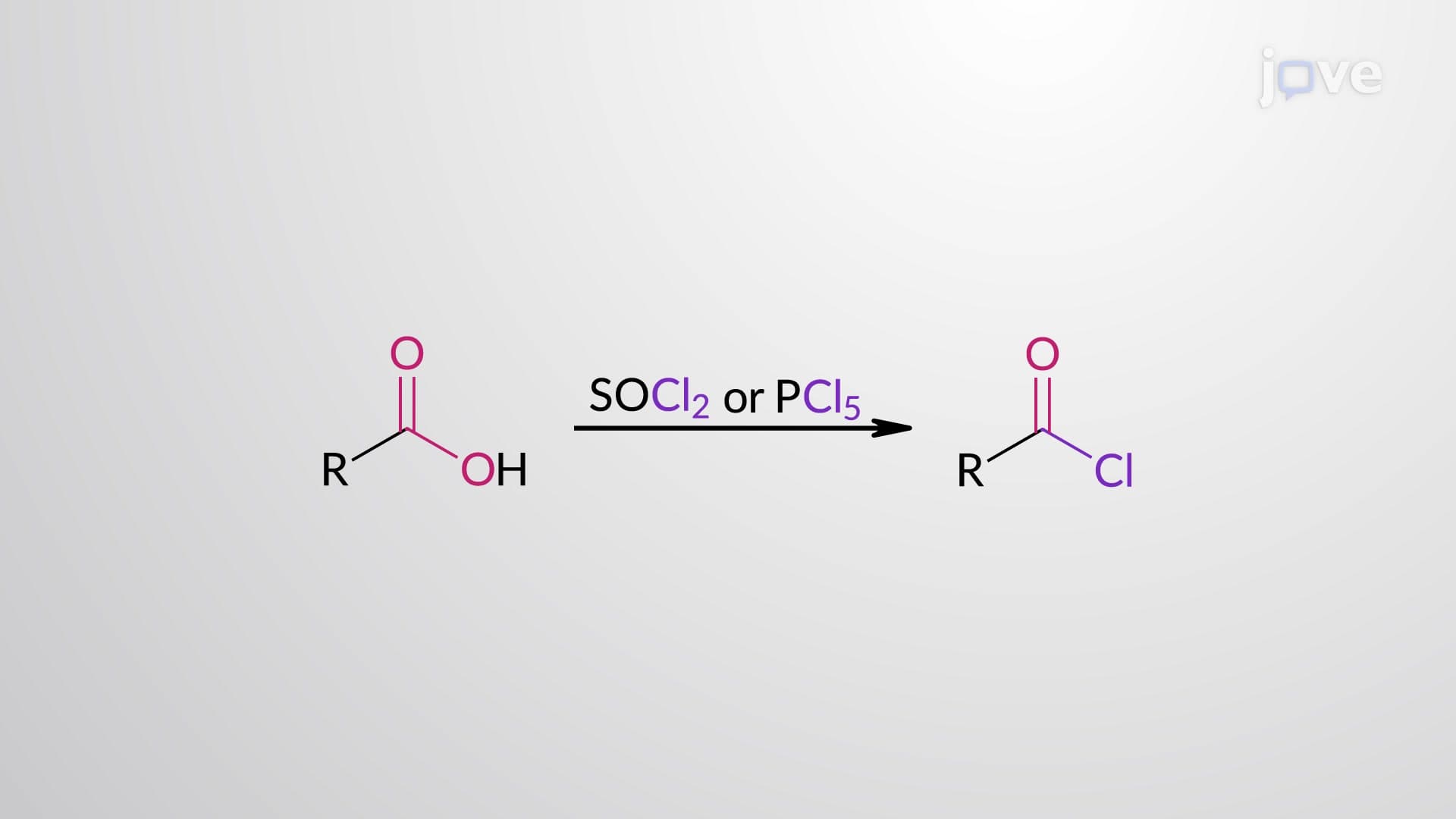

Video Summary: Carboxylic Acids to Acid Chlorides Explained
Ever wonder how pharmaceutical companies create the building blocks for life-saving medications? Converting carboxylic acids to acid chlorides represents one of organic chemistry's most powerful transformations, turning relatively stable molecules into highly reactive synthetic intermediates. This process drives the production of everything from aspirin at Bayer's facilities to advanced polymers in DuPont's laboratories. Carboxylic Acids To Acid Chlorides Explained reveals the precise mechanisms behind SOCl₂ and PCl₅ reactions that replace hydroxyl groups with chlorine atoms. Watch the full video on JoVE Coach to master this concept with expert-led visuals and step-by-step explanations.
The transformation of carboxylic acids into acid chlorides represents a cornerstone reaction in organic synthesis, particularly relevant for students preparing for AP Chemistry, college organic chemistry courses, and pre-medical MCAT preparation. This conversion fundamentally alters the reactivity profile of carboxylic compounds by replacing the relatively stable hydroxyl group (-OH) with a highly electronegative chlorine atom, creating molecules primed for further synthetic manipulation.
Thionyl chloride (SOCl₂) operates through a sophisticated multi-step mechanism beginning with nucleophilic attack by the carboxylic acid oxygen on the sulfur center. This initial interaction forms a charged intermediate that rapidly expels a chloride ion, followed by deprotonation to generate a chlorosulfite derivative. The beauty of this mechanism lies in its built-in leaving group-the chlorosulfite moiety provides excellent departure characteristics during the final nucleophilic substitution step.
Phosphorus pentachloride (PCl₅) offers an alternative pathway driven by thermodynamic favorability. The reaction produces phosphorus oxychloride (POCl₃) as a byproduct, featuring an exceptionally stable P=O double bond. This thermodynamic driving force makes the PCl₅ method particularly effective for challenging conversions, explaining why synthetic chemists at major pharmaceutical companies like Merck and Pfizer often prefer this reagent for large-scale productions.
The resulting acid chlorides exhibit dramatically enhanced electrophilic character due to dual electron-withdrawing effects. Both the carbonyl oxygen and chlorine atom pull electron density away from the central carbon, creating a highly electrophilic center susceptible to nucleophilic attack. This electronic arrangement makes acid chlorides approximately 10⁴ times more reactive than their parent carboxylic acids-a reactivity difference crucial for understanding synthetic strategy in advanced organic chemistry courses.
Understanding carboxylic acid to acid chloride conversions proves essential for students pursuing careers in pharmaceutical development, materials science, or chemical engineering. Companies like 3M utilize these transformations in polymer synthesis, while biotechnology firms employ acid chloride chemistry in peptide bond formation for drug development. MCAT test-takers frequently encounter these mechanisms in biochemistry passages, particularly when analyzing enzyme-catalyzed acylation reactions or understanding how cells synthesize complex lipids and proteins.
Related Micro-courses