Loading video…


 17 Concepts
 108.3K views

Video Summary: Carboxylic Acids to Methylesters Alkylation Explained
Did you know that forensic labs across the United States use a specialized chemical reaction to detect cocaine in urine samples? Carboxylic acids methylesters alkylation transforms carboxylic acids into methyl esters using diazomethane, a process crucial for mass spectrometry analysis in criminal investigations. This Carboxylic Acids To Methylesters Alkylation Explained mechanism involves nucleophilic attack and nitrogen gas release, making it distinctly different from traditional Fischer esterification. Watch the full video on JoVE Coach to master this concept with expert-led visuals and step-by-step explanations.
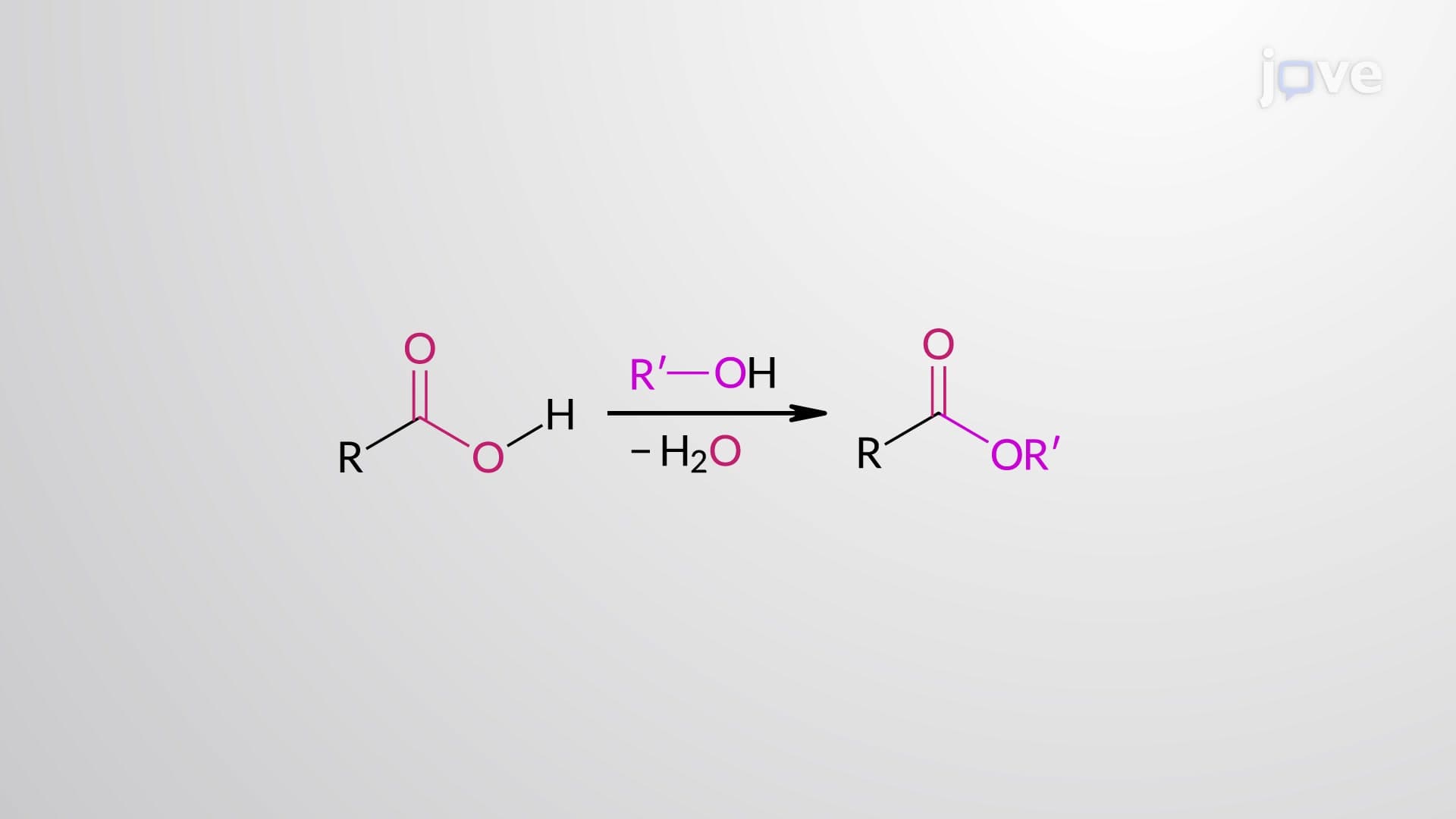
The transformation of carboxylic acids to methyl esters using diazomethane represents a powerful synthetic tool in organic chemistry, particularly valuable in analytical and forensic applications. Unlike traditional esterification methods, this reaction proceeds through a unique alkylation mechanism that offers distinct advantages for specific analytical purposes.
Diazomethane (CH2N2) exists as a resonance hybrid of three dipolar structures, making it highly reactive toward protic compounds like carboxylic acids. Generated from precursors such as N-methyl-N-nitrosourea in the presence of base, this yellow gas must be handled with extreme caution due to its explosive nature. The resonance structures contribute to diazomethane's dual character as both an electrophile and nucleophile, though in carboxylic acid reactions, it acts primarily as an alkylating agent.
The reaction begins when diazomethane encounters a carboxylic acid, leading to protonation and formation of a carboxylate anion paired with a methyldiazonium cation. This methyldiazonium species is extraordinarily unstable, with dinitrogen serving as an exceptional leaving group. The carboxylate anion then performs a nucleophilic attack via an SN2 mechanism, simultaneously displacing nitrogen gas and forming the desired methyl ester. This mechanism contrasts sharply with Fischer esterification, where the carbonyl carbon acts as the electrophilic center.
One of the most significant applications occurs in forensic laboratories nationwide, where benzoylecgonine (a cocaine metabolite found in urine) undergoes methylation to improve its detection by mass spectrometry. The methyl ester derivative provides enhanced volatility and more predictable fragmentation patterns, crucial for accurate identification in criminal cases. This application demonstrates how fundamental organic chemistry principles directly impact real-world problem-solving in forensic science.
Students preparing for AP Chemistry, MCAT, or college organic chemistry courses should understand that this reaction type frequently appears in synthesis problems and mechanism-based questions. The key conceptual elements-nucleophilic substitution, leaving group stability, and ester formation-represent core topics that bridge multiple areas of organic chemistry study.
Related Micro-courses